Enrollment for the ISI-CMI is Live! Apply Now
Select your path to excellence.

Master Course Directory.

From foundational Math Kangaroo to USACO Platinum and collegiate research publishing. 1-on-1 remote mentorship strictly guided by First Principles.

Available Masterclasses

Showing all 22 programs

Advanced Technologies & Physics Olympiad
Global

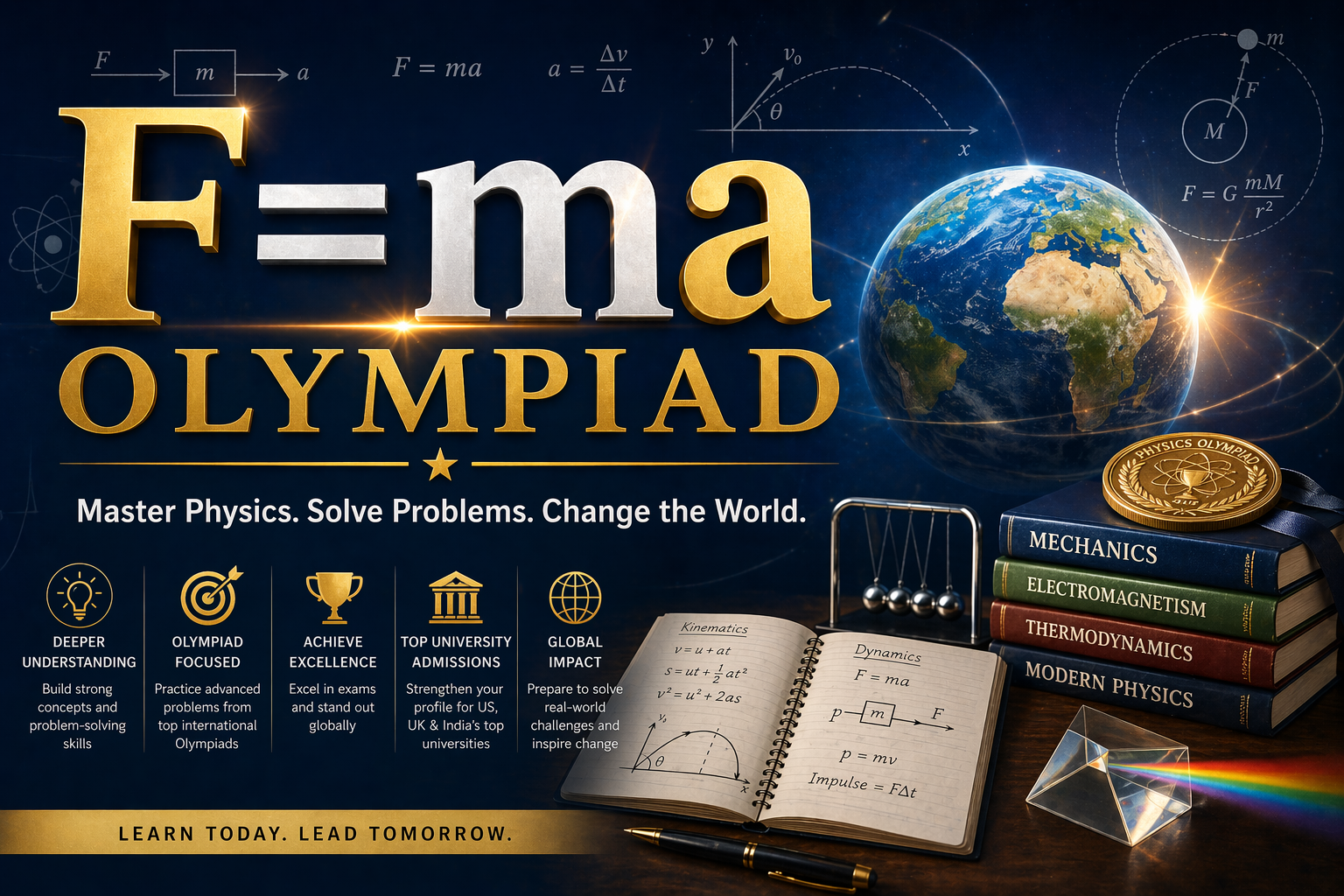
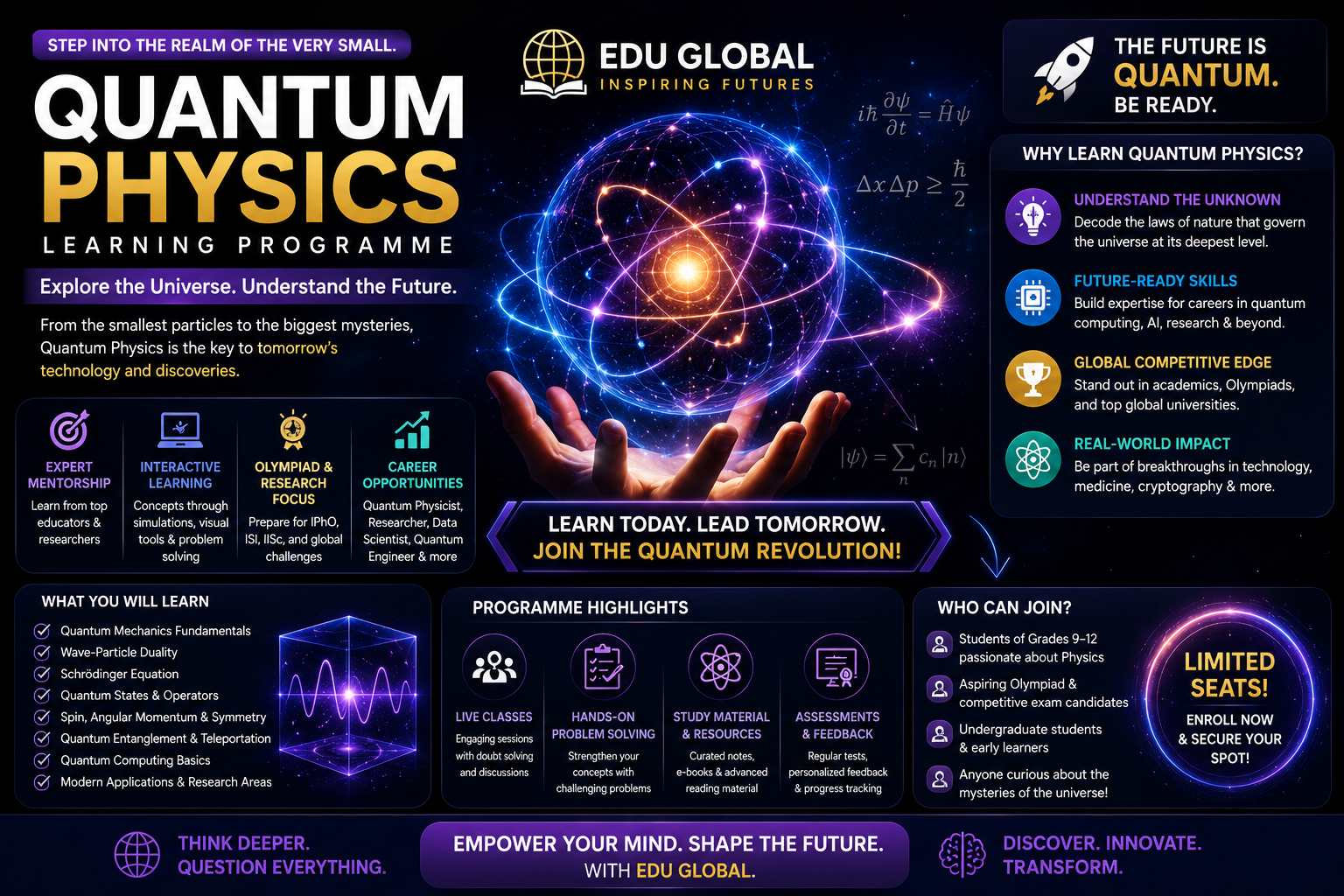
Quantum Physics Learning Programme

Quantum Physics & Computing Learning Programme Bridge the gap between deep theoretical quantum mechanics and cutting-edge computational algorithms. Build a future-proof career in the next paradigm of technology with elite global certification. 🟢 Active & Enrolling 🌐 Global Cohorts: India, USA, UK, UAE, Singapore Program Overview The global quantum technology ecosystem is undergoing an unprecedented shift. No longer confined to theoretical academic loops, quantum systems are actively disrupting cryptography, financial modeling, molecular simulations, and machine learning architectures. The Edu Global Institute Quantum Physics Learning Programme is a mathematically rigorous, industry-aligned training framework. Guided by expert physicists and computer scientists, this syllabus takes you seamlessly from quantum baselines up to deploying active algorithms on cloud-based quantum hardware simulators. Why Train With Edu Global Institute? Simulated Cloud Labs Go beyond theory. Program and execute live quantum circuits using open-source SDKs and quantum cloud simulators. Professional Certification Earn a blockchain-verifiable Quantum Specialist Credential recognized globally by tech enterprises and research tracks. Flexible Hybrid Design Access on-demand foundational models alongside high-intensity weekend mastery sessions tailored for working professionals. Curriculum & Detailed Syllabus Module 1: Foundations of Quantum Mechanics & Mathematics Baseline Objective: Master the fundamental mathematical language of the quantum universe. Linear Algebra Foundations: Hilbert Spaces, Bra-Ket (Dirac) notation, Operators, and Eigenstates. Wave Mechanics & Historical Baselines: Wave-particle duality, De Broglie relations, and the Photoelectric effect. The Schrödinger Equation: Time-dependent and time-independent forms applied to potential wells. Postulates of Quantum Mechanics: Superposition principles, state vectors, and the measurement problem. Module 2: Quantum Information Theory & Qubit Architectures Objective: Transition from classical bits to quantum information systems. The Qubit Paradigm: Geometry of the Bloch Sphere and state visualization. Multi-Qubit Systems: Quantum entanglement, Bell States, and composite space tensor products. Quantum Logic Gates: Single-qubit operations (Pauli X, Y, Z, Hadamard, Phase) and multi-qubit controls (CNOT, Toffoli). Hardware Topologies Overview: Superconducting qubits, trapped ions, and photonic network platforms. Module 3: Advanced Quantum Algorithms & Architecture Objective: Learn to design, program, and scale mathematical quantum routines. Quantum Parallelism: Harnessing constructive interference for exponential computational scale. Deutsch-Jozsa and Simon’s Algorithms: Structural proofs of quantum advantage. Shor’s Algorithm: Period finding, Quantum Fourier Transform (QFT), and implications for modern RSA cryptography. Grover’s Search Algorithm: Quadratic acceleration protocols for unstructured data parsing. Variational Quantum Eigensolvers (VQE) and Optimization Tools for NISQ-era devices. Module 4: Real-World Industry Applications & Cryptography Objective: Deploy quantum solutions to real market bottlenecks. Quantum Key Distribution (QKD): Bulletproof secure networks using the BB84 communication protocol. Post-Quantum Cryptography (PQC): Building defenses against systemic decryption vectors. Quantum Machine Learning: Feature mapping, quantum-enhanced neural structures, and classification maps. Molecular & Material Simulations: Accelerating drug discovery paths and solid-state physics modeling. Ready to Pivot to the Quantum Era? Seats are tightly capped to ensure direct computational access and elite project mentorship. Secure your baseline roadmap review today. Apply for Enrollment →

Masterclass View Syllabus
Physics Fundamentals / STEM Foundation / AP Physics Prep
Global

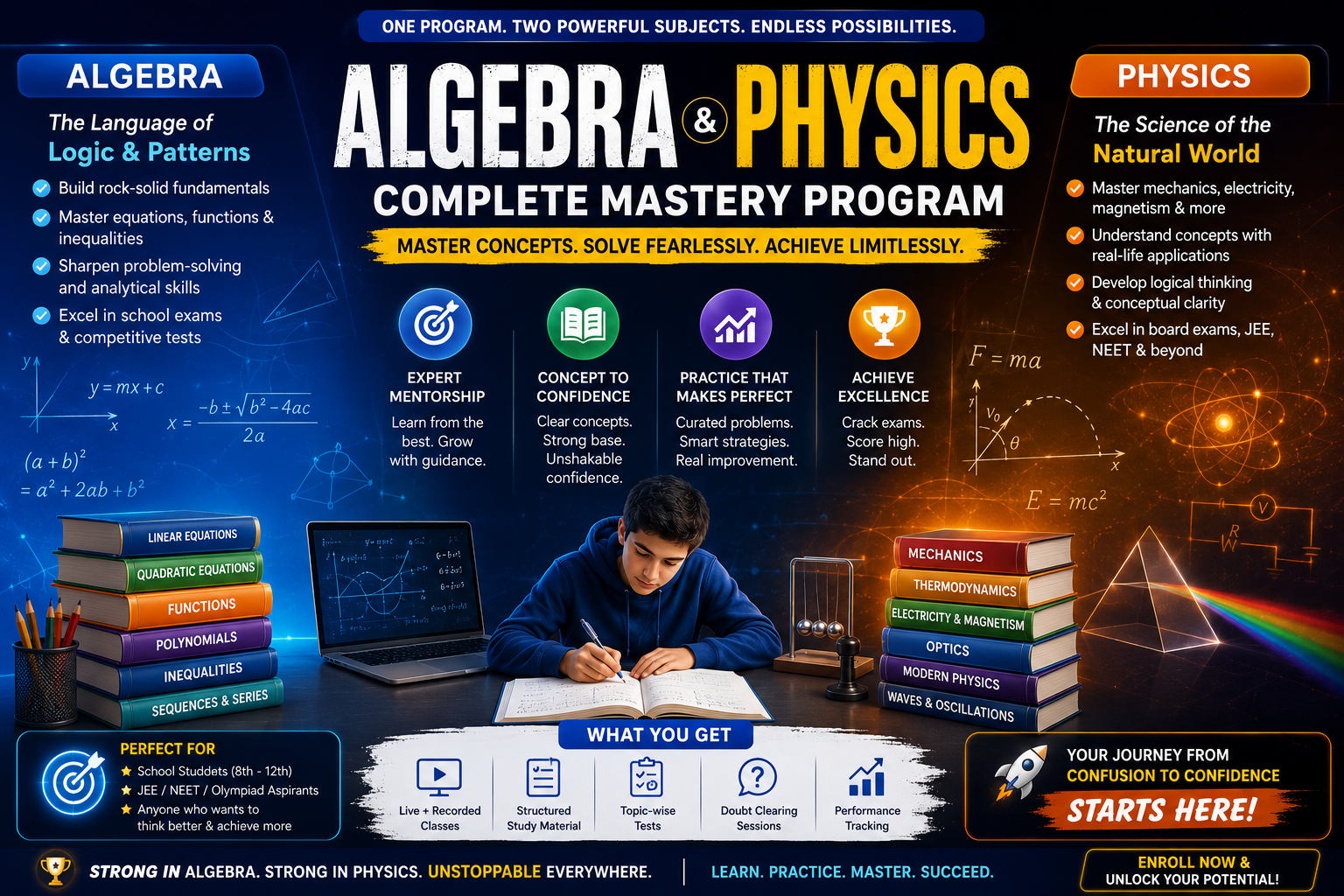
Algebra Physics Complete Mastery Program

Master Algebra Physics — From Zero to Hero in 40 Weeks The most comprehensive, research-based algebra physics program designed for students with no calculus background. Covers the entire AP Physics 1 + AP Physics 2 syllabus with 100% free digital tools, hands-on labs, and zero topic omissions. Course Overview Algebra Physics Complete Mastery is a rigorous, two-semester program that teaches introductory physics entirely through algebra and trigonometry. Built for high school students, homeschoolers, and adult learners, this course bridges the gap between "I've never done physics" and "I'm ready for AP Physics or college-level STEM." No calculus required: Only Algebra II & Geometry 25 fully-researched chapters: Zero topic gaps 100% free teaching tools: PhET, Physics Classroom, Khan Academy, HyperPhysics Hands-on labs: Using household items + smartphone sensors AP Physics Aligned: Covers AP Physics 1 & 2 curriculum What You Will Learn Solve any 1D or 2D kinematics problem using the five kinematic equations Draw and analyze free-body diagrams for complex multi-object systems Apply Newton's Three Laws to inclined planes, pulleys, circular motion, and orbits Use conservation of energy and momentum to solve collision and explosion problems Analyze rotational motion, torque, and angular momentum Explain wave behavior, standing waves, and the Doppler effect mathematically Solve DC circuit problems using Ohm's Law and Kirchhoff's Rules Calculate electric fields, potentials, and capacitor energy Apply the laws of thermodynamics and ideal gas behavior Trace light rays through mirrors and lenses using the thin-lens equation Explain quantum phenomena: photoelectric effect, Bohr model, wave-particle duality Calculate radioactive decay, half-life, and nuclear binding energy Understand special relativity: time dilation, length contraction, E=mc² Complete Module Breakdown (25 Chapters | 40 Weeks) Semester 1: Mechanics, Fluids & Waves (20 Weeks) Module 0 — Math Foundations for Physics (2 Weeks) Scientific notation, SI prefixes, unit conversions Algebraic manipulation, literal equations, inverse-square relationships Right-triangle trigonometry (SOH CAH TOA) Vectors: components, addition, resultant magnitude/direction Module 1 — Introduction to Physics (1 Week) Scientific method, models vs. theories vs. laws SI units, dimensional analysis, uncertainty & error propagation Problem-solving methodology (GUESS method) Module 2 — One-Dimensional Kinematics (2 Weeks) Position, displacement, velocity, acceleration Position-time, velocity-time, acceleration-time graphs Five kinematic equations for constant acceleration Free-fall motion, symmetry, g on other planets Module 3 — Vectors & Two-Dimensional Kinematics (2 Weeks) Coordinate systems, component method Projectile motion: independence of horizontal/vertical motion Trajectory equation, time of flight, max height, range Uniform circular motion & relative velocity Module 4 — Newton's Laws of Motion (2 Weeks) Newton's Three Laws & Free-body diagrams Complete force catalog: gravity, normal, friction, tension, spring Atwood machines, inclined planes, elevators, multi-body systems Module 5 — Forces in Two Dimensions (1 Week) Equilibrium conditions: ΣFx=0, ΣFy=0 Non-equilibrium with angled forces Advanced friction & Pulley systems Module 6 — Work, Energy & Power (2 Weeks) Work: W=Fdcosθ, Work-Energy Theorem Kinetic energy & Gravitational/elastic potential energy Conservation of mechanical energy & Power Module 7 — Linear Momentum & Collisions (1 Week) Momentum, impulse, force-time graphs Conservation of linear momentum Elastic, inelastic, perfectly inelastic collisions & explosions Module 8 — Circular Motion & Gravitation (2 Weeks) Centripetal force sources & Vertical circular motion Newton's Law of Universal Gravitation Kepler's Three Laws & Orbital velocity Module 9 — Rotational Motion & Torque (2 Weeks) Angular kinematics & Torque (τ=rFsinθ) Moment of inertia & Newton's Second Law for rotation Rotational kinetic energy & Angular momentum conservation Module 10 — Simple Harmonic Motion (1 Week) SHM characteristics: amplitude, period, frequency Mass on spring & Simple pendulum equations Damped & driven oscillations, resonance Module 11 — Mechanical Waves & Sound (2 Weeks) Wave types, Wave equation, behavior at boundaries Superposition, interference, standing waves Sound waves, Doppler effect, intensity Module 12 — Fluid Mechanics (2 Weeks) Density, pressure, Pascal's principle Archimedes' Principle & buoyancy Ideal fluid flow, continuity equation, Bernoulli's equation Semester 2: E&M, Thermodynamics, Optics & Modern Physics (20 Weeks) Module 13 — Static Electricity & Charge (1 Week) Electric charge, conductors, insulators Coulomb's Law & superposition of electric forces Electric field lines & Faraday cages Module 14 — Electric Potential & Capacitance (1 Week) Electric potential energy & voltage Equipotential surfaces Capacitors: capacitance, energy storage, dielectrics Module 15 — Electric Circuits (2 Weeks) Current, resistance, Ohm's Law Series & parallel combination circuits Kirchhoff's Junction & Loop Rules RC circuits Module 16 — Magnetism (2 Weeks) Magnetic poles & Earth's magnetic field Lorentz force on moving charges Magnetic field sources: wire, loop, solenoid Module 17 — Electromagnetic Induction (1 Week) Magnetic flux, Faraday's Law, Lenz's Law Motional EMF & self-inductance AC basics & transformers Module 18 — Temperature & Heat (1 Week) Temperature scales & thermal expansion Internal energy, specific heat, calorimetry Latent heat of fusion & vaporization Module 19 — Thermodynamics (2 Weeks) Ideal Gas Law & kinetic theory of gases First Law of Thermodynamics & PV diagrams Second Law, entropy, Carnot efficiency Module 20 — Reflection & Mirrors (1 Week) Law of reflection & plane mirrors Spherical mirrors: concave & convex Ray tracing & image characteristics Module 21 — Refraction & Lenses (2 Weeks) Index of refraction, Snell's Law, dispersion Total internal reflection & fiber optics Thin lenses: converging & diverging, lens equation Module 22 — Physical Optics (1 Week) Interference: Young's double-slit, thin films Diffraction & Diffraction gratings Polarization & Malus's Law Module 23 — Quantum Physics (2 Weeks) Planck's quantum hypothesis & Photoelectric effect Wave-particle duality & de Broglie wavelength Atomic spectra & Bohr model Module 24 — Atomic & Nuclear Physics (2 Weeks) Atomic structure, isotopes, nuclear forces Binding energy, mass defect, E=mc² Radioactivity (alpha, beta, gamma) & Half-life Nuclear fission & fusion Module 25 — Special Relativity (1 Week) Postulates of special relativity Time dilation & length contraction Relativistic momentum & mass-energy equivalence Free Tools & Resources Included (Zero Additional Cost) Every student receives unlimited access to our curated toolkit: Simulations: PhET Interactive Simulations, Physics Classroom, HyperPhysics, oPhysics, Falstad Circuit Simulator Textbooks & Courses: OpenStax College Physics, Khan Academy Physics, CK-12 Physics, MIT OpenCourseWare Mobile Lab Tools: phyphox (Smartphone sensor suite), Physics Toolbox Suite, Tracker Software, Audacity Video Channels: Veritasium, MinutePhysics, Flipping Physics, Professor Dave Explains

Masterclass View Syllabus
Elite Masterclass
High-achieving students aiming for USACO Gold/Platinum, Grades 9-12

USACO Elite Prep Bootcamp: Master Algorithms & Data Structures for Gold & Platinum

USACO Elite Prep Bootcamp: Master Algorithms & Data Structures for Gold & PlatinumElevate your competitive programming skills to an elite level with EduGlobal Institute's intensive USACO Elite Prep Bootcamp. Designed for ambitious students targeting Gold and Platinum divisions, this masterclass provides a deep dive into advanced algorithms and data structures essential for excelling in the USACO contest. Our expert instructors, all former USACO finalists, will guide you through complex problem-solving strategies, optimization techniques, and rigorous practice sessions.Who Should Enroll?High-achieving students currently in or aspiring to the USACO Gold division.Students with a solid foundation in basic data structures (arrays, linked lists, trees) and algorithms (sorting, searching, basic graph traversal).Those committed to intensive learning and challenging themselves with advanced competitive programming problems.Masterclass Curriculum Highlights:Advanced Data Structures: Segment Trees, Fenwick Trees (BITs), Disjoint Set Union (DSU), Suffix Arrays/Trees, Heavy-Light Decomposition.Graph Algorithms: Dijkstra's, Bellman-Ford, Floyd-Warshall, Minimum Spanning Trees (Prim's, Kruskal's), Network Flow (Max Flow/Min Cut), Bipartite Matching.Dynamic Programming: Advanced DP states, Tree DP, Profile DP, Digit DP, DP with bitmasking.Computational Geometry: Convex Hull, Line Intersection, Point in Polygon, Sweep Line Algorithms.Number Theory: Modular Arithmetic, Prime Factorization, GCD/LCM, Sieve of Eratosthenes, Chinese Remainder Theorem.String Algorithms: KMP, Rabin-Karp, Z-Algorithm, Aho-Corasick.Problem-Solving Strategies: Advanced recursion, backtracking, greedy approaches, divide and conquer, meet-in-the-middle.Optimization Techniques: Time and space complexity analysis, constant factor optimization, memoization, tabulation.Why Choose EduGlobal Institute?Elite Instructors: Learn from former USACO Gold/Platinum finalists and IMO medalists with proven coaching experience.Rigorous Curriculum: A meticulously designed syllabus covering all critical topics for Gold and Platinum success.Personalized Feedback: Small class sizes ensure individualized attention and detailed code reviews.Challenging Problem Sets: Access to a curated bank of USACO-style problems, including past contest problems and custom challenges.Mock Contests & Analysis: Regular simulated contests followed by in-depth solution analysis and strategy discussions.Prerequisites:Proficiency in C++ (preferred), Java, or Python.Strong understanding of basic algorithms (sorting, searching) and data structures (arrays, lists, trees, maps).Prior experience with competitive programming platforms (e.g., USACO Bronze/Silver level proficiency).Outcomes:Master the advanced algorithms and data structures required for USACO Gold and Platinum divisions.Develop sophisticated problem-solving and algorithmic thinking skills.Gain confidence and strategic approaches to tackle complex competitive programming challenges.Significantly increase your chances of advancing to the USACO Platinum division and beyond.

Masterclass View Syllabus
Elite Masterclass
Grades 9-12

Advanced Math Mastery Bootcamp: Conquer Proofs, Linear Algebra & Calculus (Without University)

Unlock Elite Mathematical Prowess: Your Path to Advanced Math MasteryWelcome to the EduGlobal Institute's 'Advanced Math Mastery Bootcamp' – an unparalleled, rigorous program designed for the most ambitious young minds ready to transcend conventional high school mathematics. This elite masterclass empowers you to conquer the foundational pillars of higher mathematics: rigorous proofs, the elegance of linear algebra, and the power of calculus, all without needing a university enrollment. Prepare to develop a profound understanding, critical thinking skills, and problem-solving abilities that set you apart.This bootcamp is not just about learning formulas; it's about cultivating a mathematician's mindset. We delve deep into the 'why' behind the 'what,' fostering intuition and analytical precision. If you're a high school student or an independent learner with a strong aptitude for math, eager to tackle university-level concepts, this is your definitive launchpad.Module 1: The Art & Science of Mathematical Proofs (Weeks 1-4)Mathematical proofs are the bedrock of all advanced mathematics. This module demystifies the process, equipping you with the logical tools and structured thinking necessary to construct compelling arguments and validate mathematical statements.Week 1: Introduction to Logic & Set Theory: Propositional logic, truth tables, quantifiers, basic set operations, Venn diagrams.Week 2: Direct Proofs & Proof by Contrapositive: Understanding definitions, axioms, theorems; constructing direct proofs; mastering contrapositive arguments.Week 3: Proof by Contradiction & Induction: The power of contradiction; principle of mathematical induction (weak and strong forms); applications to sequences and series.Week 4: Advanced Proof Techniques & Number Theory: Pigeonhole principle, existence proofs, uniqueness proofs; divisibility, prime numbers, modular arithmetic.Module 2: Unveiling Linear Algebra: Vectors, Matrices & Transformations (Weeks 5-8)Linear Algebra is the language of data science, engineering, and physics. This module provides a robust introduction to vector spaces, linear transformations, and matrix operations, building both conceptual understanding and computational fluency.Week 5: Vectors & Vector Spaces: Geometric and algebraic vectors, vector operations, linear combinations, span, linear independence, basis, dimension.Week 6: Matrices & Systems of Linear Equations: Matrix operations, inverse matrices, solving systems using Gaussian elimination, determinants, Cramer's Rule.Week 7: Linear Transformations & Eigenvalues: Understanding transformations (rotations, scaling, projections); null space, column space; introduction to eigenvalues and eigenvectors.Week 8: Orthogonality & Applications: Dot products, orthogonal vectors, orthonormal bases, Gram-Schmidt process; introduction to least squares.Module 3: Mastering Calculus: Limits, Derivatives & Integrals (Weeks 9-12)Calculus is the study of change, essential for understanding dynamics in science and engineering. This module builds a solid conceptual and practical foundation in differential and integral calculus, moving beyond rote memorization to true comprehension.Week 9: Limits & Continuity: Understanding the concept of a limit, properties of limits, continuity, intermediate value theorem, limits at infinity.Week 10: Differentiation: Definition of the derivative, differentiation rules (power, product, quotient, chain), implicit differentiation, related rates.Week 11: Applications of Derivatives & Optimization: Mean Value Theorem, L'Hôpital's Rule, curve sketching, optimization problems, Newton's method.Week 12: Integration: Antiderivatives, Riemann sums, definite and indefinite integrals, Fundamental Theorem of Calculus (Part 1 & 2), substitution rule.Why Choose EduGlobal's Advanced Math Mastery Bootcamp?University-Level Preparation: Gain a significant edge for competitive university admissions and excel in your first-year STEM courses.Expert Instruction: Learn from seasoned mathematicians and educators with a passion for making complex concepts accessible.Rigorous Curriculum: A meticulously designed program that challenges and expands your mathematical intuition and problem-solving capabilities.Flexible Learning: Master advanced topics on your schedule, without the constraints of traditional university enrollment.Certification of Mastery: Receive an EduGlobal Institute certificate upon successful completion, validating your advanced mathematical proficiency.Embark on a transformative mathematical journey. Enroll in the Advanced Math Mastery Bootcamp and unlock your full potential today!

Masterclass View Syllabus
Elite Masterclass
Grades 9-12

EduGlobal's Advanced Mathematics Mastery Bootcamp: From Foundations to Proofs

Unlock the Universe of Advanced MathematicsEduGlobal's Advanced Mathematics Mastery Bootcamp is an intensive, six-week journey meticulously crafted for the brightest young minds aspiring to excel in university-level mathematics, competitive math challenges, and future STEM leadership. This elite masterclass transcends typical curriculum, guiding students from the bedrock of mathematical logic to the elegance of rigorous proofs and sophisticated problem-solving techniques. Prepare to transform your understanding from rote memorization to profound insight, mastering the art and science of mathematical thought.What You Will Master:Rigorous Foundational Concepts: Develop an unshakeable understanding of core mathematical principles.Diverse Proof Techniques: Master direct proofs, induction, contradiction, contrapositive, and more.Advanced Problem-Solving Strategies: Tackle complex, multi-step problems with confidence and creativity.University & Competition Readiness: Gain a significant edge for higher education and prestigious math competitions.Critical Thinking & Logical Reasoning: Sharpen your analytical skills applicable across all disciplines.Syllabus Timeline: A Journey from Foundations to FrontiersWeek 1: Foundations of Mathematical Thought & Number TheoryIntroduction to Logic & Set Theory: Propositional and Predicate Logic, Quantifiers, Set Operations, Relations, Functions.Axiomatic Systems & Proof Structures: Direct Proofs, Proof by Contrapositive.Elementary Number Theory: Divisibility, Primes, GCD, LCM, Euclidean Algorithm, Modular Arithmetic.Diophantine Equations: Linear Diophantine Equations.Week 2: Advanced Algebra & Abstract StructuresPolynomials & Roots: Vieta's Formulas, Rational Root Theorem, Polynomial Identities.Complex Numbers: Operations, Polar Form, De Moivre's Theorem, Roots of Unity.Introduction to Abstract Algebra: Basic Group Theory concepts (groups, subgroups, homomorphisms).Inequalities: AM-GM, Cauchy-Schwarz, Jensen's Inequality and their proofs.Week 3: Calculus & Real Analysis FundamentalsRigorous Limits: Epsilon-Delta Definition of Limits for Sequences and Functions, Limit Theorems.Continuity & Differentiability: Formal Definitions, Intermediate Value Theorem, Mean Value Theorem (proofs).Introduction to Sequences & Series: Convergence Tests, Power Series basics.Theorems of Calculus: Fundamental Theorem of Calculus (conceptual understanding and basic proofs).Week 4: Discrete Mathematics & CombinatoricsAdvanced Counting Principles: Permutations, Combinations, Stars and Bars, Principle of Inclusion-Exclusion.Recurrence Relations: Linear Homogeneous Recurrences, Generating Functions for solving recurrences.Graph Theory: Basic Definitions, Paths, Cycles, Trees, Planarity, Euler & Hamiltonian Paths.Pigeonhole Principle: Advanced applications and problem-solving.Week 5: Linear Algebra & Geometric TransformationsVector Spaces: Definition, Subspaces, Linear Independence, Basis, Dimension.Linear Transformations: Properties, Matrix Representation, Kernel, Image.Matrices & Determinants: Eigenvalues, Eigenvectors, Diagonalization.Analytic Geometry in Higher Dimensions: Vectors, Planes, Lines, Geometric Proofs.Week 6: Advanced Proof Techniques & Olympiad Problem SolvingMathematical Induction: Weak, Strong, Structural Induction, Well-Ordering Principle.Proof by Contradiction: Advanced applications.Constructive vs. Non-Constructive Proofs: Existential Proofs.Invariant Principle & Extremal Principle: Powerful problem-solving tools.Intensive Problem-Solving Sessions: Tackling competition-level problems from various domains, synthesizing learned techniques.Why Choose EduGlobal?At EduGlobal, we believe in nurturing future innovators. Our bootcamp is led by world-renowned mathematicians and educators with a passion for inspiring excellence. With small class sizes, personalized mentorship, and a curriculum designed to challenge and engage, you will join a vibrant community of peers poised for unparalleled academic success. Elevate your mathematical prowess and secure your place among the next generation of STEM leaders.

Masterclass View Syllabus
Elite Masterclass
Grades 9-12

USACO Mastery Bootcamp: From Fundamentals to Platinum – Your Accelerated Path to Top Scores

Welcome to the USACO Mastery Bootcamp: From Fundamentals to PlatinumEduGlobal Institute proudly presents an elite, intensive Masterclass meticulously designed for ambitious high school students aiming to conquer the USA Computing Olympiad (USACO). This bootcamp is your accelerated, rigorous pathway to not just understanding complex algorithms, but mastering the strategic thinking required to achieve top scores and reach the coveted Platinum division.Why Choose EduGlobal's USACO Mastery Bootcamp? Expert-Led Instruction: Learn directly from USACO Finalists, International Olympiad medalists, and university-level competitive programming coaches. Accelerated Curriculum: A streamlined, high-density program that covers years of self-study in a fraction of the time, optimized for rapid progress. Small Cohort Advantage: Benefit from personalized feedback, direct Q&A, and a collaborative learning environment in small, highly selective groups. Comprehensive Problem-Solving: Beyond algorithms, we teach advanced problem decomposition, debugging strategies, and time management crucial for contest success. Real-World Application: Gain skills transferable to collegiate competitive programming, internships, and a strong foundation for a career in tech.Course Syllabus & Accelerated TimelineModule 1: Bronze & Silver Foundations – Building Your Algorithmic Arsenal (Weeks 1-2) Week 1: USACO Bronze Essentials Introduction to Competitive Programming & C++ STL Basic Data Structures: Arrays, Vectors, Strings Simulation Problems & Ad-Hoc Logic Time Complexity Analysis (Big O Notation) Basic Greedy Algorithms & Sorting Techniques Week 2: USACO Silver Breakthroughs Prefix Sums & Difference Arrays Two Pointers & Sliding Window Techniques Binary Search on Answers & Data Introduction to Graphs: DFS & BFS Traversal Basic Dynamic Programming: Memoization & Tabulation Disjoint Set Union (DSU) Fundamentals Module 2: Gold Division Strategies – Mastering Intermediate Algorithms (Weeks 3-4) Week 3: Advanced Graph Theory & Data Structures I Shortest Path Algorithms: Dijkstra's, Bellman-Ford, Floyd-Warshall Minimum Spanning Trees: Prim's, Kruskal's Segment Trees & Fenwick Trees (BIT) for Range Queries Meet-in-the-Middle & Divide and Conquer Strategies Week 4: Dynamic Programming & Number Theory Deep Dive Advanced DP Techniques: Tree DP, Profile DP, State Compression DP Number Theory for Competitive Programming: Primes, GCD, LCM, Modular Arithmetic Combinatorics & Probability (Basic to Intermediate) Introduction to Amortized Analysis Module 3: Platinum Division Excellence – Elite Techniques & Contest Simulation (Weeks 5-6) Week 5: Cutting-Edge Algorithms & Complex Data Structures Flow Networks & Bipartite Matching Advanced Data Structures: Splay Trees, Treaps, Heavy-Light Decomposition Computational Geometry: Convex Hull, Line Intersection, Point-in-Polygon String Algorithms: KMP, Suffix Arrays/Trees (Introduction) Week 6: Contest Mastery & Optimization Strategies Advanced Problem Decomposition & Pattern Recognition Optimization Techniques: Pruning, Bitmasking, Fast I/O Debugging & Test Case Generation Strategies Full-Length USACO-style Mock Contests with detailed post-contest analysis Personalized performance review and future growth roadmap Enroll now to transform your competitive programming journey and secure your place among the USACO elite!

Masterclass View Syllabus
Elite Masterclass
Ambitious high school students (Grades 9-12) with foundational programming experience (e.g., USACO B

USACO Elite Prep Masterclass: From Fundamentals to Gold Medal Strategies

Unlock Your Potential: The EduGlobal USACO Elite Prep MasterclassAre you an aspiring competitive programmer with your sights set on USACO Gold or even Platinum? The EduGlobal Institute's 'USACO Elite Prep Masterclass' is meticulously designed for the most ambitious students ready to transform their problem-solving skills and achieve top-tier results. This rigorous, intensive program goes beyond basic syntax, diving deep into advanced algorithms, data structures, and competitive programming paradigms essential for USACO success.Led by seasoned USACO coaches and former medalists, this masterclass provides a structured pathway from core computer science principles to sophisticated algorithmic thinking. You will not only learn the 'what' but also the 'why' and 'how' of solving complex computational problems under pressure, equipping you with the strategies to conquer even the most challenging USACO problems.What You Will Master:Advanced Data Structures: Trees (Segment Trees, Fenwick Trees), Graphs (Adjacency Lists, Matrices), Heaps, Hash Tables, Disjoint Set Union.Core Algorithmic Paradigms: Dynamic Programming (advanced states, optimizations), Greedy Algorithms, Divide and Conquer, Recursion & Backtracking.Graph Theory Expertise: BFS, DFS, Dijkstra, Bellman-Ford, Floyd-Warshall, MST (Prim's, Kruskal's), Topological Sort, strongly connected components.Specialized Topics: Number Theory (modular arithmetic, prime factorization, GCD/LCM), Computational Geometry (basic concepts), String Algorithms (KMP, Tries), Bit Manipulation.Competitive Programming Strategies: Time and space complexity analysis, problem decomposition, debugging techniques, contest time management, and optimization heuristics.Syllabus Timeline: From Fundamentals to Gold Medal StrategiesModule 1: Foundations & Essential Data Structures (Weeks 1-3)Week 1: Review of Fundamentals & Complexity AnalysisC++ STL deep dive (vectors, pairs, tuples, algorithms)Big O notation, amortized analysis, practical considerationsBasic sorting & searching revisited (quick sort, merge sort, binary search)Week 2: Advanced Array & List StructuresPrefix sums, difference arrays, 2D data structuresStacks, Queues, Deques, Circular BuffersIntroduction to Linked Lists & their applicationsWeek 3: Trees & HeapsBinary Trees, Binary Search Trees (BSTs)Heaps (priority queues) and their usesIntroduction to balanced BSTs (e.g., Treaps, implicit trees)Module 2: Core Algorithmic Paradigms (Weeks 4-6)Week 4: Recursion, Backtracking & Brute Force OptimizationDeep dive into recursive problem-solvingBacktracking for permutations, combinations, subsetsMeet-in-the-middle and pruning techniquesWeek 5: Greedy Algorithms & Divide and ConquerProof techniques for greedy choicesClassic greedy problems (coin change, activity selection)Master Theorem for recurrence relationsWeek 6: Dynamic Programming I - 1D & 2D DPMemoization vs. TabulationCommon DP patterns (knapsack, longest common subsequence, path counting)State definition and transition formulationModule 3: Graph Theory & Advanced DP (Weeks 7-9)Week 7: Graph Theory FundamentalsGraph representations (adjacency list/matrix)BFS & DFS for traversal, connectivity, cyclesTopological Sort, Bipartite CheckingWeek 8: Shortest Path Algorithms & MSTsDijkstra's Algorithm (with priority queue optimization)Bellman-Ford & Floyd-Warshall for all-pairs shortest pathMinimum Spanning Trees (Prim's & Kruskal's)Week 9: Dynamic Programming II - Advanced DP TechniquesDP on Trees, DP on Profiles (bitmask DP)Digit DP, Convex Hull Trick (introduction)Range DP, Game Theory DPModule 4: Specialized Topics & USACO Gold Medal Strategies (Weeks 10-12)Week 10: Number Theory & Computational GeometryModular arithmetic, Fermat's Little Theorem, Euler's Totient FunctionPrime factorization, Sieve of Eratosthenes, GCD/LCMBasic geometric primitives (points, lines, segments), cross product, areaWeek 11: String Algorithms & Bit ManipulationHashing for strings, KMP algorithm (brief introduction)Tries (prefix trees)Bitwise operations for set manipulation and optimizationWeek 12: USACO Gold Medal Strategies & Mock ContestsAdvanced problem decomposition and pattern recognitionEffective debugging and testing strategies under contest conditionsTime management, common pitfalls, and optimization heuristicsFull-length Mock USACO Gold Contest with detailed post-contest analysis and personalized feedback.

Masterclass View Syllabus
Elite Masterclass
Aspiring undergraduates, Grades 11-12, and gap-year students targeting ISI B.Stat/B.Math programs, a

ISI Entrance Exam Mastery Bootcamp: Crack Olympiad Math & Advanced Concepts in 60 Days

Unleash Your Potential: The ISI Entrance Exam Mastery BootcampAre you an ambitious mathematics enthusiast dreaming of securing a coveted spot at the Indian Statistical Institute (ISI) or excelling in prestigious national and international Olympiads? EduGlobal Institute proudly presents the ISI Entrance Exam Mastery Bootcamp: Crack Olympiad Math & Advanced Concepts in 60 Days – an unparalleled, intensive, and elite program meticulously designed to transform your mathematical prowess.This bootcamp is not merely a coaching class; it's a rigorous intellectual journey crafted for the brightest minds. Over 60 days, you will delve deep into the intricate world of Olympiad-level mathematics, advanced calculus, probability theory, and problem-solving strategies essential for conquering the highly competitive ISI entrance examination and other top-tier math challenges. Prepare to elevate your understanding, sharpen your analytical skills, and develop the strategic thinking required to outperform.Why Choose EduGlobal's ISI Mastery Bootcamp?Elite Curriculum Design: A bespoke syllabus covering advanced topics in Algebra, Combinatorics, Geometry, Number Theory, Calculus, and Probability, specifically tailored to ISI and Olympiad standards.Expert Faculty: Learn from seasoned mentors, Olympiad medalists, and ISI alumni who possess an intimate understanding of the exam patterns and problem-solving nuances.Intensive 60-Day Immersion: A high-octane, focused program ensuring comprehensive coverage and deep understanding within a compressed timeframe.Strategic Problem-Solving: Master advanced techniques, heuristic approaches, and critical thinking strategies to tackle unconventional and challenging problems.Regular Mock Tests & Personalized Feedback: Simulate exam conditions with full-length mock tests, followed by in-depth analysis and individualized feedback to identify strengths and areas for improvement.Small Cohort Advantage: Benefit from a highly interactive learning environment with personalized attention, fostering deeper engagement and concept clarity.The 60-Day Mastery Roadmap: Syllabus TimelineWeeks 1-2: Foundations & Number Theory Deep DiveAdvanced Number Theory: Divisibility, Congruences, Modular Arithmetic, Diophantine Equations.Polynomials: Roots, Vieta's Formulas, Polynomial Inequalities.Functions: Properties, Functional Equations, Inverse Functions.Introduction to Proof Techniques.Weeks 3-4: Advanced Algebra & InequalitiesAlgebraic Inequalities: AM-GM, Cauchy-Schwarz, Jensen's Inequality, Rearrangement Inequality.Sequences & Series: Arithmetic, Geometric, Harmonic Progressions, Summation Techniques, Recurrence Relations.Complex Numbers: Geometric Interpretation, De Moivre's Theorem, Roots of Unity.Matrices & Determinants (Advanced Applications).Weeks 5-6: Combinatorics & Discrete ProbabilityCounting Principles: Permutations, Combinations, Principle of Inclusion-Exclusion.Generating Functions: Applications in Counting.Pigeonhole Principle.Basic Probability: Conditional Probability, Bayes' Theorem, Random Variables (Discrete).Expected Value and Variance for Discrete Distributions.Weeks 7-8: Geometry & Trigonometry RefresherEuclidean Geometry: Advanced Theorems (Ceva, Menelaus), Cyclic Quadrilaterals, Power of a Point.Coordinate Geometry: Conic Sections (Advanced Properties), Transformations.Trigonometry: Advanced Identities, Inverse Trigonometric Functions, Solutions of Trigonometric Equations.Vector Geometry (Applications).Weeks 9-10: Calculus & Real Analysis FundamentalsLimits & Continuity: Epsilon-Delta Definition, L'Hopital's Rule.Differentiability: Mean Value Theorems, Taylor Series Expansions.Integration: Advanced Techniques (Integration by Parts, Partial Fractions), Definite Integrals, Area, Volume.Differential Equations: First Order Linear, Separable Equations.Sequences & Series of Functions, Uniform Convergence (Introduction).Weeks 11-12: Advanced Probability, Statistics & Mock TestsContinuous Random Variables: PDF, CDF, Expectation, Variance.Common Distributions: Normal, Exponential, Uniform.Multivariate Distributions (Introduction).Statistical Inference: Point Estimation, Hypothesis Testing (Basic Concepts).Full-Length ISI Mock Tests & Strategic Review Sessions.Problem-Solving Marathon & Doubt Clearing.Who Should Enroll?This elite bootcamp is specifically designed for:Students in Grades 11-12 aiming for the ISI B.Stat/B.Math entrance examinations.Gap-year students committed to securing admission to ISI.High-achievers aspiring to excel in national and international Mathematics Olympiads (RMO, INMO, IMO).Any student with a strong foundation in high school mathematics eager to tackle advanced concepts and rigorous problem-solving.Your Path to ISI Success Starts Here.Enroll now to transform your mathematical journey and unlock your potential for success at the Indian Statistical Institute and beyond. Limited seats available to ensure personalized attention and an optimal learning experience.

Masterclass View Syllabus
Elite Masterclass
Grades 9-12

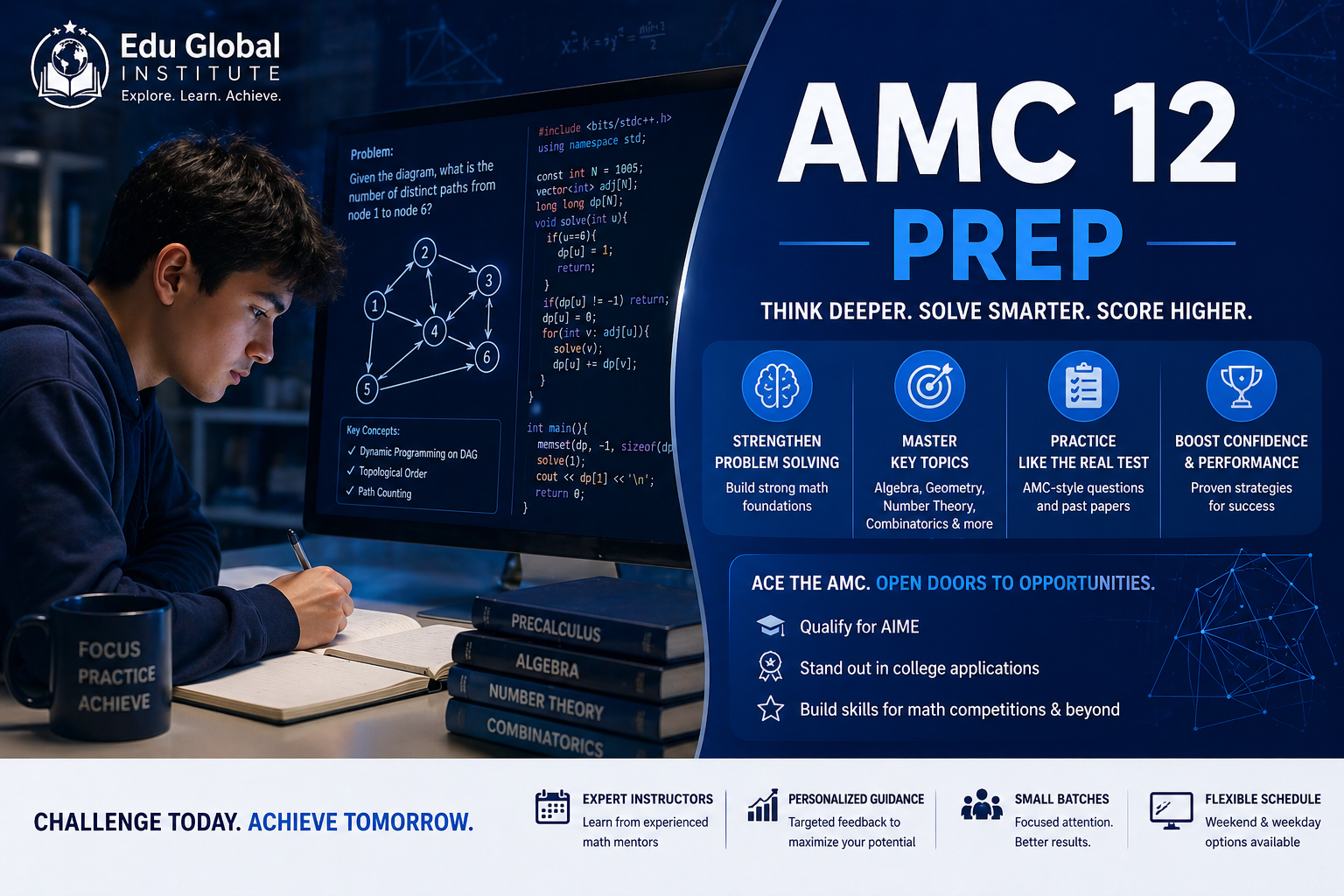
AMC 10 Strategy Bootcamp: Mastering the First 15 Questions and Advanced Elimination Techniques

Unlock Your AMC 10 Potential: Master the Crucial Early QuestionsWelcome to EduGlobal Institute's elite Masterclass, meticulously designed for ambitious students aiming to conquer the AMC 10. This intensive bootcamp focuses on a critical, often underestimated, aspect of the competition: flawlessly navigating the first 15 questions and employing sophisticated elimination techniques across the entire exam. Success in the AMC 10 hinges on accuracy and efficiency in these foundational problems, which build the momentum and confidence needed for higher scores and AIME qualification. Our curriculum goes beyond mere problem-solving; we instill a strategic mindset, teaching you how to approach each question with precision, identify common traps, and leverage advanced logical deduction to eliminate incorrect answers.Prepare to transform your problem-solving approach, elevate your score, and gain a significant competitive edge. This is not just a course; it's a strategic overhaul of your AMC 10 preparation.Masterclass Syllabus Timeline:Module 1: The Foundation of Success (Questions 1-5 Mastery)Strategic Overview: Understanding the AMC 10 scoring and the importance of early accuracy.Core Concepts Revisited: Rapid review of essential arithmetic, basic algebra, and fundamental number theory.Direct Computation & Pattern Recognition: Techniques for quickly and accurately solving straightforward problems.Initial Elimination: Identifying obviously incorrect answers through magnitude estimation and sanity checks.Practice Session: Timed drills on Q1-5 from past AMC 10 exams.Module 2: Building Momentum (Questions 6-10 Precision)Intermediate Algebra & Functions: Advanced manipulation, polynomial properties, and functional equations.Geometry Fundamentals: Area, perimeter, basic angle properties, and coordinate geometry essentials.Counting & Probability Basics: Permutations, combinations, and simple probability scenarios.Strategic Substitution & Diagramming: When and how to use these powerful problem-solving tools.Advanced Elimination I: Parity arguments, unit digit analysis, and exploiting answer choice structure.Practice Session: Focused problem sets on Q6-10, emphasizing speed and accuracy.Module 3: Strategic Breakthroughs (Questions 11-15 Decimation)Advanced Number Theory: Modular arithmetic, divisibility rules, and prime factorization applications.Complex Geometry & Trigonometry: Circle theorems, similar triangles, and basic trigonometric identities.Introduction to Combinatorics: Casework, complementary counting, and the Principle of Inclusion-Exclusion.Invariant Principles & Working Backwards: Uncovering hidden properties and reversing problem statements.Advanced Elimination II: Testing extreme cases, dimensional analysis, and recognizing common distractor types.Practice Session: Intensive drills on Q11-15, integrating all learned strategies.Module 4: Advanced Elimination Techniques & Time ManagementSystematic Answer Choice Analysis: A structured approach to evaluating options when stuck.Bounds Checking & Inequality Reasoning: Using logical limits to narrow down possibilities.Logical Deduction from Options: Inferring properties of the solution directly from the given choices.Recognizing Common Traps: Identifying pitfalls designed to mislead students.Holistic Time Management: Strategies for allocating time effectively across the entire 75-minute exam.Mock Exam Simulation: A full-length mini-test focusing on the first 15 questions, with detailed post-analysis.Module 5: Integration, Refinement & Personalized FeedbackComprehensive Review: Revisit challenging concepts and common errors from previous modules.Problem-Solving Heuristics: General strategies applicable to a wide range of AMC 10 problems.Personalized Feedback Session: One-on-one or small group discussions based on individual performance.Advanced Practice Sets: Curated problems designed to solidify understanding and build intuition.Final Strategy Synthesis: Integrating all techniques into a cohesive, high-performance exam strategy.

Masterclass View Syllabus
IBDP Curriculum
Global

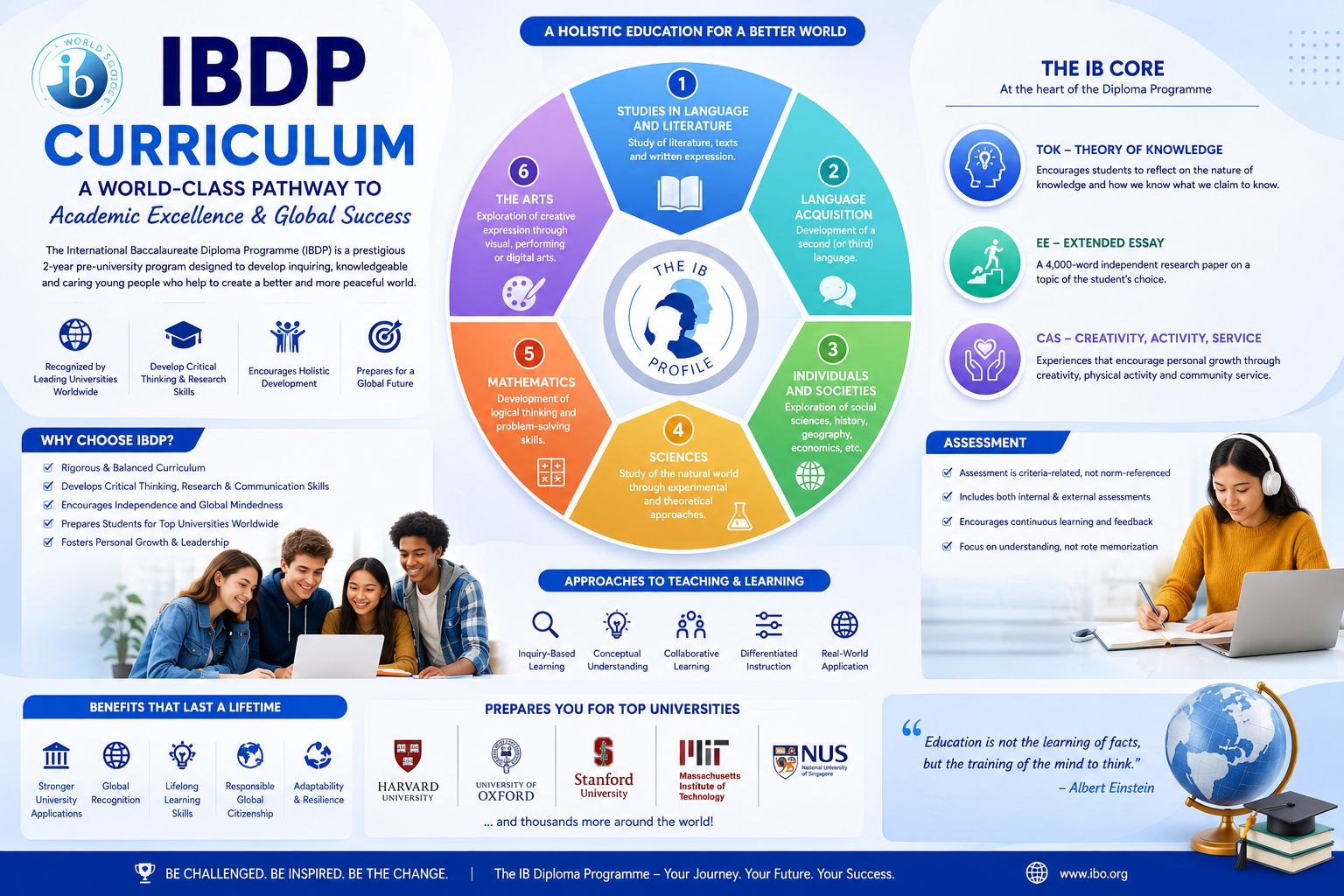
The Ultimate Guide to the IBDP Program: Curriculum, Subjects & Global Success

Decoding the IBDP Program: The Ultimate Global Curriculum GuideThe International Baccalaureate Diploma Programme (IBDP) is globally recognized as the gold standard of pre-university education. Designed for students aged 16 to 19, the IBDP program is uniquely structured to foster critical thinking, intercultural understanding, and academic rigor. Whether you are a student in India, the USA, the UK, or Singapore, understanding the nuances of the IBDP curriculum is the first step toward securing admission to the world's elite universities.However, navigating its multi-layered assessment model can be daunting. In this comprehensive guide, we break down the IBDP program structure, subject selection strategies, and how Edu Global Institute helps students achieve perfect 45-point scores.The Structure of the IBDP CurriculumUnlike traditional national curricula, the IBDP program requires students to study a broad range of subjects alongside a mandatory core. To earn the diploma, students must choose one subject from each of the six subject groups, ensuring a well-rounded educational foundation: Group 1: Studies in Language and Literature Group 2: Language Acquisition (Second Language) Group 3: Individuals and Societies (Humanities) Group 4: Sciences Group 5: Mathematics Group 6: The Arts (or an additional subject from Groups 1-5)Students must take at least three (but not more than four) subjects at Higher Level (HL), representing 240 teaching hours, and the remaining at Standard Level (SL), representing 150 teaching hours. Balancing HL and SL subjects is crucial for aligning with future university prerequisites.The Core: The Heart of the IB Diploma ProgrammeWhat truly sets the IBDP program apart is its unique core requirements, which are mandatory for every diploma candidate: Theory of Knowledge (TOK): A course that encourages students to reflect on the nature of knowledge and how we know what we claim to know. Extended Essay (EE): An independent, self-directed 4,000-word research paper on a topic of the student's choice. Creativity, Activity, Service (CAS): A framework that pushes students to engage in creative projects, physical activity, and community service, fostering holistic personal growth."The IBDP core is not just an academic hurdle; it is a transformative experience that prepares students for the self-directed research required at Ivy League and Russell Group universities." — Academic Director, Edu Global InstituteWhy Choose the IBDP Program?Universities worldwide hold the IBDP in exceptionally high regard. Admissions officers in the USA, UK, Canada, and Singapore recognize that IBDP graduates possess superior research skills, time-management abilities, and global perspectives. Statistics show that IBDP graduates have higher acceptance rates at top-tier universities compared to students from other curricula.How Edu Global Institute Guarantees IBDP SuccessThe academic intensity of the IBDP program requires systematic preparation. Edu Global Institute provides specialized, elite tutoring and mentorship tailored to the demanding IBDP curriculum. Our services include: Subject Selection Counseling: Aligning your HL/SL choices with university admission requirements in India, USA, UK, and Singapore. Internal Assessment (IA) & EE Mentorship: One-on-one guidance from certified IB examiners to structure, research, and refine your essays. Targeted Exam Prep: Comprehensive revision of past papers and marking schemes to maximize your score out of 45.Don't navigate the complex world of the IBDP alone. Partner with the global leaders in IB education. Book a personalized consultation with Edu Global Institute today and unlock your academic potential.

Masterclass View Syllabus
Math Olympiad
Global

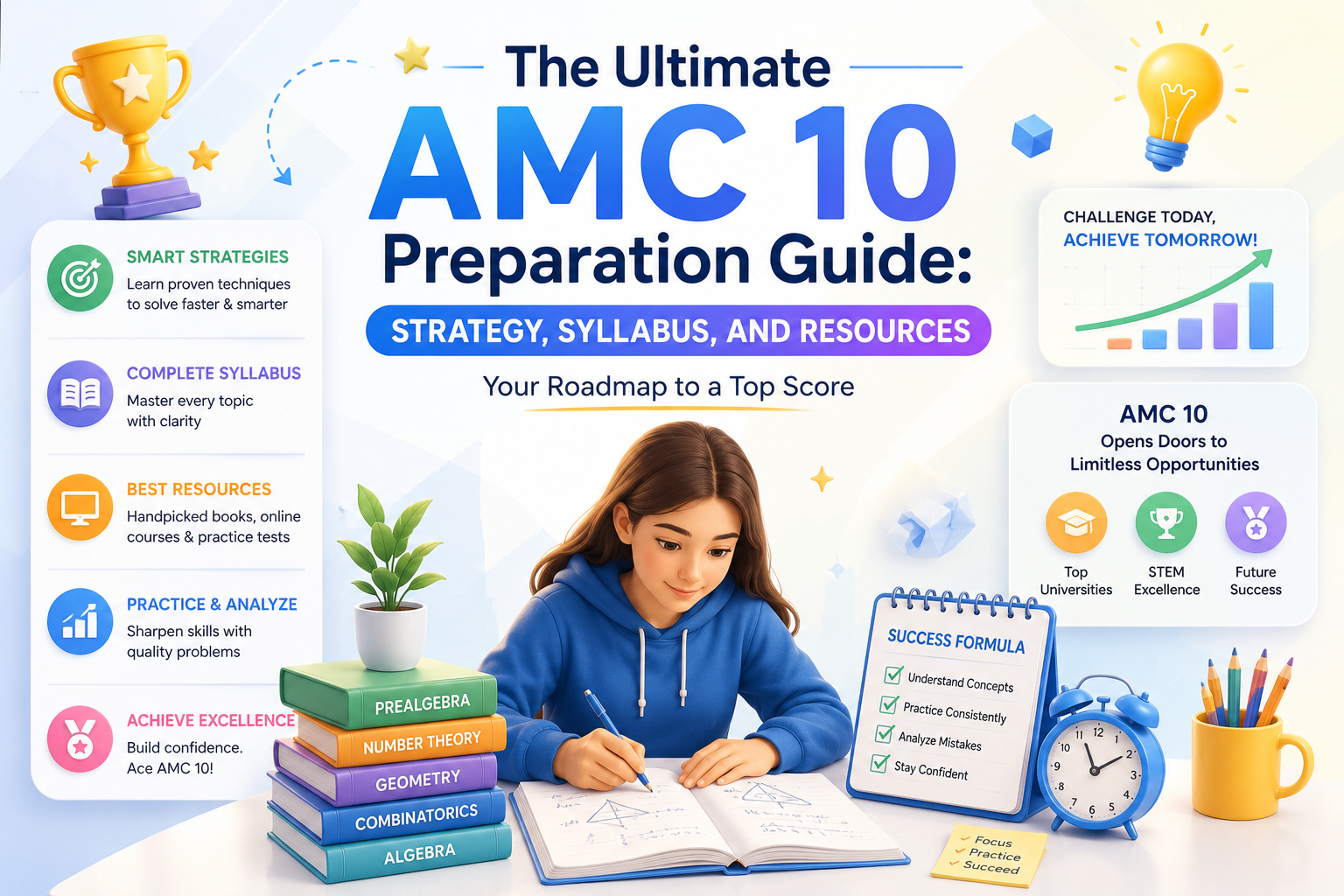
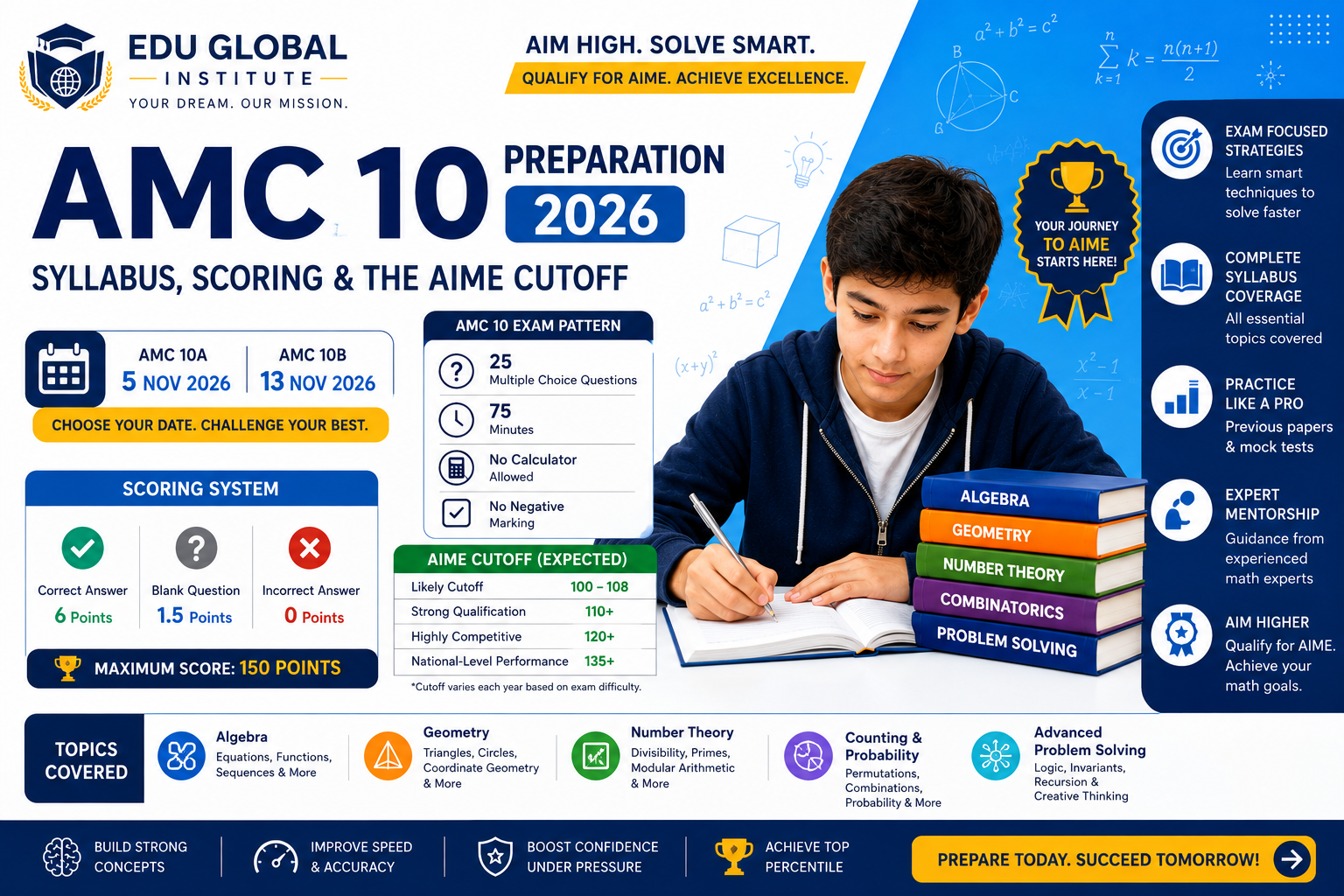
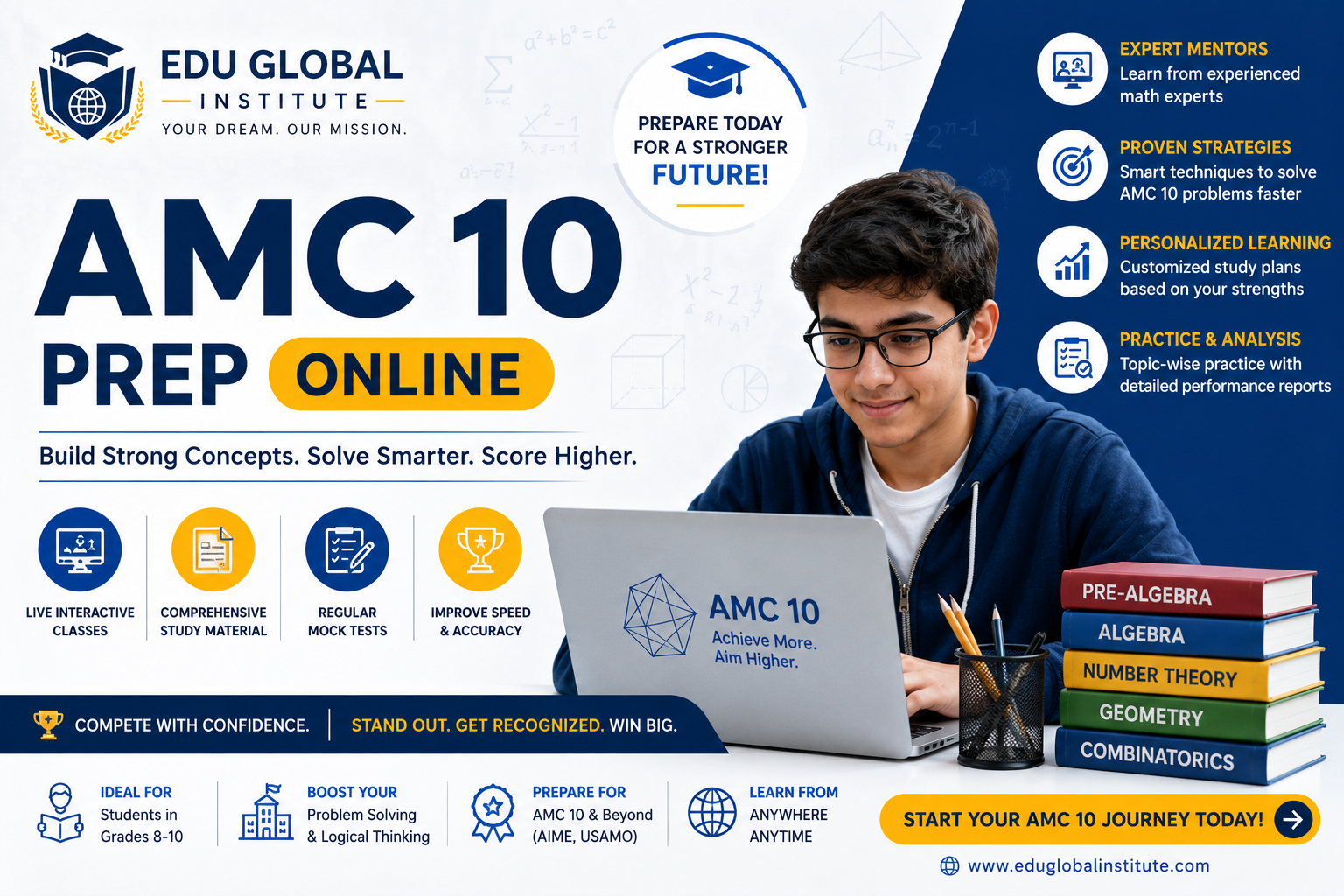
AMC 10 Program: Master the Math Olympiad | Edu Global Institutte

What is the AMC 10 and Why Does It Matter?The American Mathematics Competitions 10 (AMC 10) is the first critical step on the pathway to the prestigious American Invitational Mathematics Examination (AIME) and the USA Mathematical Olympiad (USAMO). Designed for students in grade 10 or below, this 25-question, 75-minute exam tests advanced problem-solving skills that go far beyond standard high school curricula.Succeeding in the AMC 10 is not just about winning medals; it is a powerful differentiator on college applications to Ivy League universities and top-tier STEM institutions like MIT, Caltech, and Stanford. To bridge the gap between school math and competitive math, a structured, rigorous AMC 10 Program is essential."The AMC 10 is not a test of memorization; it is a test of mathematical ingenuity. It challenges students to apply fundamental concepts to entirely unfamiliar problems."Core Pillars of Our AMC 10 SyllabusAt Edu Global Institutte, our comprehensive AMC 10 Program is meticulously designed to cover the four primary pillars of competition mathematics: Advanced Algebra: Master sequences and series, complex systems of equations, quadratic and polynomial properties, and functions. Euclidean Geometry: Deep dive into triangle properties, circle geometry, power of a point, areas, and coordinate geometry. Number Theory: Explore prime factorization, modular arithmetic, divisibility rules, and Diophantine equations. Combinatorics & Probability: Build a strong foundation in permutations, combinations, the Principle of Inclusion-Exclusion (PIE), and geometric probability.Why Choose the Edu Global Institutte AMC 10 Program?Our program stands out by combining world-class curriculum design with personalized mentorship. Here is what makes the Edu Global Institutte approach uniquely effective:1. Expert-Led Live Interactive ClassesOur instructors are seasoned Olympiad coaches, math PhDs, and former AIME qualifiers who know exactly what it takes to score in the top 1% globally. They don't just teach formulas; they teach the underlying logic and problem-solving intuition.2. Weekly Mock Exams & Real-Time AnalyticsPractice makes perfect, but targeted practice makes champion scorers. Students take weekly proctored AMC 10 mock exams designed to replicate the exact difficulty, pressure, and pacing of the official competition. Our proprietary analytics pinpoint precise areas of weakness for immediate correction.3. Comprehensive Problem-Solving ToolkitsWe provide students with curated problem sets sourced from decades of past papers, alongside exclusive shortcuts, mental math strategies, and time-management techniques tailored specifically for the 75-minute exam window."Joining the AMC 10 Program at Edu Global Institutte transformed my approach to complex geometry. The strategies I learned helped me qualify for the AIME with room to spare!" — AIME Qualifier & Edu Global AlumnusHow to Enroll in Our AMC 10 ProgramReady to unlock your academic potential and secure a top score? Getting started with the Edu Global Institutte AMC 10 Program is simple:Step 1: Free Diagnostic Evaluation — Take a comprehensive diagnostic test to identify your current baseline score and conceptual gaps.Step 2: Custom Study Pathing — Meet with our academic advisors to select the class tier (Foundational, Intermediate, or Intensive) that matches your goals.Step 3: Join the Cohort — Dive into interactive lectures, collaborate with peer groups, and begin your journey toward math mastery.Don't leave your math competition goals to chance. Contact Edu Global Institutte today to schedule your free diagnostic assessment and secure your spot in our upcoming cohort!

Masterclass View Syllabus
Mathematics & STEM / Competitive Exam Prep
Global

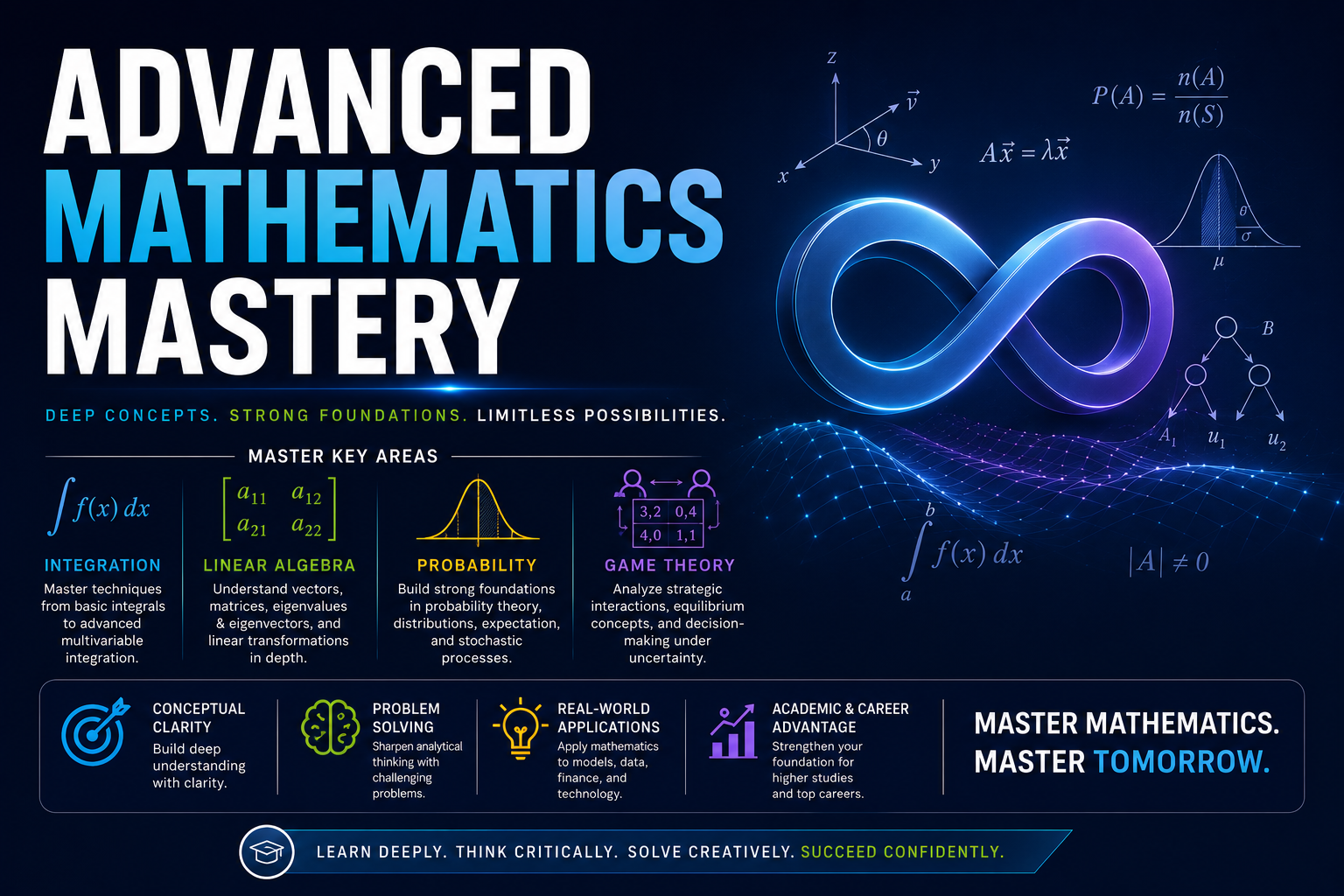
Advanced Mathematics Mastery — Integration, Linear Algebra, Probability & Game Theory

Integral Cup 2026 Official Preparation Program Advanced Mathematics Mastery Integration · Linear Algebra · Probability · Game Theory 🇺🇸 United States 🇬🇧 United Kingdom 🇮🇳 India 38Curriculum units 4Expert tracks 200+Practice problems Self-pacedLearn anywhere Who is this course for? 🎓 Undergrad & Grad Students MIT, Oxford, IIT, UCL, Stanford, IISc — build the rigorous math foundations your programme expects. 🏆 Competition Participants Integral Cup, Putnam, IMO, CMI entrance, USAMO — get structured prep aligned to real competition syllabi. 🤖 ML & AI Engineers Understand the maths behind transformers, diffusion models, GPs, and optimisation — not just the APIs. 📈 Quant & Finance Professionals SDEs, optimal transport, game theory, Bayesian inference — the quantitative toolkit for modern finance. What you will master ✓Single & multivariable integration, Fourier & Laplace transforms ✓Gradient descent, KKT conditions & convex optimisation ✓Eigenvalues, SVD, tensor decomposition & optimal transport ✓Probability, measure theory & Brownian motion ✓PAC learning, Rademacher complexity & generalisation bounds ✓MCMC, variational inference & Gaussian processes ✓Diffusion models, score matching & SDEs ✓Nash equilibria, Sprague-Grundy & backward induction 4-track curriculum — 38 units Every topic is sequenced so prerequisites always come first. Official Integral Cup 2026 content highlighted. Track 1 Integration & Analysis 16 units Basic integrals & substitution Infinite series & summation Limits & continuity MVT & differentiability Riemann–Lebesgue sums ODEs & Laplace transforms Fourier transforms ★ Multivariable calculus ★ Gradient descent & optimisation ★ Autodiff & backpropagation ★ Variational calculus & Euler–Lagrange ★ Riemannian optimisation ★ Neural ODEs & Hamiltonian dynamics ★ SDEs & score matching Track 2 Linear Algebra & Optimisation 13 units Matrices & determinants Vector spaces & linear maps Eigenvalues & SVD Convex optimisation & KKT Linear programming & simplex ★ Spectral graph theory ★ Kernel methods & RKHS ★ Tensor decomposition (CP, Tucker) ★ Random matrix theory ★ Optimal transport ★ Attention & positional embeddings ★ Neural tangent kernel ★ Manifold learning & PCA Track 3 Probability & Statistics 19 units Random variables & distributions Joint distributions & CLT Statistical inference & testing Markov chains Bayesian statistics & queuing ★ Measure theory ★ Information theory & KL divergence ★ Concentration inequalities ★ PAC learning & VC dimension ★ Variational inference & ELBO ★ MCMC & Gibbs sampling ★ Gaussian processes ★ Brownian motion & Itô calculus ★ Diffusion probabilistic models ★ Causal inference & high-dim stats Track 4 Game Theory 6 units Strategic & extensive form games Nash equilibria Rationalizable strategies Zero-sum & impartial games Sprague–Grundy theorem Backward & forward induction ⬛ Standard = official Integral Cup 2026 syllabus  |  ★ Extended = advanced AI/ML mathematics layer Trusted by serious learners worldwide 3,800+Active students 4.9 / 5Average rating 28Countries enrolled 94%Completion rate What students say ★★★★★ "The curriculum sequencing is genius — everything builds perfectly on what came before. I finally understand the maths behind transformers." Priya S. IIT Bombay, India ★★★★★ "Placed top 50 in the Integral Cup after three weeks of study. The sample-problem alignment to curriculum units is something no other course offers." James T. University of Cambridge, UK ★★★★★ "As an ML engineer at a top US lab, I needed the real math — not tutorials. This course gave me Itô calculus, NTK, and optimal transport in one place." Marcus R. Senior ML Engineer, San Francisco Frequently asked questions Do I need prior university-level maths? A solid A-Level / AP Calculus / Class 12 CBSE foundation is enough. The curriculum is sequenced from first principles — Units 1A through 1D cover everything from scratch before advancing. Is this course good for Integral Cup 2026 prep? Yes — the official Integral Cup 2026 Grand Prix syllabus is the backbone of this curriculum. Every sample problem is mapped to specific units in the course. How long does the course take to complete? Most students complete the full 38-unit programme in 12–16 weeks studying 8–10 hours per week. You can also pick individual tracks (roughly 3–4 weeks each at the same pace). Is there a certificate? Yes — a verified digital certificate is awarded on completing all 38 units and passing the final assessments. Recognised by STEMvibe and shareable on LinkedIn.

Masterclass View Syllabus
Finance & Data Science / Algorithmic Trading
Global

Mastering Quantitative Trading: Python, AI & Algorithmic Strategies

Launch Your Career in High-Frequency Finance In the rapidly evolving financial landscape, quantitative trading has emerged as the most sophisticated approach to global markets. Combining mathematics, computer science, and financial theory, algorithmic trading now accounts for over 70% of global equity volumes. Edu Global Institute’s Quantitative Trading Course is a rigorous, comprehensive program designed to take you from foundational mathematics to deploying advanced, AI-driven algorithmic strategies. Whether you are in India, the USA, the UK, or the UAE, this course equips you with the exact tools hedge funds and proprietary trading firms demand. Why Choose Edu Global Institute? Learn from the Best: Taught by industry experts with deep experience in market microstructure and algorithmic execution. Tech-Driven Curriculum: Heavy focus on Python, Machine Learning, and Artificial Intelligence (AI) in trading. Global Certification: Earn a globally recognized Algorithmic Trading Certification. Dedicated Career Placement: Resume optimization, mock interviews, and direct placement assistance with top trading firms. The Comprehensive Syllabus Module 1: The Absolute Foundations (Mathematics & Statistics) Probability Theory & Statistical Inference Linear Algebra & Principal Component Analysis (PCA) for factor modeling Calculus and Convex Optimization for portfolio management Module 2: Programming & Data Architecture (Python Mastery) High-performance data manipulation with NumPy and Pandas Managing tick-level data and working with time-series databases Hands-on Project: Building a high-speed financial data ingestion pipeline Module 3: Financial Markets & Microstructure Understanding Equities, Fixed Income, Futures, and Derivatives (Greeks) Deep dive into Market Microstructure: The Limit Order Book (LOB) and order types Liquidity, bid-ask spreads, and maker-taker models Module 4: Time Series Analysis for Trading Stationarity testing (ADF, Hurst Exponent) and fractional differencing Linear models (ARIMA) and Volatility modeling (GARCH) Cointegration and the mathematics of Statistical Arbitrage (Pairs Trading) Module 5: Algorithmic Strategy Design & Backtesting Strategy Types: Mean Reversion, Trend Following, and Market Making The Science of Backtesting: Avoiding look-ahead bias and overfitting Hands-on Project: Developing and backtesting a Pairs Trading strategy from scratch Module 6: Portfolio Management & Risk Position Sizing: The Kelly Criterion Modern Portfolio Theory and the Efficient Frontier Advanced Risk Management: Value at Risk (VaR) and Conditional VaR Module 7: Advanced Machine Learning & AI in Finance Why standard ML fails in finance (and how to fix it with Purged Cross-Validation) Feature Engineering: Dollar bars, Meta-labeling Implementing Gradient Boosting (XGBoost) and Deep Learning for signal generation

Masterclass View Syllabus
Engineering Entrance / IIT-JEE Competitive Coaching
Global

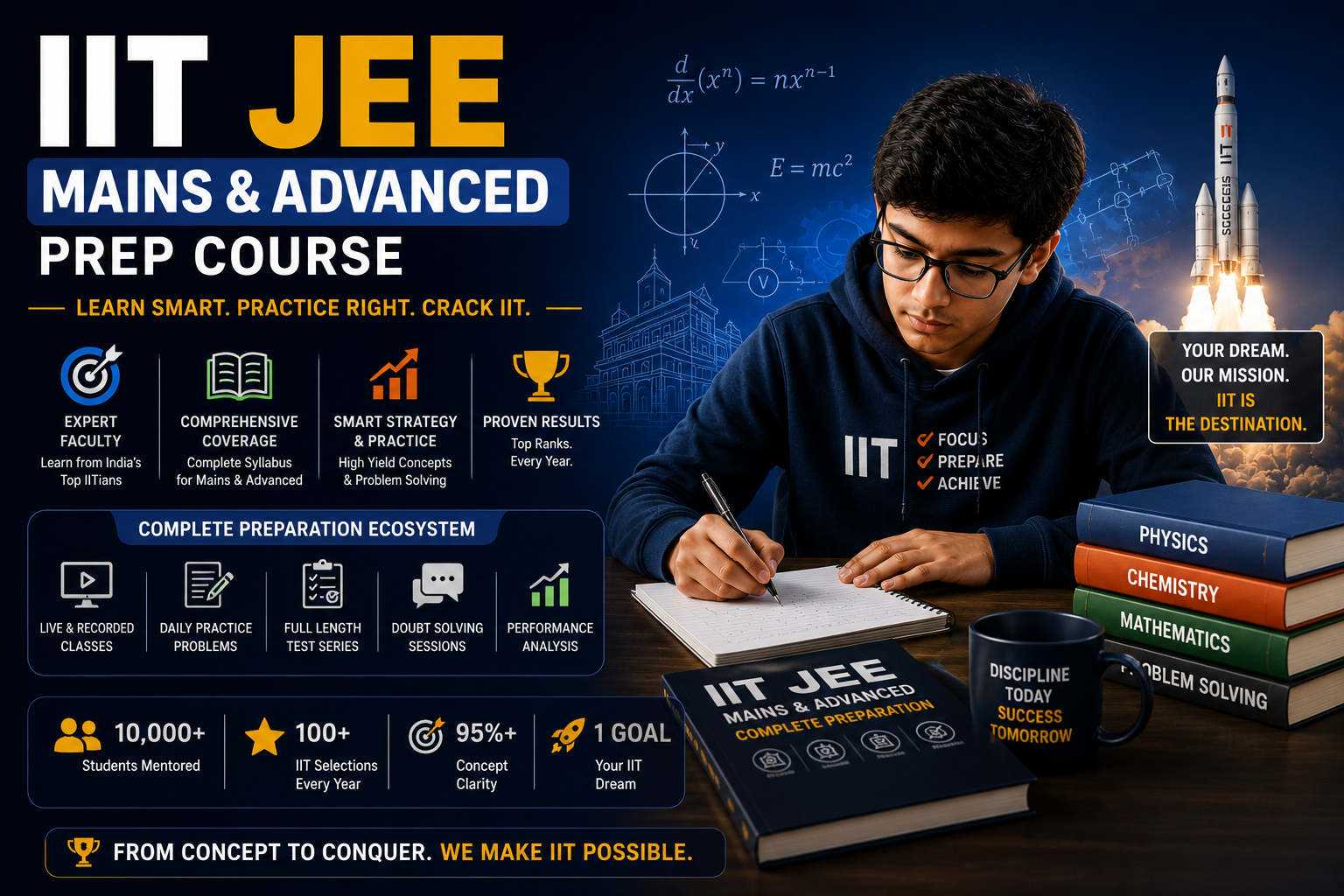
IIT JEE Mains & Advanced Prep Course 2026: Global Excellence Track

Master the Engineering Dream: Your Gateway to IIT Success The IIT JEE Mains and Advanced Prep Course at Edu Global Institute is more than just a coaching program; it is a meticulously engineered ecosystem designed for the JEE 2026 cycle. Whether you are navigating the high-speed requirements of JEE Main or the deep analytical complexity of JEE Advanced, our course provides the expert mentorship needed to conquer both. The Edu Global Advantage: Why We Outrank the Rest Dual-Track Strategy: We explicitly bridge the gap between JEE Main vs Advanced preparation, moving from fundamental NCERT mastery to the "Multi-Step Thinking" required for Advanced. The Global Edge: Specialized support for students in the UAE, USA, and UK, accounting for time-zone differences and regional academic baselines. AI-Driven Block Scheduling: We utilize the JEE block scheduling method to ensure students master high-weightage chapters with maximum efficiency. Psychological Resilience: Integrated stress management and mental conditioning to handle the intense pressure of the IIT-JEE journey. Subject-Wise Syllabus Architecture Physics: The Conceptual Engine We focus on building an intuitive understanding of physical laws using HC Verma Physics and DC Pandey Physics. Mechanics & Kinematics (Rotational Motion Focus). Electrodynamics & Current Electricity. Modern Physics & Optics. Chemistry: The Equilibrium of Theory & Logic Our curriculum balances the rote requirements of Inorganic with the logic-heavy Organic sections using OP Tandon and NCERT foundations. Physical: Mole Concept & Thermodynamics. Organic: General Organic Chemistry (GOC) & Coordination Compounds. Inorganic: P-block elements & Chemical Bonding. Mathematics: The Problem-Solving Core From RD Sharma basics to Cengage Maths complexity, we build the "proof-based" logic required for the top 1%. Calculus & Definite Integration. Vectors & 3D Geometry. Coordinate Geometry & Complex Numbers. The 2026 Performance Protocol Mock Test Series: Full-length JEE Main mock test and JEE Advanced mock test with real-time percentile calculation. PYQ Deep Dive: 15+ years of JEE PYQs with solutions analyzed for recurring trends. Doubt Resolution: Dedicated platform for instant JEE doubt solving and 1-on-1 mentor sessions. Counseling Support: Post-exam guidance for the JoSAA counseling process to secure seats in top engineering colleges.

Masterclass View Syllabus
Math Olympiad
Global

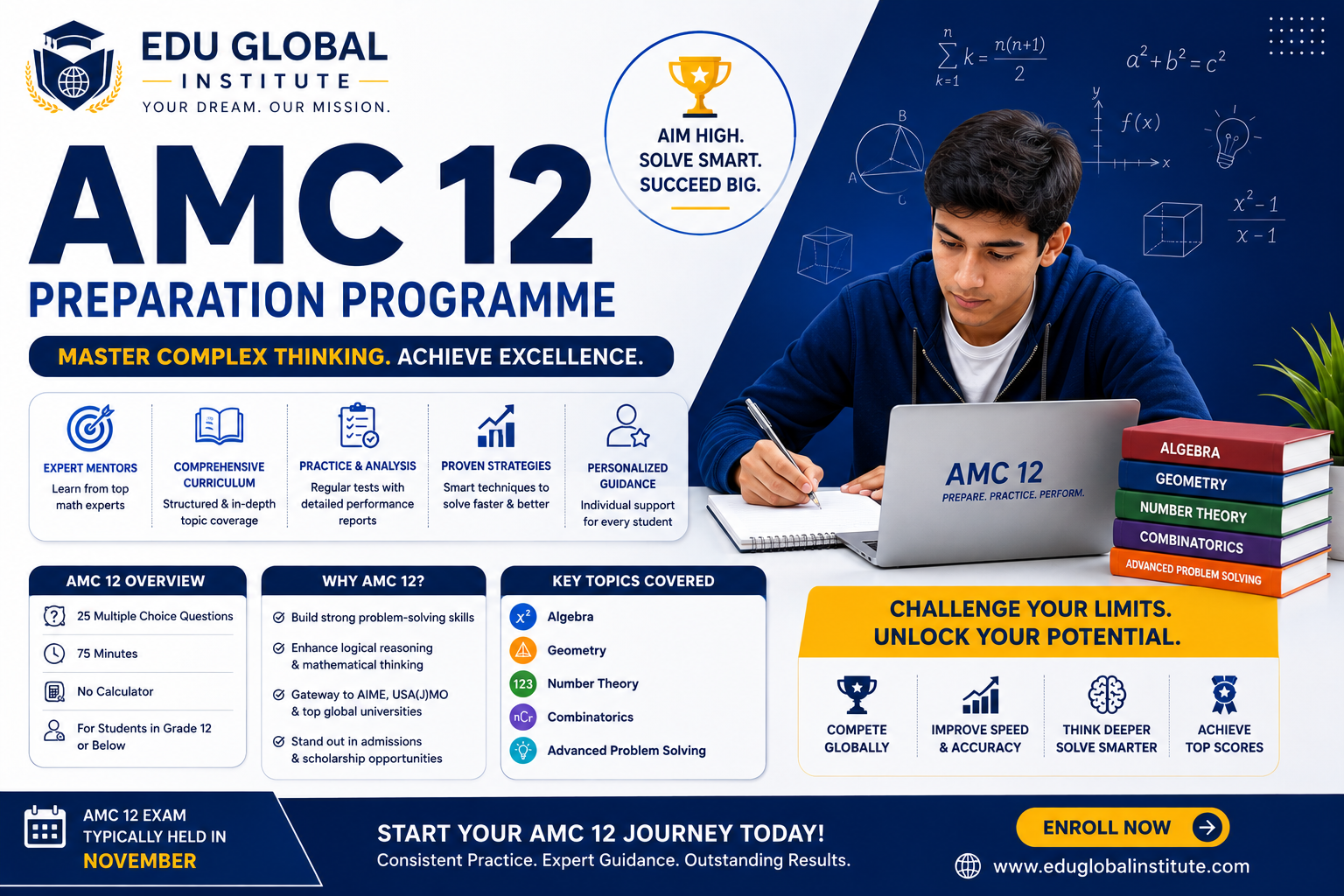
Elite AMC 10/12 Masterclass: The AIME & Ivy League Pathway

Elite AMC 10/12 Masterclass: The Definitive 2026 Global Pathway A Strategic Training Architecture for Ambitious Minds in India, USA, UK, and UAE. The "Academic Spike": Why AMC 10/12 is the Global Signal In the hyper-competitive landscape of 2026 admissions, a high GPA is no longer a differentiator; it is a prerequisite. To secure admissions at institutions like MIT, Stanford, and the Ivy League, students must demonstrate "Intellectual Vitality". The American Mathematics Competition (AMC) 10/12 serves as the premier global benchmark for elite problem-solving capabilities. Achieving Honor Roll status provides a decisive signal to admissions officers that a student possesses the cognitive resilience required for high-level STEM research. The EduGlobal Advantage: Bridging the National Curriculum Gap Our program is engineered to act as a "force multiplier" for your existing academic foundation: India (JEE Foundation): We transition students from the computational intensity of JEE to the logic-driven "Subjective Intuition" required for AMC/AIME. UK (GCSE/A-Levels): We bridge the gap between standard UK curricula and the advanced discrete mathematics (Number Theory/Combinatorics) favored by the MAA. UAE/USA (IB/AP): We provide the rigorous proof-based depth often missing from modular curricula, focusing on the "No-Calculator Mastery" essential for competitive success. The 4-Pillar Syllabus Architecture Our curriculum does not teach students to "solve"; it teaches them to decompose complex systems. 1. Algebra & Functional Logic (The Foundational Engine) Detailed Topics: Advanced Polynomials, Vieta’s Formulas, Logarithmic inequalities, recursive sequences, and functional equations. The Strategy: "Rapid Execution Frameworks." We train students to clear Problems 1–15 in under 40 seconds each by recognizing recursive patterns instantly. 2. Advanced Euclidean & Coordinate Geometry Detailed Topics: Power of a Point, Stewart’s Theorem, Mass Point Geometry, 3D Spatial Visualization, and complex Trigonometric identities. The Strategy: "Geometric Intuition." Developing the ability to visualize 3D transformations on a 2D plane to bypass lengthy coordinate calculations. 3. Number Theory & Modular Arithmetic Detailed Topics: Primes, Divisibility Rules, Chinese Remainder Theorem, Fermat’s Little Theorem, and Base Representation. The Strategy: "Hidden Structure Identification." Cracking the difficult Problems 20–25 by identifying parity and modular constraints in large integer sets. 4. Combinatorics & Statistical Probability Detailed Topics: Pigeonhole Principle, Inclusion-Exclusion, Casework Analysis, Geometric Probability, and Expected Value. The Strategy: "Complementary Counting Hack." Learning to calculate the "inverse" of a problem to find solutions faster when traditional counting is too complex. The 2026 Training Protocol: Engineering the Honor Roll We replace passive learning with high-intensity cognitive conditioning: Weekly High-Intensity Sprints: 90-minute live interactive sessions focusing on "Elite Problem Decomposition" and time-pressure management. Proctored Mock Exams: 15 full-length simulations that replicate the exact 75-minute psychological wall of the real exam. The Guessing Optimizer: A data-driven model teaching students when to leave a question blank ($1.5$ points) versus when the Expected Value (EV) favors an educated guess. 24/7 Global Mentor Access: Direct, one-on-one doubt resolution across IST, GST, GMT, and EST time zones. Global Logistics & ROI Country-Specific Registration: Concierge support for finding test centers and managing registration deadlines in India, UAE, UK, and the USA. AIME Pathway Bridge: Automatic enrollment in our AIME Intensive for students hitting the 100+ (AMC 10) or 90+ (AMC 12) scoring benchmarks.

Masterclass View Syllabus
Competitive Mathematics & STEM Excellence
Global

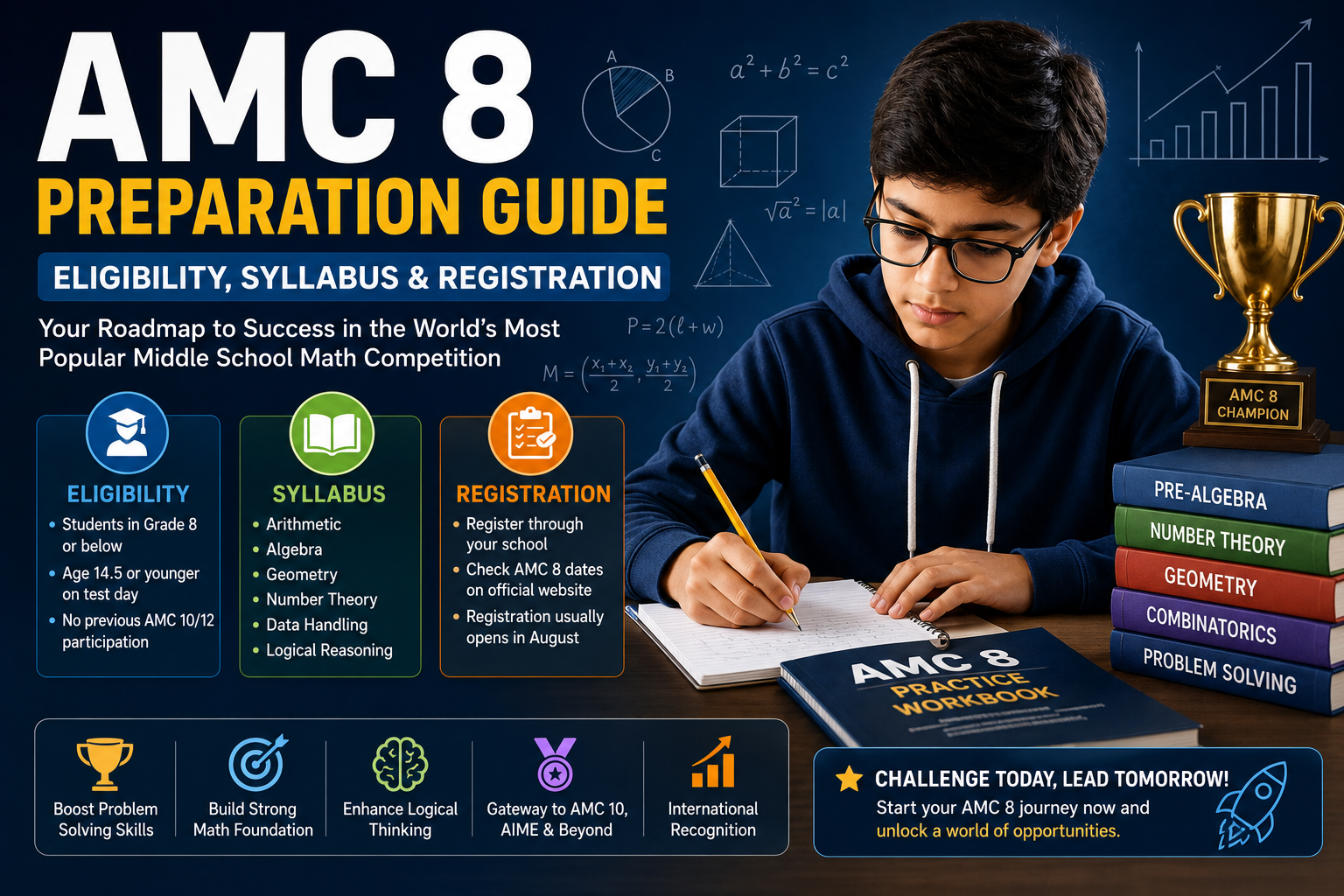
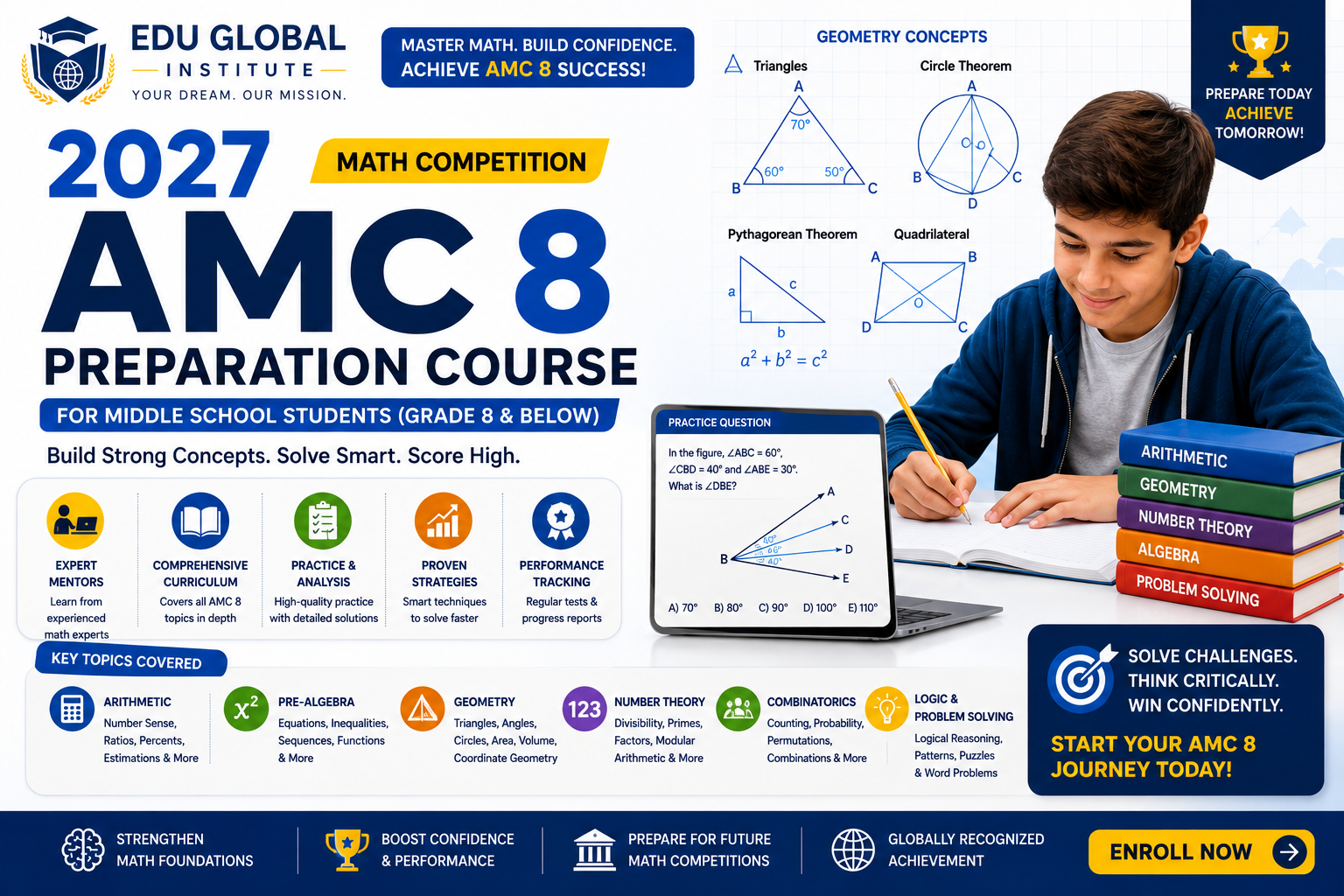
Elite AMC 8 Masterclass: The Logic & Strategy Intensive

The Gateway to Global STEM Leadership The American Mathematics Competition (AMC 8) is more than just a test; it is the gold standard for identifying mathematical talent in middle schoolers (Grades 6-8). For students in India, the USA, and the UK, a high AMC 8 score is the first building block of an 'Academic Spike'—the specialized profile that elite universities like MIT, Stanford, and Oxford look for in future applicants. At Edu Global Institute, we don't just teach math; we teach Mathematical Intuition. Our Masterclass is designed to transition students from school-level arithmetic to the high-level competitive logic required to secure a spot on the Distinguished Honor Roll (Top 1%). What Parents & Students Demand (and We Deliver) Beyond Rote Memorization: We focus on The Why. Students learn to derive formulas under pressure rather than just memorizing them. Global Registration Support: We provide a step-by-step roadmap for international registration in India and the UK, ensuring no student is left behind due to administrative hurdles. The No-Calculator Advantage: We train mental math agility and estimation hacks, turning the "No Calculator Rule" into your child’s greatest strength. AI-Driven Performance Analytics: Our platform identifies exactly where your child loses time, whether it's in Geometry visualization or Combinatorics logic. The Four Pillars of AMC 8 Mastery Module 1: The Algebra & Proportional Reasoning Lab Core Focus: Linear equations, rate/work problems, and complex ratios. Strategy: Solving multi-step word problems in under 90 seconds. Module 2: Visual Geometry & Spatial Intuition Core Focus: Pythagorean theorem, area-perimeter relationships of non-standard polygons, and 3D volume. Strategy: "Drawing for Clarity"—how to visualize 3D problems on a 2D page. Module 3: Number Theory & Divisibility Secrets Core Focus: Prime factorization, modular arithmetic basics, and finding the last digit of massive powers. Strategy: Identifying "Hidden Patterns" in large number sequences. Module 4: Counting, Probability & Statistical Logic Core Focus: Permutations, combinations, and geometric probability. Strategy: The "Complementary Counting" hack to avoid common traps in hard-level problems. Program Deliverables Weekly 75-Minute High-Intensity Sessions: Interactive, small-group problem-solving. 10 Full-Length Mock Exams: Proctored sessions replicating the 40-minute stress of the real exam. Personalized Strategy Log: A custom-built guide documenting your child's common errors and time-management goals. The "AIME Track" Bridge: Advanced sessions for students aiming to bypass AMC 8 and prepare for AMC 10/12.

Masterclass View Syllabus
Competitive Mathematics & University Admissions
Global

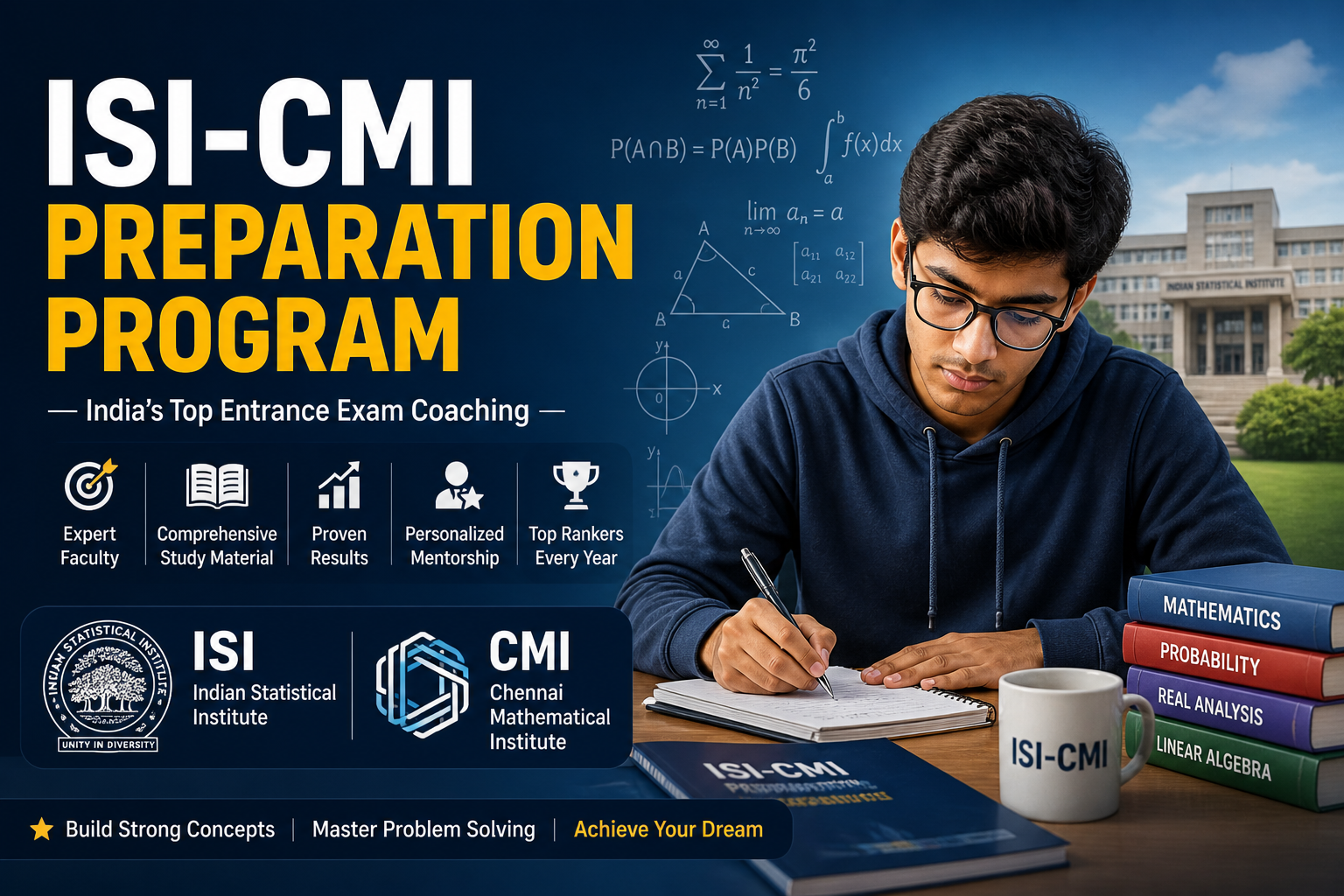
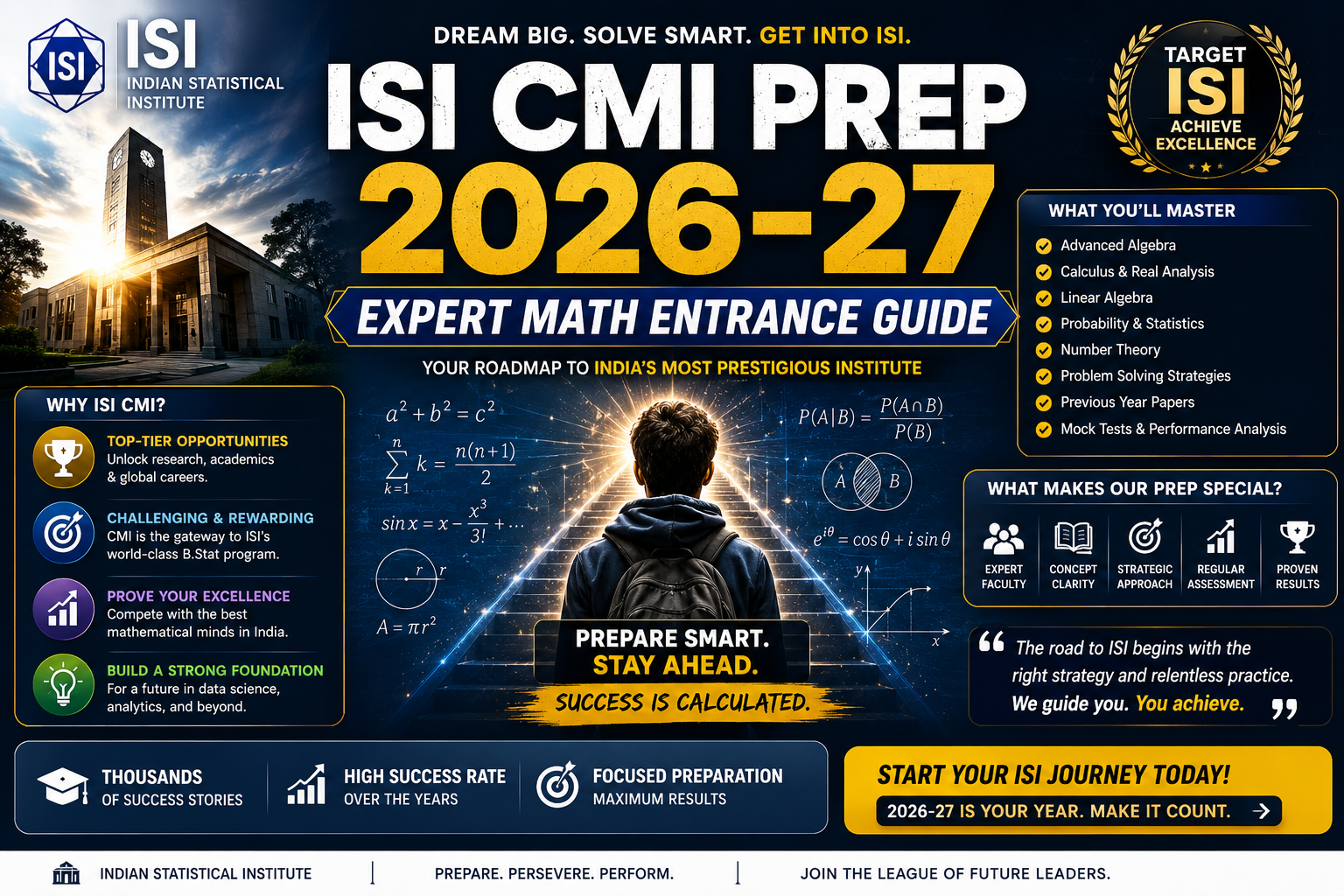
Elite ISI & CMI Entrance Coaching: The B.Stat & B.Math Mastery Track

The Pinnacle of Mathematics: Why ISI & CMI? While millions of students chase IIT JEE, an elite tier of mathematical minds targets the Indian Statistical Institute (ISI) and Chennai Mathematical Institute (CMI). Offering the prestigious B.Stat, B.Math, and B.Sc. (Math & Computer Science) degrees, these institutes are the premier gateways to global research, top-tier quantitative finance, and elite data science careers. Unlike IITs, students at ISI pay zero tuition fees and actually receive a monthly stipend to study. However, cracking the ISI CMI entrance exam requires a fundamental shift in thinking. While JEE Advanced tests speed and calculation across three subjects, ISI and CMI test extreme depth, logic, and rigorous proof-writing in pure mathematics. The Edu Global Advantage: Bridging the JEE & ISI Gap One of the biggest concerns for students is ISI CMI preparation while preparing for JEE. Competitors force students to choose or treat ISI prep as an afterthought. At Edu Global Institute, our curriculum is highly integrated. We leverage your existing JEE calculus and algebra foundation, elevating it to the Olympiad-level proof-writing standards required for the ISI UGB (subjective) and CMI papers. Subjective Proof-Writing Evaluation: The biggest hurdle for JEE students is the subjective section. Our expert mentors manually grade your proofs line-by-line, teaching you how to structure logical arguments to secure maximum partial credit. Decoded Previous Year Questions (PYQs): We don't just hand you an answer key. We provide deep, algorithmic breakdowns of 20+ years of ISI CMI previous year questions, revealing recurring patterns and hidden heuristics. Dual-Prep Synergy: Our targeted schedule ensures your ISI/CMI preparation enhances your JEE Advanced mathematics score, rather than disrupting your physics and chemistry study time. The Four-Tiered ISI-CMI Syllabus Architecture Phase 1: Advanced Number Theory & Combinatorics Goal: Mastering the discrete mathematics rarely taught at the JEE level, but heavily tested in ISI/CMI. Primes, Divisibility, Congruences, and the Chinese Remainder Theorem. Fermat’s Little Theorem and Euler’s Totient Function. Advanced Counting, Pigeonhole Principle, and Inclusion-Exclusion. Generating Functions and Recurrence Relations. Phase 2: Deep Algebra & Polynomials Goal: Elevating algebraic manipulation to Olympiad standards. Roots of polynomials, Vieta's relations in higher degrees, and symmetric polynomials. Inequalities: AM-GM-HM, Cauchy-Schwarz, and Jensen’s Inequality. Complex numbers: De Moivre’s Theorem, nth roots of unity, and geometric transformations. Functional equations and abstract algebra basics. Phase 3: Rigorous Calculus & Real Analysis Goal: Transitioning from computational calculus to proof-based real analysis. Epsilon-delta definitions of limits and continuity. Advanced applications of Mean Value Theorems (Rolle's, Lagrange, Cauchy). Definite integration via limit of sums, Leibniz rule, and improper integrals. Sequence and series convergence tests. Phase 4: Euclidean Geometry & Conics Goal: Solving complex spatial problems using pure geometry and coordinate geometry. Properties of triangles, circles, and quadrilaterals (Ceva's, Menelaus, Ptolemy). Locus problems, tangents, normals, and advanced properties of parabolas, ellipses, and hyperbolas. Vector algebra and 3D geometry applications. Execute Your Strategy: Mock Tests & Analytics Familiarity with the ISI CMI exam pattern is critical. We subject our students to rigorous, timed mock exams that perfectly replicate the dual-paper structure (UGA multiple-choice and UGB subjective). Stop worrying about the ISI CMI vs IIT JEE difficulty—prepare with the experts who understand both.

Masterclass View Syllabus
Math Olympiad
Global

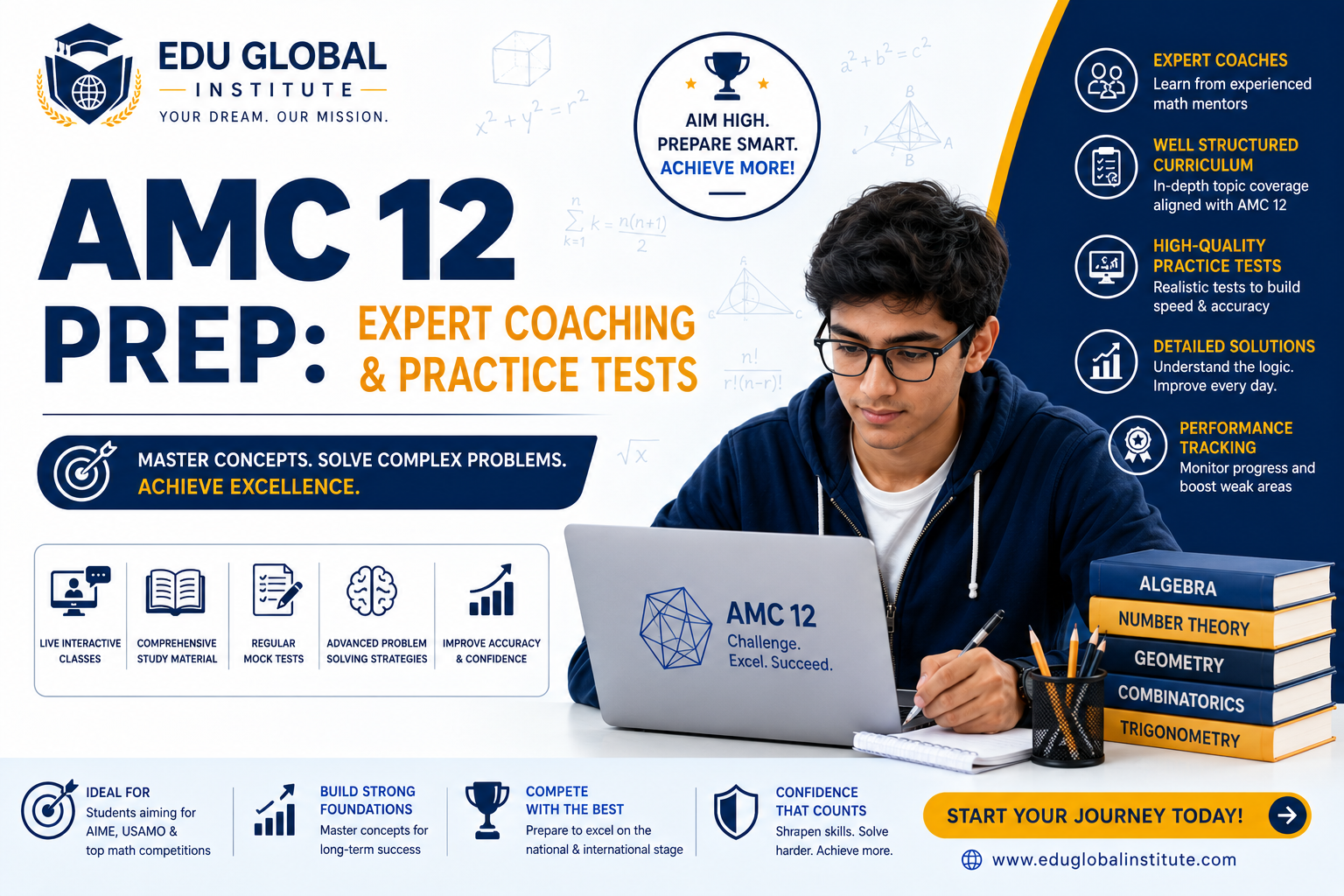
AMC 12 Elite Mastery: The AIME Qualification Track

The Competitive Edge: Beyond Standard AMC 12 Prep In the race for elite STEM university admissions across the US and India, a high score on the American Mathematics Competition (AMC 12) is one of the most powerful differentiators. It is the definitive gateway to the American Invitational Mathematics Examination (AIME) and the USAMO/INMO. However, standard prep programs rely on generic, one-size-fits-all problem sets that fail to address individual student weaknesses. Edu Global Institute revolutionizes competitive math training. We combine the rigorous conceptual depth required by elite US universities with the intensive, mastery-based pedagogy favored by top Indian academies. Powered by AI-driven analytics and expert 1-on-1 mentorship, our curriculum is engineered specifically to secure AIME qualification. The Edu Global Advantage: Why We Outperform AI-Powered Adaptive Learning: Our platform tracks your performance on every mock test, identifying highly specific micro-weaknesses (e.g., modular arithmetic vs. general number theory) and dynamically generating targeted practice to fix them. Guaranteed Doubt Resolution: Unlike massive community forums where your questions get lost, we provide rapid, expert-led 1-on-1 mentorship slots to ensure absolute conceptual clarity. The "Global Edge" Methodology: We seamlessly blend the creative, proof-based problem-solving of the US Olympiad system with the rigorous, high-speed calculation techniques of the Indian competitive ecosystem. The Four-Tiered Syllabus Architecture Phase 1: Advanced Algebra & Functional Equations Goal: Mastering non-standard algebraic manipulation and pattern recognition. Vieta's Formulas, advanced polynomials, and rational expressions. Logarithmic and exponential inequalities. Complex numbers, De Moivre’s Theorem, and geometric interpretations. Symmetric systems of equations and recursive sequences. Phase 2: Elite Geometry & Spatial Reasoning Goal: Moving beyond high school geometry to Olympiad-level spatial deduction. Advanced Euclidean Geometry: Mass point geometry, Ceva's, Menelaus', and Ptolemy's theorems. Coordinate Geometry & Vectors: Rotations, reflections, and dot/cross product applications. Advanced Trigonometry: Complex identities and the Law of Sines/Cosines in obscure orientations. 3D Geometry: Polyhedra properties, spatial diagonals, and volume optimization. Phase 3: Number Theory & Diophantine Equations Goal: Rapidly executing modular arithmetic and identifying hidden integer properties. Prime factorization strategies, divisibility rules, and the Euclidean Algorithm. Fermat’s Little Theorem, Euler’s Totient Theorem, and Chinese Remainder Theorem. Solving linear and non-linear Diophantine equations. Number bases and advanced cryptography basics. Phase 4: Combinatorics, Probability, & AIME Transition Goal: Counting complex arrangements and mastering expected value under extreme time limits. Advanced Permutations/Combinations and the Inclusion-Exclusion Principle. The Pigeonhole Principle and Stars & Bars method. Generating functions and solving recurrence relations. Conditional probability and complex expected value calculations. Execute Your Strategy Preparation is incomplete without realistic stress-testing. Students undergo regular, full-length AMC 12 mock exams under strict timed conditions, followed by granular AI-performance reports that pinpoint exactly how to maximize point yields. Don't leave your AIME qualification to chance.

Masterclass View Syllabus
Competitive Programming & Olympiads
Global

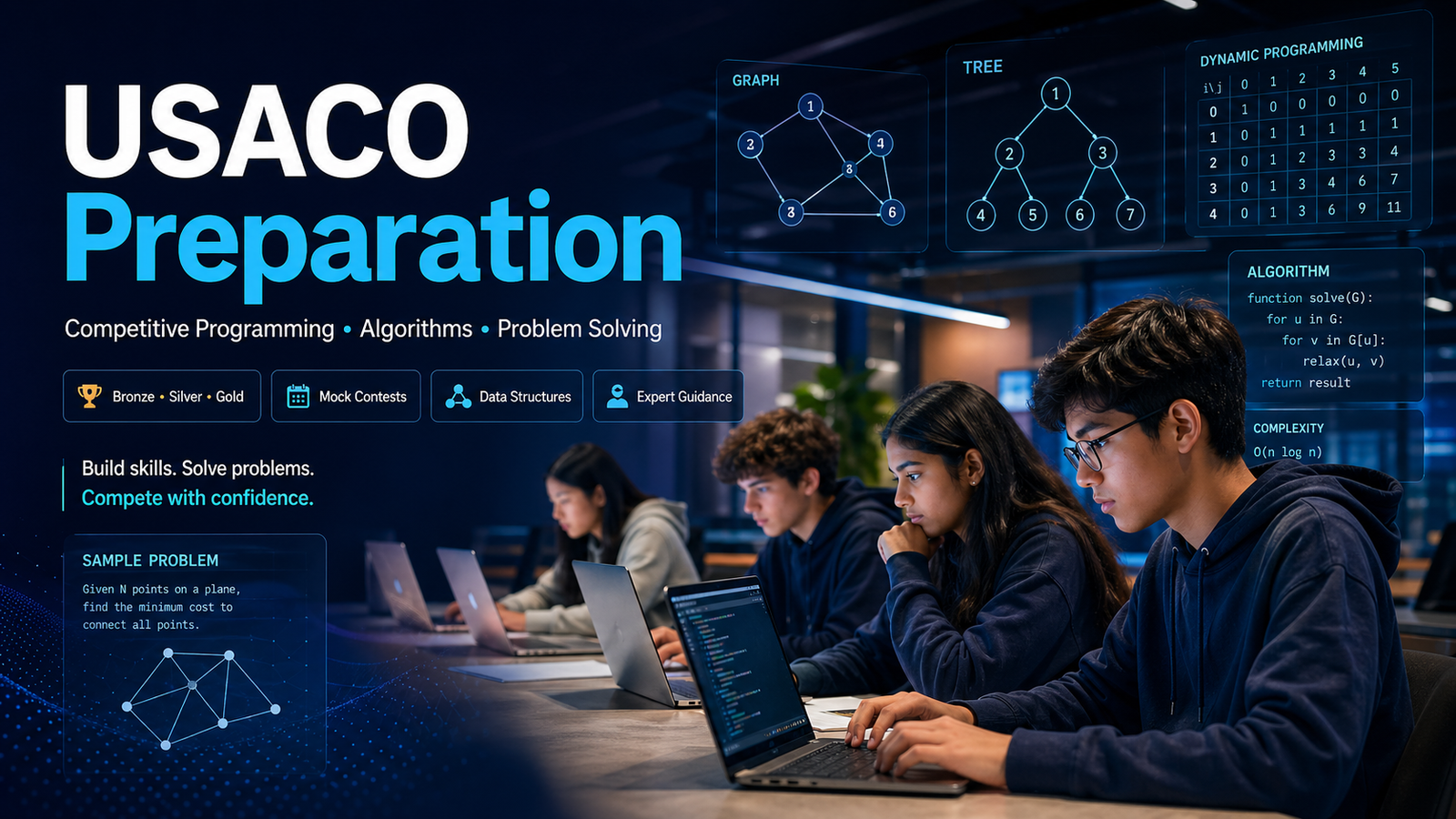
Elite USACO Masterclass: Bronze to Platinum Algorithmic Training

The Competitive Edge: Why USACO Defines Elite CS Admissions In the hyper-competitive landscape of global university admissions, simply knowing how to write Python or Java is no longer a differentiator. For students targeting elite Computer Science programs at institutions like MIT, Stanford, Carnegie Mellon, and the Ivy League, admissions officers look for Intellectual Vitality. Achieving a Silver, Gold, or Platinum ranking in the USA Computing Olympiad (USACO) is arguably the most powerful signal a high school student can send. At Edu Global Institute, our USACO Masterclass is not a standard coding camp. It is a rigorous, strategic training ground taught by competitive programming experts. We transition students from writing basic syntax to mastering advanced data structures, graph theory, and Big O time-complexity optimization. The Edu Global Methodology: Coding to Win USACO does not test if you can write code; it tests if you can write efficient code under extreme pressure. Our curriculum teaches students how to map problem descriptions to algorithmic patterns, avoiding the dreaded "Time Limit Exceeded" (TLE) errors. We fully support both C++ (the industry standard for competitive programming speed) and Python. The Four-Tiered Syllabus Architecture Phase 1: The Bronze Foundation (Algorithmic Basics) Goal: Escaping brute-force limitations and building competitive stamina. Language Mastery & I/O: Optimizing input/output operations for contest environments. Fundamental Logic: Complete Search (brute force with pruning), greedy algorithms, and comprehensive simulation. Data Structures: Mastering dynamic arrays, strings, sets, and hash maps. Time Complexity (Big O Notation): Understanding why an O(N^2) solution fails where an O(N log N) solution succeeds. Phase 2: The Silver Breakthrough (Intermediate Algorithms) Goal: Transitioning to structural logic and graph traversal. Historically, reaching Silver places students in the top tier of high school programmers. Graph Theory 101: Breadth-First Search (BFS) and Depth-First Search (DFS) on trees and grids. Flood fill algorithms. Optimization Techniques: Two-pointers, sliding windows, and prefix sums for rapid range queries. Custom Sorting & Binary Search: Binary searching on the answer (monotonic functions). Phase 3: The Gold Standard (Advanced Complexity) Goal: Combining multiple algorithmic concepts to solve multi-layered problems. Reaching Gold makes a student a highly recruited Ivy League CS candidate. Dynamic Programming (DP): Memoization, tabulation, Knapsack variations, and DP on trees. Advanced Graph Algorithms: Shortest path algorithms (Dijkstra's, Bellman-Ford), Minimum Spanning Trees (Prim's, Kruskal's), and Topological Sorting. Advanced Data Structures: Disjoint Set Union (DSU) and basic Segment Trees. Number Theory & Math: Modular arithmetic, combinatorics, and prime factorization algorithms. Phase 4: The Platinum Pinnacle (Elite Level) Goal: For the top 1% of competitive programmers globally. Platinum competitors are routinely recruited by FAANG companies before entering college. Highly Advanced Data Structures: 2D Segment trees, Fenwick Trees (BITs), and Heavy-Light Decomposition. Advanced DP Optimization: Convex hull trick and divide-and-conquer DP. Complex Computational Geometry: Line sweeps and convex hulls. Elite Problem Decomposition: Combining multiple advanced theorems into a single, highly optimized, memory-efficient solution. Beyond the Code: Your USACO Success Strategy We provide weekly mock contests, live debugging sessions, and personalized post-contest analysis to identify exactly where a student's logic broke down. Don't just dream of USACO success—engineer it.

Masterclass View Syllabus
STEM Research & Internships
Global

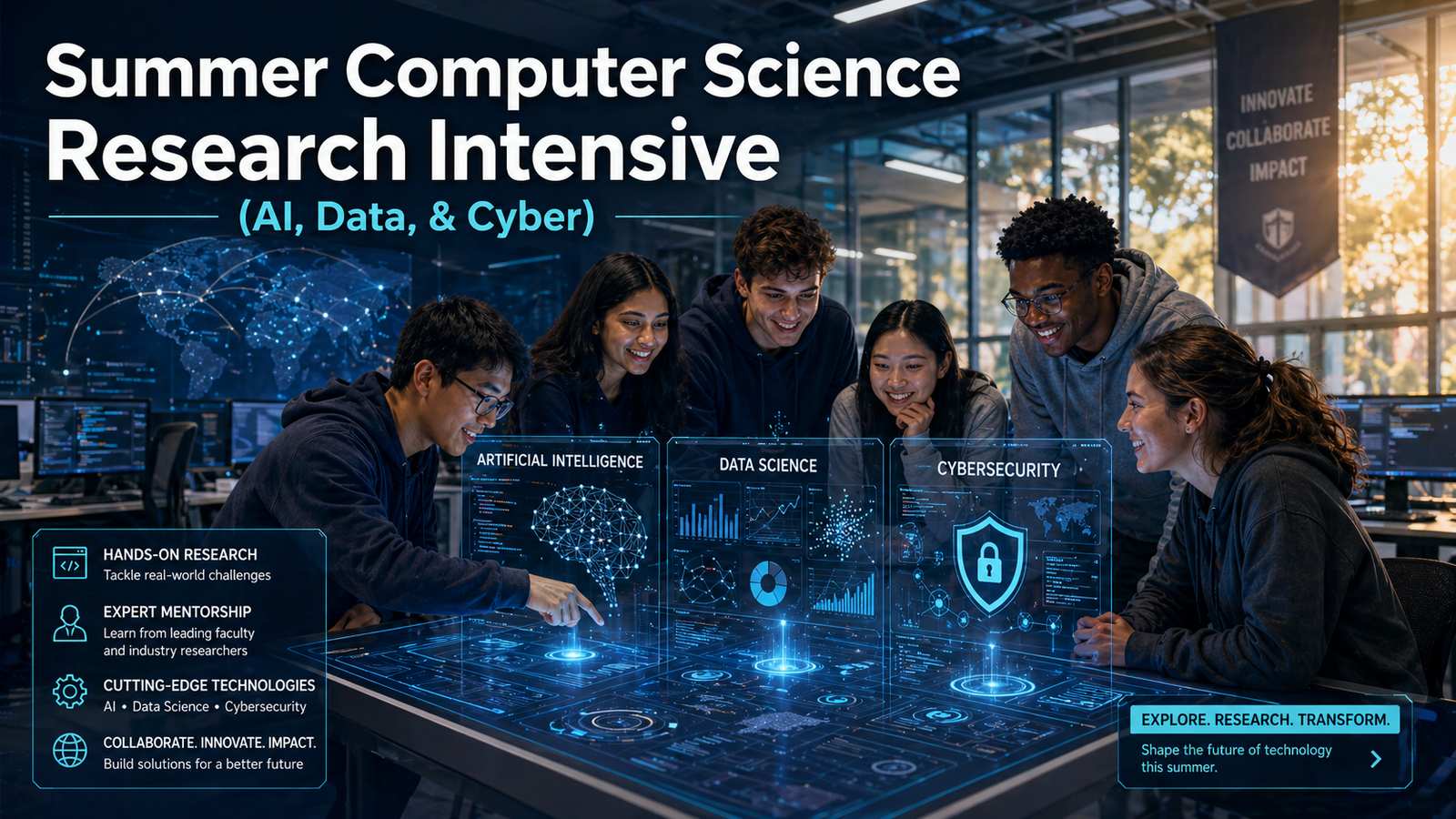
Summer Computer Science Research Intensive (AI, Data, & Cyber)

Beyond Coding: The Transition to Real CS Research In the highly competitive landscape of global university admissions, simply knowing how to code in Python or Java is no longer enough to stand out. Top-tier computer science programs in the US, UK, Australia, and elite Indian institutes expect students to demonstrate initiative, critical thinking, and the ability to apply computational logic to unsolved problems. The Edu Global Institute Summer Computer Science Research Intensive bridges the gap between high school coding classes and university-level research. This remote-first, globally connected program pairs ambitious students with expert mentors to execute, document, and present a rigorous, independent CS research project. The Global Cohort Advantage Innovation thrives on diverse perspectives. Our program operates in synchronized time zones across India, the United States, the United Kingdom, and Australia. Students not only work 1-on-1 with expert mentors but also collaborate, peer-review, and network with a curated cohort of elite international peers, building a global tech network before they even enter college. Choose Your Research Track We do not assign generic "summer projects." Students must select a specialized track and formulate a unique, testable research question. Track 1: Artificial Intelligence & Machine Learning (ML) Focus: Natural Language Processing (NLP), Computer Vision, and Predictive Modeling. Sample Research: "Evaluating the Efficacy of Convolutional Neural Networks (CNNs) in Detecting Early-Stage Plant Leaf Diseases in Variable Lighting." Tools: Python, TensorFlow, PyTorch, Scikit-learn. Track 2: Data Science & Big Data Analytics Focus: Data scraping, cleaning, statistical analysis, and algorithmic visualization. Sample Research: "A Sentiment Analysis of Global Financial News and Its Correlation to Short-Term Tech Stock Volatility." Tools: Pandas, NumPy, Matplotlib, R. Track 3: Cybersecurity & Cryptography Focus: Network security, encryption algorithms, and vulnerability analysis. Sample Research: "Analyzing the Time-Complexity and Brute-Force Vulnerabilities of Modified RSA Encryption Algorithms." Tools: Python (Cryptography libraries), Wireshark, Linux environments. Track 4: Computational Science & Bioinformatics Focus: Applying computational power to solve biological, environmental, or physical problems. Sample Research: "Simulating the Spread of Viral Pathogens Using Agent-Based Python Modeling and SIR Differential Equations." Tools: SciPy, BioPython, Agent-based simulation software. The 8-Week Research Architecture This program demands commitment. It is structured to mirror the exact process of publishing an academic paper in a peer-reviewed journal. Weeks 1-2: Literature Review & Proposal. Formulating a strict, testable research question. Weeks 3-5: Data Collection & Algorithm Design. Writing the code, training the models, and gathering datasets. Weeks 6-7: Analysis & Debugging. Interpreting the results, measuring error rates, and graphing data. Week 8: Final Deliverables & Symposium. Writing the final academic paper and defending the research. Tangible University Deliverables To ensure this program provides maximum ROI for college applications, every student leaves with a comprehensive portfolio: A Formatted Research Paper: Ready for submission to high school research journals or inclusion as a university application supplement. A Clean GitHub Repository: Documented, reproducible code proving technical competency. A Symposium Presentation Video: A recorded defense of the research, showcasing elite communication skills.

Masterclass View Syllabus
Maths Research
Global

Summer Mathematics Research Program : Theory to Application

Program Overview: Execute Real Mathematical Research Traditional mathematics education teaches students to solve established problems. True mathematical research challenges them to formulate new questions, model real-world phenomena, and build quantifiable proofs. Launching on 15 May 2026, the Edu Global Institute Summer Mathematics Research Program is a rigorous, 8-week project-based intensive designed for ambitious high school and intermediate students. We do not accept vague, school-level projects like "A Study of Graph Theory." Every student in this program will operate like a university researcher. You will define a strict research question, apply computational or theoretical methods, analyze data, and produce a tangible, high-level deliverable. Student Cohort Levels To ensure students are appropriately challenged, incoming researchers are placed into one of three capability tracks: Level 1 (Exploratory Research): For younger students comfortable with school-level algebra. Focuses on visual mathematics and foundational modeling. Level 2 (Applied Research): For students comfortable with Python/Excel and statistics. Focuses on algorithm application and real-world data analysis. Level 3 (Advanced Research): For students with strong programming and math foundations. Focuses on cryptography, advanced algorithms, and rigorous proofs. The 5 Flagship Research Tracks Students must select one of the following highly specific research tracks to execute during the 8-week program. Track A: Measuring the Fractal Dimension of Natural Patterns (Level 2) The Question: Can the fractal dimension of natural structures (coastlines, leaves, lightning) be estimated using box-counting algorithms? Methodology: Convert high-resolution images to binary arrays and apply the box-counting method using Python to estimate the fractal dimension from a log-log slope. Track B: Graph Theory for Local Route Optimization (Levels 2 & 3) The Question: Can weighted graph algorithms reduce travel time or distance in a specific, local transit network (e.g., school buses or delivery paths)? Methodology: Model physical locations as nodes and roads as weighted edges. Apply Dijkstra's algorithm via NetworkX to find optimal paths and mathematically compare them to standard routes. Track C: Prime Numbers and RSA Cryptography (Level 3) The Question: How does RSA encryption depend on prime factorization, and how does increasing key size alter the time required for brute-force factorization? Methodology: Build a working model of RSA encryption from scratch. Write brute-force factorization scripts for progressively larger semiprimes to test computational limits. Track D: Pascal’s Triangle Modulo Primes (Levels 1 & 2) The Question: How do modular reductions of Pascal’s Triangle (modulo 2, 3, 5, 7) reveal predictable number-theoretic and geometric, fractal-like structures? Methodology: Use Python to generate massive iterations of Pascal's Triangle, apply modular arithmetic, and map the results to color grids to analyze the emergence of self-similar geometries. Track E: Game Theory Models of Strategic Decision Making (Level 1) The Question: Can Nash Equilibrium predict rational strategies in simple, real-world competitive scenarios (e.g., local pricing competition or sports strategies)? Methodology: Define players/strategies, construct mathematical payoff matrices, calculate dominant strategies, and test theoretical equilibrium against simulated human behavior. Program Deliverables & Evaluation At the conclusion of the 8-week period, every student is required to submit a comprehensive research package to be used for university admissions portfolios. This includes: Code/Data Repository: A clean, documented GitHub repository or Colab notebook containing all simulations and scripts. Final Research Paper: A professionally formatted document including Background, Methodology, Results (Graphs/Tables), Error Analysis, and Conclusion. Final Presentation: A verbal defense of the research findings.

Masterclass View Syllabus
Physics Olympiad
Global

F=ma Physics Olympiad Preparation

The F=ma Reality: Executing Under Pressure The F=ma Physics Contest, administered by the AAPT, is the definitive gateway to the United States Physics Olympiad (USAPhO). The exam format is brutal: 25 multiple-choice questions to be solved in exactly 75 minutes. It strictly assesses non-calculus classical mechanics. However, the questions require a level of analytical agility and multi-step logical deduction that standard high school physics courses simply do not teach. To clear the cutoff threshold (typically the top 400 students globally), students must average 3 minutes per question. The EduGlobal Institute F=ma Intensive is a rigorous, data-driven academic intervention designed to build that exact computational speed and conceptual retention. The EduGlobal Training Architecture Success in competitive physics is not about memorizing equations; it is about recognizing physical systems and deploying the correct algorithmic framework instantly. Powered by the Syamabal Learning Software, our program replaces passive lectures with aggressive, targeted skill-building: The 6-Quiz Reinforcement Protocol: We prevent the "illusion of competence." After every core mechanics module, students must pass six progressively difficult application quizzes. The software demands proven, data-backed retention before the curriculum advances. Dimensional Analysis & Estimation Hacks: Because the F=ma is multiple-choice, we train students in advanced meta-strategies—using dimensional analysis and boundary-condition testing to eliminate incorrect options in seconds. 75-Minute Stress Diagnostics: We utilize decades of historical F=ma past papers to build endurance. Our dashboard analytics pinpoint exact error patterns (e.g., spending too much time on rotational dynamics) to optimize pacing. Strict Mechanics Syllabus (F=ma Aligned) The F=ma exam is strictly limited to classical mechanics. Our curriculum deeply isolates these specific domains, elevating them to an Olympiad standard. Module 1: Advanced Kinematics & Relative Motion 1D and 2D kinematics under varying constraints. Complex projectile motion on inclined planes. Vector-based relative velocity and Galilean transformations. Module 2: Newtonian Dynamics & System Analysis Advanced applications of Newton's Laws of Motion. Multi-body systems, tension, and interconnected pulleys. Kinetic and static friction modeling, and fictitious/inertial forces in accelerating frames. Module 3: Conservation Laws (Energy & Momentum) The Work-Energy Theorem in conservative and non-conservative fields. 1D and 2D elastic vs. perfectly inelastic collisions. Center of mass tracking and impulse analysis. Module 4: Rotational Mechanics (The Deciding Factor) Historically, rotational mechanics problems separate the USAPhO qualifiers from the rest. Calculating rotational inertia for complex, non-standard geometries. Torque, rolling without slipping, and static equilibrium. Conservation of angular momentum in dynamic, changing systems. Module 5: Oscillations & Orbital Gravity Simple Harmonic Motion (SHM) parameters: physical pendulums and complex spring-mass configurations. Kepler's Laws, escape velocity, and total orbital energy.

Masterclass View Syllabus

Join 10,000+ Elite Scholars

Get exclusive access to mathematical shortcuts, free strategy guides, and olympiad registration deadlines delivered to your inbox.