
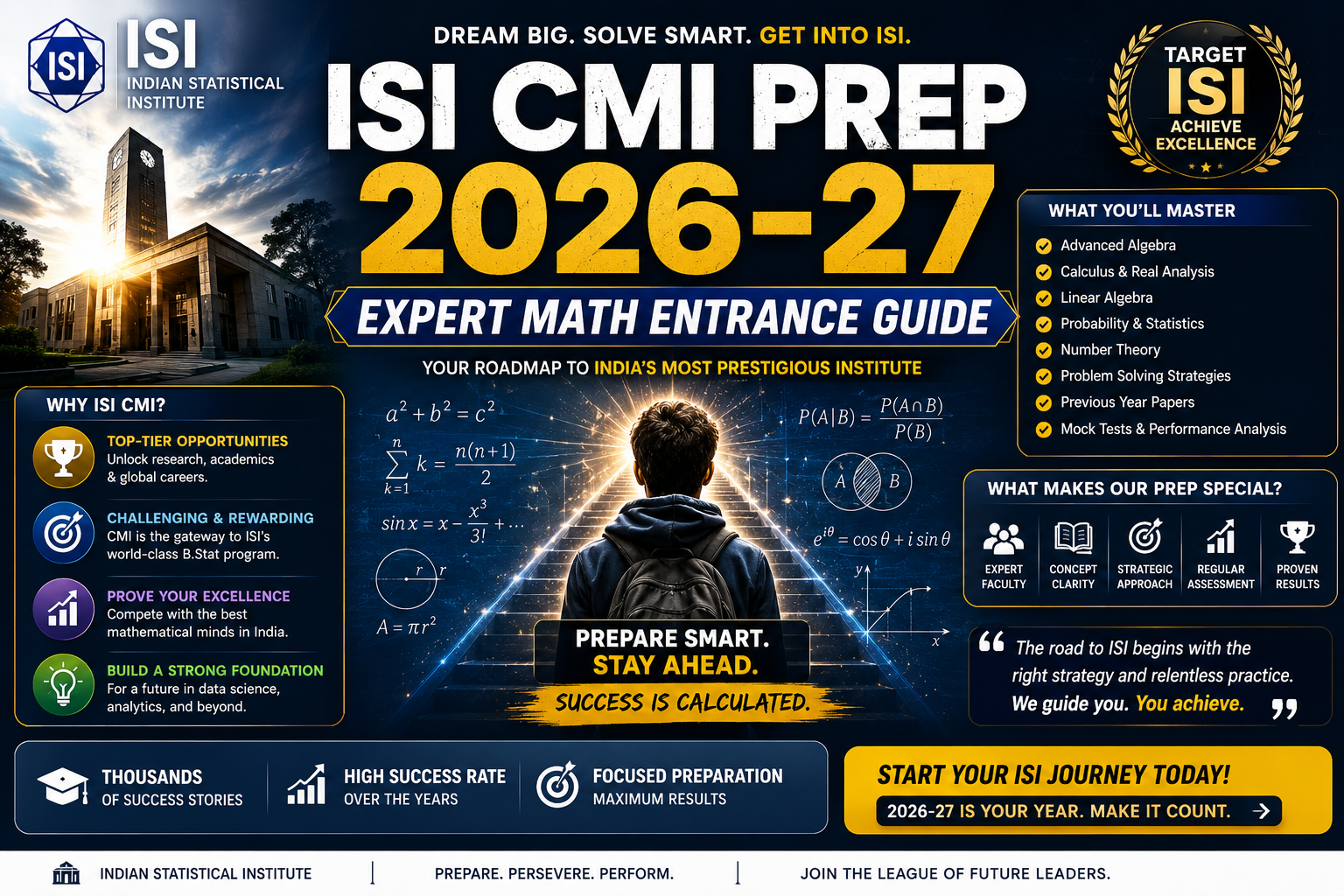
ISI CMI Comprehensive Preparation Program (2026-27)
- For
- Class 11 - Class 12
- Level
- Intermediate
- Duration
- 24 weeks
- Each week
- 4.5 hours
- Mode
- Online
- Fee
- Free
ISI CMI Preparation Program 2026-27: The Ultimate Math Entrance Guide
Securing admission to the Indian Statistical Institute (ISI) or the Chennai Mathematical Institute (CMI) is the pinnacle of achievement for aspiring mathematicians, computer scientists, and statisticians. Offering legendary undergraduate programs like Bachelor of Statistics (BStat), Bachelor of Mathematics (BMath), and BSc (Hons) in Mathematics, Computer Science, and Data Science, these premier institutes maintain a fierce selection barrier with acceptance rates traditionally remaining below 5%.
To succeed against this intense global pool—stretching across India, UAE, USA, UK, and Australia—students require far more than high school engineering entrance tricks. They must cultivate profound mathematical maturity, abstract logical reasoning, and elegant proof-writing clarity. The Edu Global Institute ISI CMI preparation program 2026 is custom-engineered to convert raw mathematical aptitude into standard-setting ranks. Whether you are aiming for the ISI BStat online course 2027 or finalizing your CMI BSc Math entrance strategy, this comprehensive curriculum provides a definitive blueprint to clear these legendary examinations.
Program Eligibility and Examination Architecture
Understanding the strict boundaries of the evaluation process is critical before launching your preparation timeline. Both institutes run unique testing parameters that demand highly specific training mindsets.
ISI Admission Test Eligibility 2026 & Pattern
- ISI 75 Percent Criteria: Candidates must have successfully completed their 10+2 high school education or equivalent with Mathematics and English as compulsory subjects. While a minimum percentage is historically flexible for the test itself, maintaining a top-tier score (greater than 75%) across central and international board curricula ensures smooth absolute documentation clearance under the ISI admission test eligibility 2026 guidelines.
- Exam Structure (UGA & UGB): The test is split into two halves held on the same day.
- Part 1 (UGA Paper): Multiple-Choice Questions (MCQs) focusing on speed, structural accuracy, and counter-example tracking.
- Part 2 (UGB Paper): Entirely subjective, advanced math paper requiring rigorous, watertight logical steps. Scoring well on the UGB section dictates your final rank and interview qualification.
CMI Entrance Examination Structure
- The Subjective Paradigm: Unlike most global screening examinations, CMI drops standard options completely in its core scoring blocks. The exam values the raw journey of problem-solving. Points are awarded heavily for intermediate progress, rigorous mathematical notation, and creative execution.
- The Broad Track Focus: While sharing overlapping algebra and calculus spaces with ISI, the CMI paper stretches deeper into pure foundational logic, number structures, and theoretical discrete configurations.
The Master Syllabus Breakdown (2026-2027 Cycle)
This comprehensive curriculum forms the backbone of our premium preparation engine, carefully mapping every concept included within the official CMI entrance exam syllabus 2027 and ISI framework.
Module 1: Advanced Algebra and Classical Number Theory
Algebra forms the foundational canvas upon which complex conceptual models are built. We train students to move completely away from mechanical formula applications toward deep functional structures.
- Theory of Equations & Polynomials: Fundamental Theorem of Algebra, Vieta’s formulas connecting roots and coefficients, location of roots, Descartes’ Rule of Signs, symmetric polynomials, transformation of coordinate equations, and irreducible polynomial constraints over rational fields.
- Advanced Inequalities: Classical frameworks including AM-GM-HM inequality, Cauchy-Schwarz inequality, Chebyshev's inequality, Jensen's inequality for convex/concave functions, and their geometric interpretations in maximization problems.
- Complex Numbers: De Moivre’s Theorem, $n$-th roots of unity and their geometric distributions, Euler's identity, geometry on the complex plane (lines, circles, and conics defined through complex variables), and transformation mapping.
- Elementary Number Theory: Divisibility criteria, Euclidean Algorithm, prime factorization models, modular arithmetic structures, Chinese Remainder Theorem (CRT), Fermat’s Little Theorem, Euler’s Totient Function $\phi(n)$, Wilson's Theorem, and solving non-trivial linear Diophantine equations.
- Matrices & Determinants: Operations, properties of determinants, Cramer's rule, systems of linear equations, and introductory vector space transformations.
Module 2: Rigorous Calculus and Real Analysis
Calculus at this level demands absolute formal precision. Students must master the mechanics of limits and continuity long before attempting advanced integration operations.
- Limits, Continuity, and Differentiability: Formal $\epsilon$-$\delta$ definition of a limit, properties of continuous functions, Intermediate Value Theorem (IVT), uniform continuity basics, and evaluating non-trivial indeterminate forms via L'Hôpital's Rule and Taylor expansions.
- Applications of Derivatives: Rolle's Theorem, Mean Value Theorems (Lagrange and Cauchy forms), Monotonicity, Maxima and Minima of single variable and multivariable functions, curve tracing, and optimization proofs.
- Integration Techniques: Riemann integration foundations, Fundamental Theorem of Calculus, complex substitutions, integration by parts, reduction formulas, evaluating definite integrals through symmetry, and improper integrals.
- Sequences and Series: Bounded and monotonic sequences, convergence tests (Ratio, Root, Integral, and Comparison tests), alternating series convergence via Leibniz’s rule, and absolute vs. conditional convergence tracking.
Module 3: Combinatorics, Probability, and Mathematical Statistics
This domain represents the primary point of differentiation for students targeting the ISI BStat question paper 2026. It demands intense structural visualization and creative counting methods.
- Advanced Combinatorics: Permutations and combinations with repetitions, Pigeonhole Principle (PHP) and its non-trivial extensions, Principle of Inclusion-Exclusion (PIE), derangements, generating functions, and recurrence relations.
- Classical Probability Foundations: Sample spaces, fields of events, axiomatic probability definitions, conditional probability matrices, and Bayes' Theorem application in complex logical trees.
- Random Variables & Distributions: Discrete and continuous random variables, Probability Mass Functions (PMF), Probability Density Functions (PDF), Cumulative Distribution Functions (CDF), Mathematical Expectation, Variance, and Covariance calculations.
- Theoretical Discrete Distributions: Binomial, Poisson, Geometric, Hypergeometric distributions, along with Chebyshev's inequality bounds for statistical distributions.
Module 4: Modern Coordinate & Plane Geometry
We blend classical Euclidean techniques with Cartesian structures to build flexible problem-solving vectors.
- Classical Plane Geometry: Properties of triangles (Centroid, Orthocenter, Incenter, Circumcenter relationships), cyclic quadrilaterals, Ptolemy's Theorem, Ceva's and Menelaus's Theorems, and power of a point dynamics.
- Analytical Geometry: Systems of straight lines, circle systems (radical axis, orthogonal intersections), standard and non-standard conic sections (Parabola, Ellipse, Hyperbola configurations under general transformations).
Module 5: Discrete Mathematics & Theoretical Computer Science (CMI Exclusive Track)
For aspirants optimizing their CMI theoretical computer science preparation, this customized segment establishes foundational abstract computing architecture.
- Mathematical Logic & Set Theory: Propositional calculus, truth tables, quantifiers, logical equivalence, set operations, power sets, cartesian products, and countable vs. uncountable infinity models.
- Binary Relations and Functions: Equivalence relations, equivalence classes, partial orderings, lattices, injective/surjective/bijective function maps, and pigeonhole application on relational structures.
- Elementary Graph Theory: Graphs, vertices, edges, paths, cycles, connectedness, Eulerian and Hamiltonian paths, trees and their structural properties, and planar graphs.
Comparative Overview: Technical Differences
The table below summarizes the contrasting operational realities between the two entrance systems, allowing students to balance their structural focus accurately.
| Strategic Parameters | Indian Statistical Institute (ISI Entrance) | Chennai Mathematical Institute (CMI Entrance) |
|---|---|---|
| Examination Medium | Dual Tier: Part A objective (MCQ) + Part B Subjective math sheets. | Single Tier: Subjective paper focused heavily on proof execution. |
| Primary Syllabus Focus | High weight on Advanced Probability, Combinatorics, and Statistics. | Heavy focus on Pure Mathematics, Abstract Proofs, and Discrete CS Logic. |
| Evaluating Factor | UGB evaluation depends entirely on crossing the raw cutoff threshold in UGA. | Comprehensive evaluation of conceptual depth, notation, and clarity. |
| Selection Stages | Written Examination + Strict Interview Phase. | Written Examination (Interviews conducted for select edge-cases/CS tracks). |
Advanced Preparation Methodologies
The Math Olympiad to ISI CMI Transition Pathway
Many students coming from background pathways like IOQM, INMO, AMC 10/12, or AIME possess exceptional non-routine problem-solving skills. However, the Math Olympiad to ISI CMI transition requires tactical adjustments. Olympiads value finding the answer through any creative leap; entrance papers require complete, systematic coverage of standard calculus frameworks, real numbers, and statistical distributions within a strictly timed window. Our program specializes in channeling this high-level creative energy to match structural exam constraints perfectly.
Mastering ISI Entrance Subjective Questions
Writing a flawless mathematical proof under examination pressure is an art form. To score maximum points in the UGB section and CMI subjective blocks, students are trained across a rigorous protocol:
- Hypothesis Isolation: Clearly listing all given parameters and constraints before initializing the proof.
- Logical Continuity: Eliminating gaps in logic. Assertions like "it is clear that" must be replaced with formal axioms, theorems, or algebraic steps.
- Notation Accuracy: Correctly employing standard set-builder notation, logical implication arrows ($\implies$), equivalence indices ($\iff$), and quantification symbols ($\forall, \exists$).
Elite Reference Library & Study Resources
Achieving success requires utilizing premium source materials. Our course framework integrates premium text paths, enabling highly effective self-study loops and regular assignment mapping.
- The Bible of ISI Prep: Test of Mathematics at 10+2 Level (published by ISI). Our curriculum features full ISI TOMATO book solutions pdf walkthroughs, breaking down every complex geometry and counting problem from this famous text.
- Pure Problem-Solving Guides: Challenge and Thrill of Pre-College Mathematics by Krishnamurthy et al., and An Excursion in Mathematics.
- Calculus Mastery: Problems in Calculus of One Variable by I.A. Maron, alongside Advanced Calculus models by Apostol.
- Online Evaluation Engines: Utilizing elite peer communication platforms like the Art of Problem Solving (AoPS) and Math Stack Exchange under dedicated expert moderation.
To support this rigorous journey, students can access our targeted library of free resources for ISI preparation, including downloadable ISI UGA UGB mock tests, video walkthroughs, and verified archives of ISI CMI previous year papers with solutions.
The Edu Global Advantage: Structured Success Pathways
Preparing completely alone can feel isolating and overwhelming. Our comprehensive training systems provide the peer network, diagnostic tracking, and expert mentorship needed to help you succeed.
- ISI CMI Dropper Batch 2026: A dedicated, full-time program tailored specifically for gap-year students who want to focus entirely on deep mathematical concepts, free from board exam distractions.
- ISI CMI Test Series 2026: A highly precise testing engine featuring automated performance mapping, timed subjective grading cycles, and granular error analysis.
- ISI Interview Preparation Tips: Specialized post-exam bootcamps that focus on real-time problem solving, chalkboard communication confidence, and structural interview defense.
The journey toward the ISI entrance exam date 2026 requires deep dedication, consistent practice, and a genuine love for mathematics. Secure your seat in our premium training program, explore our complete ISI BMath self study guide, and start your journey toward absolute mathematical excellence today.
What students will be able to do
- Answer both the objective and subjective ISI papers under exam conditions
- Write rigorous proofs, which carry most of the marks in the subjective paper
- Work fluently across number theory, combinatorics, algebra and geometry
- Handle the negative marking on the objective paper without losing accuracy
- Cover ISI past papers from 2010 onward with complete derivations
Common questions
Who is eligible for ISI B.Stat and B.Math?
Students who have completed Class 12 with Mathematics and English. Any board is accepted, including CBSE, ICSE, State boards, IB and IGCSE.
What is the exam structure?
Two papers on the same day: a multiple-choice paper in the morning and a subjective proof-based paper in the afternoon. Both must be cleared.
How does it compare with JEE Advanced?
JEE Advanced rewards speed across three subjects. The ISI entrance is mathematics only and rewards depth and written proof. Most students find the subjective paper harder.
Is olympiad experience required?
No, but it helps. The subjective paper draws on olympiad-style reasoning, which is why our course builds that technique from fundamentals.
What follows the written test?
B.Math candidates are called for an interview at the Bangalore centre. B.Stat interviews are held at Kolkata.
Book a trial
Three sessions with the mentor who would teach the full course. Nothing is charged until your slot is confirmed.
- A diagnostic, a taught class and written feedback
- Taught by the mentor who leads the course
- You pick the slot from our live calendar
- Pay only after the slot is confirmed
- For
- Class 11 - Class 12
- Level
- Intermediate
- Duration
- 24 weeks
- Each week
- 4.5 hours
- Mode
- Online
- Fee
- Free
Ask a question, or book a trial
Tell us about the student and we will reply with an honest view of whether this programme fits. If you would like to see the teaching first, add a trial class.
- No obligation - send the enquiry without booking anything
- Three sessions if you do book: a diagnostic, a taught class and feedback
- Taught by the mentor who would lead the full course
- You choose the slots from our calendar after payment
| Class 1 to 5 | 3 sessions | INR 599 |
| Class 6 to 8 | 3 sessions | INR 799 |
| Class 9 and 10 | 3 sessions | INR 899 |
| Class 11 and 12 | 3 sessions | INR 999 |
| Graduation and above | 4 sessions | INR 1,099 |
Sending an enquiry is free. The fee applies only if you tick the trial box below.