
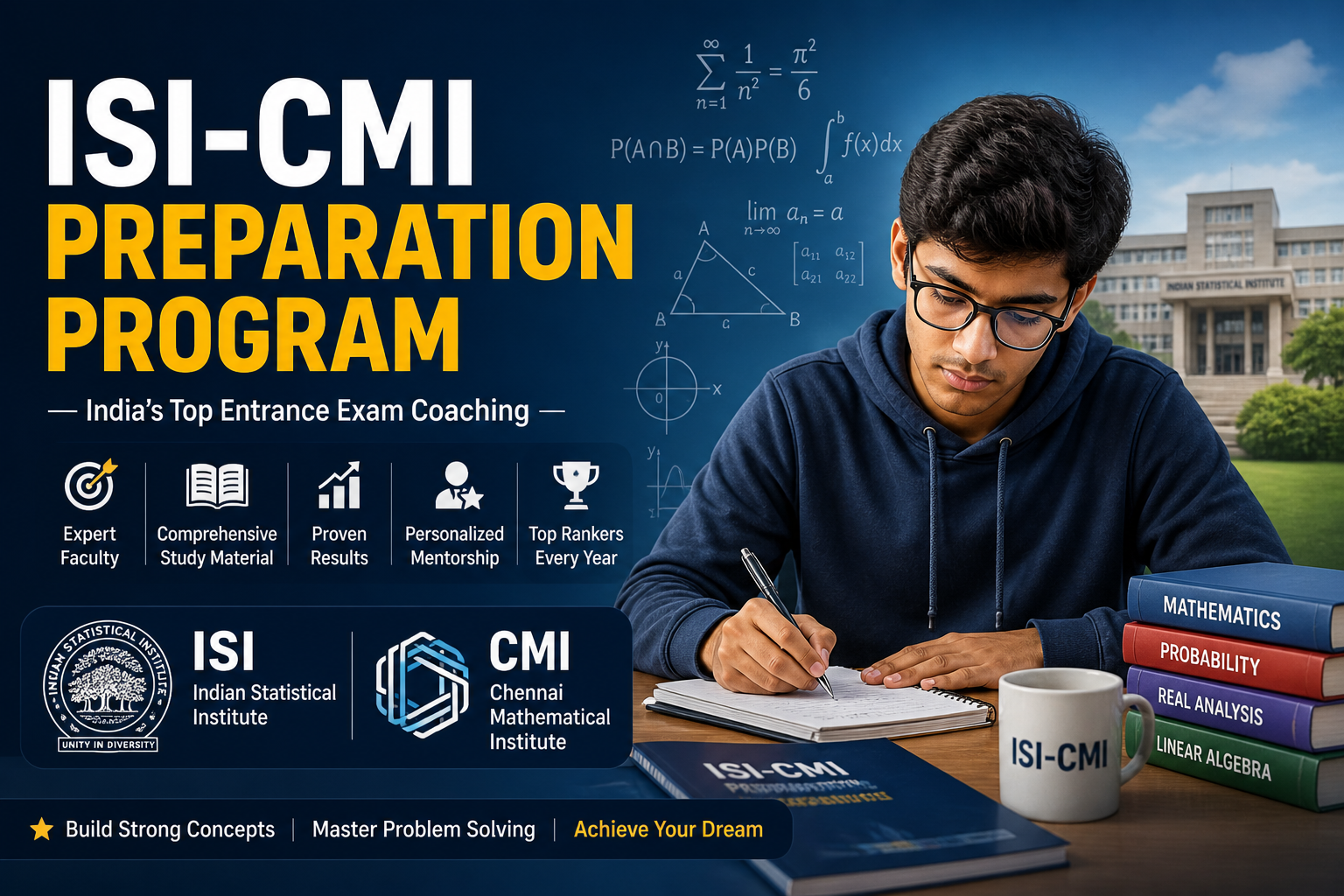
ISI and CMI Entrance Course 2027: B.Stat, B.Math and BSc Mathematics
- For
- Class 11 - Class 12
- Level
- Advanced
- Each week
- 4 hours
- Batch
- Small group, maximum 8
- Mode
- Online
- Board
- ISI, CMI
- Fee
- Free
The ISI and CMI entrance in one paragraph
The Indian Statistical Institute (ISI) and the Chennai Mathematical Institute (CMI) run the two hardest undergraduate mathematics entrances in India. ISI admits to B.Stat (Kolkata) and B.Math (Bangalore); CMI admits to BSc Mathematics and Computer Science and BSc Mathematics and Data Science. Both papers are written in May, both have an objective section and a subjective section, and both reward a kind of mathematics that school does not teach: you are asked to prove things, to construct counterexamples, and to solve problems you have never seen before. A student who has only practised board-exam questions will not pass, however strong their marks.
Who this course is for
This is a course for students in Class 11 and Class 12, and for droppers taking a second attempt, who intend to sit ISI and CMI in May 2027. You do not need olympiad medals to join. You do need genuine comfort with Class 10 algebra and geometry, and the willingness to spend time on a single problem without being told the method first. Students who have done RMO or INMO will find the first weeks familiar; students who have not will be brought up to that level deliberately.
What the papers actually demand
ISI B.Stat and B.Math
Paper 1 is UGA, thirty objective questions in two hours. Paper 2 is UGB, eight to ten subjective problems in two hours, of which you are expected to write complete solutions to a handful. The objective paper punishes slow arithmetic and rewards recognising structure. The subjective paper is marked on the proof, not the answer: a correct final number with no argument earns very little.
CMI
Part A is objective and short-answer. Part B is entirely subjective, typically six problems, and CMI is explicit that partial credit is given for genuine progress. CMI leans slightly more towards algebra and combinatorics; ISI leans slightly more towards inequalities and classical geometry. The overlap is large enough that one preparation serves both, which is why this course prepares for them together.
How the course runs
Thirty-two weeks, two live sessions a week, plus one full-length paper every fortnight. Sessions are ninety minutes and capped at eight students, so every student writes on the board and every proof gets read aloud and criticised. The first half of the course builds the four pillars: algebra, combinatorics, number theory and geometry. The second half is entirely past papers and timed practice, working backwards from the actual ISI and CMI papers of the last fifteen years.
Every fortnightly paper is marked by hand the way ISI marks: for the argument. You get the script back with the gaps circled, not just a score. This is the single most useful thing in the course, and it is the part students underestimate most at the start.
Proof writing, which is the real subject
Most students who fail ISI and CMI can solve more problems than their score suggests. They lose marks because they cannot write a proof that a reader will accept: they assert what needs justifying, they handle one case and ignore three, they write the discovery rather than the argument. A substantial part of every session is spent on writing. By week twelve students are expected to produce a proof that another student can read without the author explaining it, and by week twenty they are marking each other's work against the real scheme.
Topics covered
Algebra: polynomials and their roots, functional equations, inequalities from AM-GM through Cauchy-Schwarz, complex numbers and roots of unity. Combinatorics: bijections, recursions, the pigeonhole principle, generating functions and counting in two ways. Number theory: divisibility, congruences, Fermat and Euler, order and primitive roots, Diophantine equations. Geometry: classical Euclidean configurations, similar triangles and power of a point, coordinate and trigonometric methods. Calculus and analysis to the level ISI expects: limits, continuity, differentiability and the standard theorems, sequences and series.
Mock papers and the last eight weeks
From week twenty-four the course becomes an examination rehearsal. Students sit full ISI UGA and UGB papers and full CMI papers under real time pressure, in the same morning slot as the actual exam. Each paper is followed by a session that works only the problems the group failed, which is a more efficient use of time than reviewing problems most people solved. Students finish the course having written at least twelve full papers under timed conditions.
Interviews
B.Math and B.Stat shortlist candidates for interview. The interview is mathematical, not personal: you are given a problem and watched while you think. Students who reach the shortlist get interview sessions at no extra cost, run as one-to-one mock interviews with a written report on what the panel is likely to probe.
What students will be able to do
- Write complete, rigorous proofs that earn full marks on the ISI UGB and CMI Part B subjective papers
- Finish the ISI UGA objective paper inside two hours with time left to check
- Work confidently across all four pillars: algebra, combinatorics, number theory and classical geometry
- Handle functional equations, inequalities and roots of unity as routine techniques rather than special tricks
- Sit at least twelve full-length ISI and CMI past papers under real examination timing
- Recognise when a problem needs a bijection, an invariant, an extremal argument or induction
- Present mathematics at the B.Math and B.Stat interview under questioning from a panel
Course structure
- Weeks 1-2: Diagnosis and proof basics - A full diagnostic paper in week one, then what a proof is: direct, contrapositive, contradiction and induction, and how to write each so a marker accepts it.
- Weeks 3-6: Algebra I - Polynomials, roots and symmetric functions, the factor and remainder theorems, Vieta, and functional equations over the reals.
- Weeks 7-9: Number theory - Divisibility, gcd and the Euclidean algorithm, congruences, Fermat and Euler, order and primitive roots, and linear Diophantine equations.
- Weeks 10-13: Combinatorics - Counting in two ways, bijections, pigeonhole, inclusion-exclusion, recursions and an introduction to generating functions.
- Weeks 14-17: Geometry - Similar triangles, cyclic quadrilaterals, power of a point, the classical centres, and when to abandon synthetic methods for coordinates or trigonometry.
- Weeks 18-20: Algebra II and inequalities - AM-GM, Cauchy-Schwarz, rearrangement, complex numbers and roots of unity applied to geometry and counting.
- Weeks 21-23: Calculus and analysis - Limits, continuity, differentiability, the mean value theorem, sequences and series to the depth ISI expects.
- Weeks 24-28: ISI past papers - Full UGA and UGB papers from the last fifteen years, sat under timing and marked by hand on the argument.
- Weeks 29-31: CMI past papers - Full Part A and Part B papers, with the emphasis on partial credit and on writing progress clearly when a problem is not finished.
- Week 32: Final rehearsal and interview preparation - A last full paper in the real exam slot, then one-to-one mock interviews for shortlisted students.
Who this is for
Comfortable with Class 10 algebra and geometry. No olympiad experience required, though RMO or INMO exposure helps. Open to Class 11, Class 12 and droppers preparing for the May 2027 papers.
Students join this programme from India, United States, United Arab Emirates and Singapore.
Common questions
Do I need olympiad experience to join?
No. Students who have done RMO or INMO will find the first six weeks familiar, but the course assumes only Class 10 algebra and geometry and builds the olympiad techniques deliberately. What matters more than prior medals is willingness to sit with one problem for an hour.
Can one course really prepare for both ISI and CMI?
Yes, and it is the efficient way to do it. The syllabi overlap almost completely. ISI leans slightly towards inequalities and classical geometry, CMI slightly towards algebra and combinatorics, and the final eight weeks split into ISI papers and CMI papers so both formats are rehearsed separately.
When are the ISI and CMI 2027 exams?
Both are normally written in May. The course is built to finish its syllabus with eight weeks left for full past papers, so students reach the exam having already sat at least twelve timed papers. Confirm exact dates on the ISI and CMI websites when applications open.
What happens if I am shortlisted for the B.Math or B.Stat interview?
Interview preparation is included at no extra cost. It is run as one-to-one mock interviews: you are given a problem and questioned while you work, which is what the real panel does, and you get a written report on the areas they are likely to probe.
How are the fortnightly papers marked?
By hand, on the argument, the way ISI marks. A correct final answer with no justification earns very little, and genuine progress on an unfinished problem earns real credit. Scripts come back with the gaps in the reasoning circled rather than just a total.
Is this suitable for a dropper taking a second attempt?
Yes. Droppers usually know the topics and lose marks on proof writing and timing, which is where this course puts most of its effort. The diagnostic paper in week one is used to decide how much of the early material you can move through quickly.
How large are the classes?
Eight students at most. The format depends on it: every student writes on the board, reads a proof aloud and has it criticised, which is not possible in a large batch.
Book a trial
Three sessions with the mentor who would teach the full course. Nothing is charged until your slot is confirmed.
- A diagnostic, a taught class and written feedback
- Taught by the mentor who leads the course
- You pick the slot from our live calendar
- Pay only after the slot is confirmed
- For
- Class 11 - Class 12
- Level
- Advanced
- Each week
- 4 hours
- Batch
- Small group, maximum 8
- Mode
- Online
- Board
- ISI, CMI
- Fee
- Free
Ask a question, or book a trial
Tell us about the student and we will reply with an honest view of whether this programme fits. If you would like to see the teaching first, add a trial class.
- No obligation - send the enquiry without booking anything
- Three sessions if you do book: a diagnostic, a taught class and feedback
- Taught by the mentor who would lead the full course
- You choose the slots from our calendar after payment
| Class 1 to 5 | 3 sessions | INR 599 |
| Class 6 to 8 | 3 sessions | INR 799 |
| Class 9 and 10 | 3 sessions | INR 899 |
| Class 11 and 12 | 3 sessions | INR 999 |
| Graduation and above | 4 sessions | INR 1,099 |
Sending an enquiry is free. The fee applies only if you tick the trial box below.