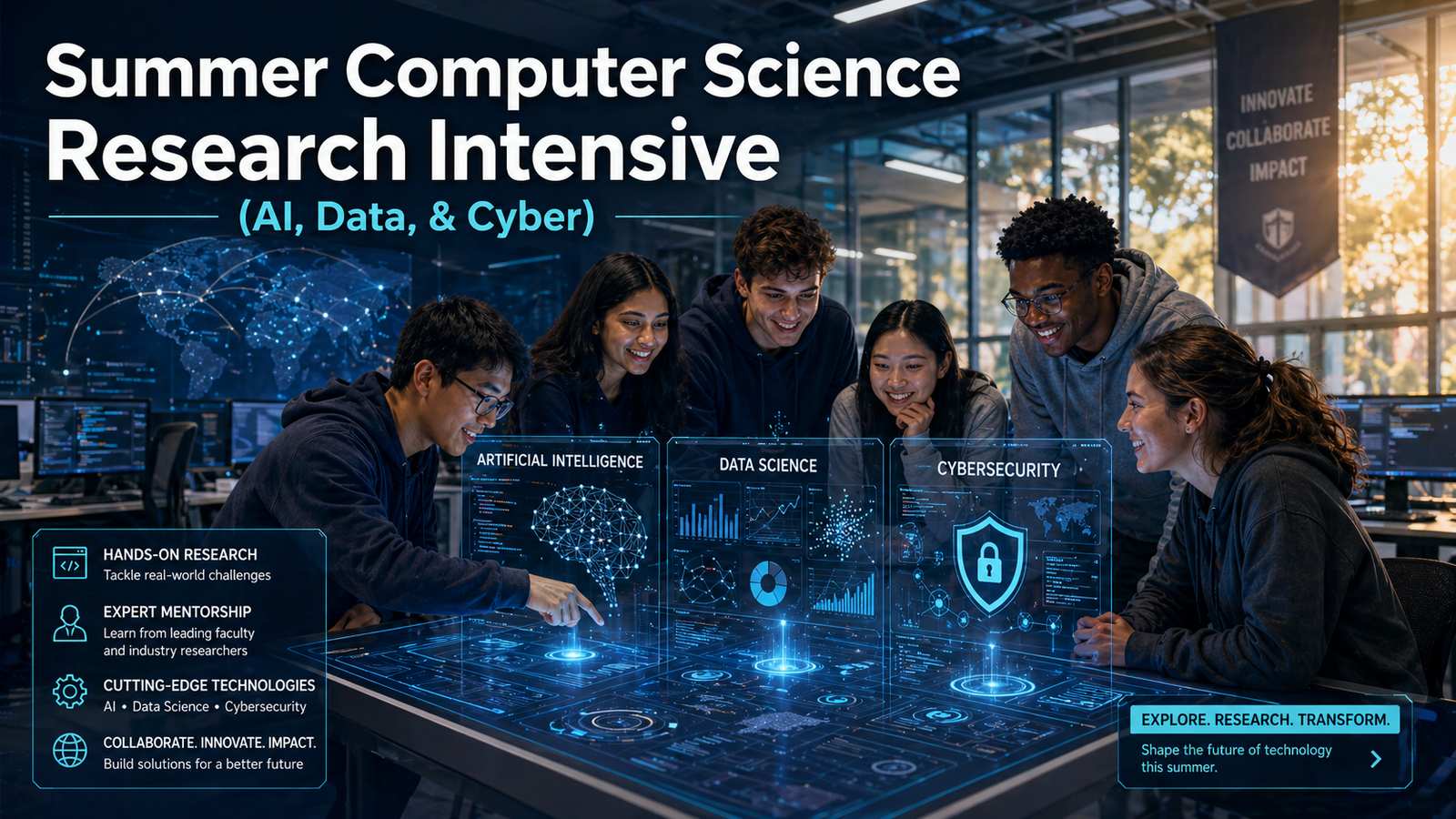
Summer Computer Science Research Intensive (AI, Data, & Cyber)
- Level
- Intermediate
- Duration
- 8 weeks
- Each week
- 6 hours
- Mode
- Online
- Fee
- Free
Beyond Coding: The Transition to Real CS Research
In the highly competitive landscape of global university admissions, simply knowing how to code in Python or Java is no longer enough to stand out. Top-tier computer science programs in the US, UK, Australia, and elite Indian institutes expect students to demonstrate initiative, critical thinking, and the ability to apply computational logic to unsolved problems.
The Edu Global Institute Summer Computer Science Research Intensive bridges the gap between high school coding classes and university-level research. This remote-first, globally connected program pairs ambitious students with expert mentors to execute, document, and present a rigorous, independent CS research project.
The Global Cohort Advantage
Innovation thrives on diverse perspectives. Our program operates in synchronized time zones across India, the United States, the United Kingdom, and Australia. Students not only work 1-on-1 with expert mentors but also collaborate, peer-review, and network with a curated cohort of elite international peers, building a global tech network before they even enter college.
Choose Your Research Track
We do not assign generic "summer projects." Students must select a specialized track and formulate a unique, testable research question.
Track 1: Artificial Intelligence & Machine Learning (ML)
- Focus: Natural Language Processing (NLP), Computer Vision, and Predictive Modeling.
- Sample Research: "Evaluating the Efficacy of Convolutional Neural Networks (CNNs) in Detecting Early-Stage Plant Leaf Diseases in Variable Lighting."
- Tools: Python, TensorFlow, PyTorch, Scikit-learn.
Track 2: Data Science & Big Data Analytics
- Focus: Data scraping, cleaning, statistical analysis, and algorithmic visualization.
- Sample Research: "A Sentiment Analysis of Global Financial News and Its Correlation to Short-Term Tech Stock Volatility."
- Tools: Pandas, NumPy, Matplotlib, R.
Track 3: Cybersecurity & Cryptography
- Focus: Network security, encryption algorithms, and vulnerability analysis.
- Sample Research: "Analyzing the Time-Complexity and Brute-Force Vulnerabilities of Modified RSA Encryption Algorithms."
- Tools: Python (Cryptography libraries), Wireshark, Linux environments.
Track 4: Computational Science & Bioinformatics
- Focus: Applying computational power to solve biological, environmental, or physical problems.
- Sample Research: "Simulating the Spread of Viral Pathogens Using Agent-Based Python Modeling and SIR Differential Equations."
- Tools: SciPy, BioPython, Agent-based simulation software.
The 8-Week Research Architecture
This program demands commitment. It is structured to mirror the exact process of publishing an academic paper in a peer-reviewed journal.
- Weeks 1-2: Literature Review & Proposal. Formulating a strict, testable research question.
- Weeks 3-5: Data Collection & Algorithm Design. Writing the code, training the models, and gathering datasets.
- Weeks 6-7: Analysis & Debugging. Interpreting the results, measuring error rates, and graphing data.
- Week 8: Final Deliverables & Symposium. Writing the final academic paper and defending the research.
Tangible University Deliverables
To ensure this program provides maximum ROI for college applications, every student leaves with a comprehensive portfolio:
- A Formatted Research Paper: Ready for submission to high school research journals or inclusion as a university application supplement.
- A Clean GitHub Repository: Documented, reproducible code proving technical competency.
- A Symposium Presentation Video: A recorded defense of the research, showcasing elite communication skills.
What students will be able to do
- Frame a research question narrow enough to complete in a single programme
- Carry out a literature review and cite sources correctly
- Produce original analysis rather than a summary of existing work
- Write up findings in the structure academic reviewers expect
- Prepare a submission for a recognised high-school research outlet
Common questions
Do students produce a publishable paper?
Students complete a full research paper. Whether it is accepted depends on the venue and the work itself; we prepare the submission but cannot guarantee publication.
What background is needed?
Comfort with the subject at Class 11 level and the discipline to work independently between sessions. Prior research experience is not required.
How long does a research project take?
Most take eight to twelve weeks from question to written paper. Rushing the literature review is the most common reason a project stalls.
Where can high-school research be submitted?
Options include the Journal of Emerging Investigators, journals run by universities, and science-fair routes such as ISEF affiliates.
Does research help university applications?
Admissions officers value demonstrated independent enquiry. A completed paper evidences that far better than a stated interest.
Book a trial
Three sessions with the mentor who would teach the full course. Nothing is charged until your slot is confirmed.
- A diagnostic, a taught class and written feedback
- Taught by the mentor who leads the course
- You pick the slot from our live calendar
- Pay only after the slot is confirmed
- Level
- Intermediate
- Duration
- 8 weeks
- Each week
- 6 hours
- Mode
- Online
- Fee
- Free
Ask a question, or book a trial
Tell us about the student and we will reply with an honest view of whether this programme fits. If you would like to see the teaching first, add a trial class.
- No obligation - send the enquiry without booking anything
- Three sessions if you do book: a diagnostic, a taught class and feedback
- Taught by the mentor who would lead the full course
- You choose the slots from our calendar after payment
| Class 1 to 5 | 3 sessions | INR 599 |
| Class 6 to 8 | 3 sessions | INR 799 |
| Class 9 and 10 | 3 sessions | INR 899 |
| Class 11 and 12 | 3 sessions | INR 999 |
| Graduation and above | 4 sessions | INR 1,099 |
Sending an enquiry is free. The fee applies only if you tick the trial box below.