
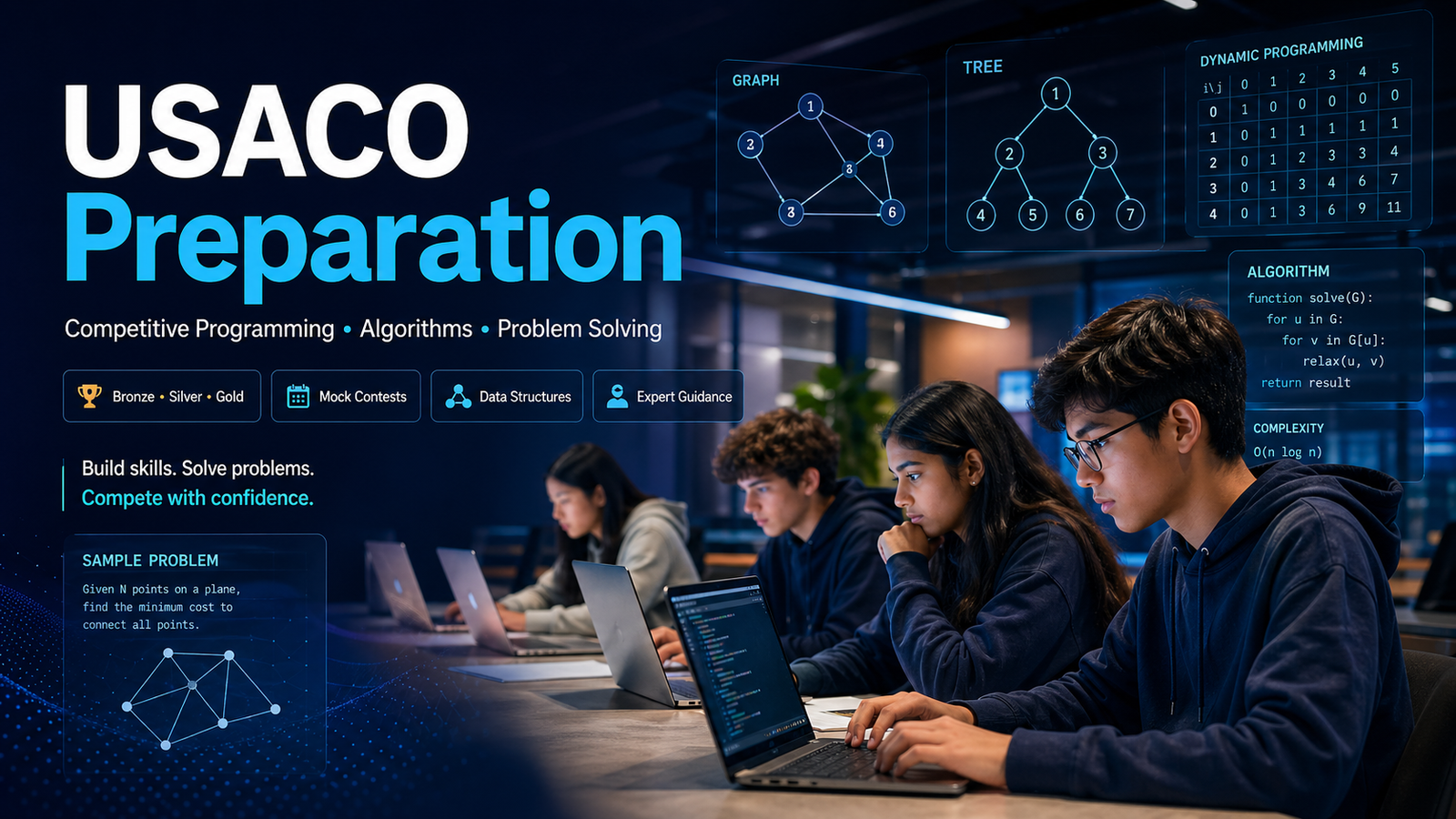
Elite USACO Masterclass: Bronze to Platinum Algorithmic Training
- For
- Class 9 - Class 12
- Level
- Intermediate
- Duration
- 16 weeks
- Each week
- 3 hours
- Mode
- Online
- Fee
- Free
The Competitive Edge: Why USACO Defines Elite CS Admissions
In the hyper-competitive landscape of global university admissions, simply knowing how to write Python or Java is no longer a differentiator. For students targeting elite Computer Science programs at institutions like MIT, Stanford, Carnegie Mellon, and the Ivy League, admissions officers look for Intellectual Vitality. Achieving a Silver, Gold, or Platinum ranking in the USA Computing Olympiad (USACO) is arguably the most powerful signal a high school student can send.
At Edu Global Institute, our USACO Masterclass is not a standard coding camp. It is a rigorous, strategic training ground taught by competitive programming experts. We transition students from writing basic syntax to mastering advanced data structures, graph theory, and Big O time-complexity optimization.
The Edu Global Methodology: Coding to Win
USACO does not test if you can write code; it tests if you can write efficient code under extreme pressure. Our curriculum teaches students how to map problem descriptions to algorithmic patterns, avoiding the dreaded "Time Limit Exceeded" (TLE) errors. We fully support both C++ (the industry standard for competitive programming speed) and Python.
The Four-Tiered Syllabus Architecture
Phase 1: The Bronze Foundation (Algorithmic Basics)
Goal: Escaping brute-force limitations and building competitive stamina.
- Language Mastery & I/O: Optimizing input/output operations for contest environments.
- Fundamental Logic: Complete Search (brute force with pruning), greedy algorithms, and comprehensive simulation.
- Data Structures: Mastering dynamic arrays, strings, sets, and hash maps.
- Time Complexity (Big O Notation): Understanding why an O(N^2) solution fails where an O(N log N) solution succeeds.
Phase 2: The Silver Breakthrough (Intermediate Algorithms)
Goal: Transitioning to structural logic and graph traversal. Historically, reaching Silver places students in the top tier of high school programmers.
- Graph Theory 101: Breadth-First Search (BFS) and Depth-First Search (DFS) on trees and grids. Flood fill algorithms.
- Optimization Techniques: Two-pointers, sliding windows, and prefix sums for rapid range queries.
- Custom Sorting & Binary Search: Binary searching on the answer (monotonic functions).
Phase 3: The Gold Standard (Advanced Complexity)
Goal: Combining multiple algorithmic concepts to solve multi-layered problems. Reaching Gold makes a student a highly recruited Ivy League CS candidate.
- Dynamic Programming (DP): Memoization, tabulation, Knapsack variations, and DP on trees.
- Advanced Graph Algorithms: Shortest path algorithms (Dijkstra's, Bellman-Ford), Minimum Spanning Trees (Prim's, Kruskal's), and Topological Sorting.
- Advanced Data Structures: Disjoint Set Union (DSU) and basic Segment Trees.
- Number Theory & Math: Modular arithmetic, combinatorics, and prime factorization algorithms.
Phase 4: The Platinum Pinnacle (Elite Level)
Goal: For the top 1% of competitive programmers globally. Platinum competitors are routinely recruited by FAANG companies before entering college.
- Highly Advanced Data Structures: 2D Segment trees, Fenwick Trees (BITs), and Heavy-Light Decomposition.
- Advanced DP Optimization: Convex hull trick and divide-and-conquer DP.
- Complex Computational Geometry: Line sweeps and convex hulls.
- Elite Problem Decomposition: Combining multiple advanced theorems into a single, highly optimized, memory-efficient solution.
Beyond the Code: Your USACO Success Strategy
We provide weekly mock contests, live debugging sessions, and personalized post-contest analysis to identify exactly where a student's logic broke down. Don't just dream of USACO success—engineer it.
What students will be able to do
- Solve problems at Bronze, Silver and Gold difficulty within the four-hour contest window
- Implement sorting, prefix sums, binary search, graph traversal and dynamic programming
- Analyse time complexity well enough to pass the USACO limits rather than time out
- Write and debug in C++, Java or Python under contest conditions
- Work through past USACO papers with full editorial reasoning
Common questions
What are the USACO divisions?
Four: Bronze, Silver, Gold and Platinum. Everyone starts at Bronze and is promoted by scoring highly within a contest window.
Which language should a student use?
C++, Java and Python are all accepted. C++ is the most common at Gold and Platinum because of its speed, but Bronze and Silver are comfortable in Python.
How long is a contest?
Four hours from the moment the student opens the problems, within a multi-day window. There are usually three problems per contest.
Is prior competitive programming needed?
No. Bronze assumes basic programming ability, such as loops, arrays and functions, rather than any contest experience.
How many contests run each year?
Four: December, January, February and the US Open in March. Promotion can happen at any of them.
Book a trial
Three sessions with the mentor who would teach the full course. Nothing is charged until your slot is confirmed.
- A diagnostic, a taught class and written feedback
- Taught by the mentor who leads the course
- You pick the slot from our live calendar
- Pay only after the slot is confirmed
- For
- Class 9 - Class 12
- Level
- Intermediate
- Duration
- 16 weeks
- Each week
- 3 hours
- Mode
- Online
- Fee
- Free
Ask a question, or book a trial
Tell us about the student and we will reply with an honest view of whether this programme fits. If you would like to see the teaching first, add a trial class.
- No obligation - send the enquiry without booking anything
- Three sessions if you do book: a diagnostic, a taught class and feedback
- Taught by the mentor who would lead the full course
- You choose the slots from our calendar after payment
| Class 1 to 5 | 3 sessions | INR 599 |
| Class 6 to 8 | 3 sessions | INR 799 |
| Class 9 and 10 | 3 sessions | INR 899 |
| Class 11 and 12 | 3 sessions | INR 999 |
| Graduation and above | 4 sessions | INR 1,099 |
Sending an enquiry is free. The fee applies only if you tick the trial box below.