Quantum Physics Learning Programme
- For
- Class 9 - Class 12
- Level
- Intermediate
- Duration
- 16 weeks
- Each week
- 3 hours
- Mode
- Online
- Fee
- Free
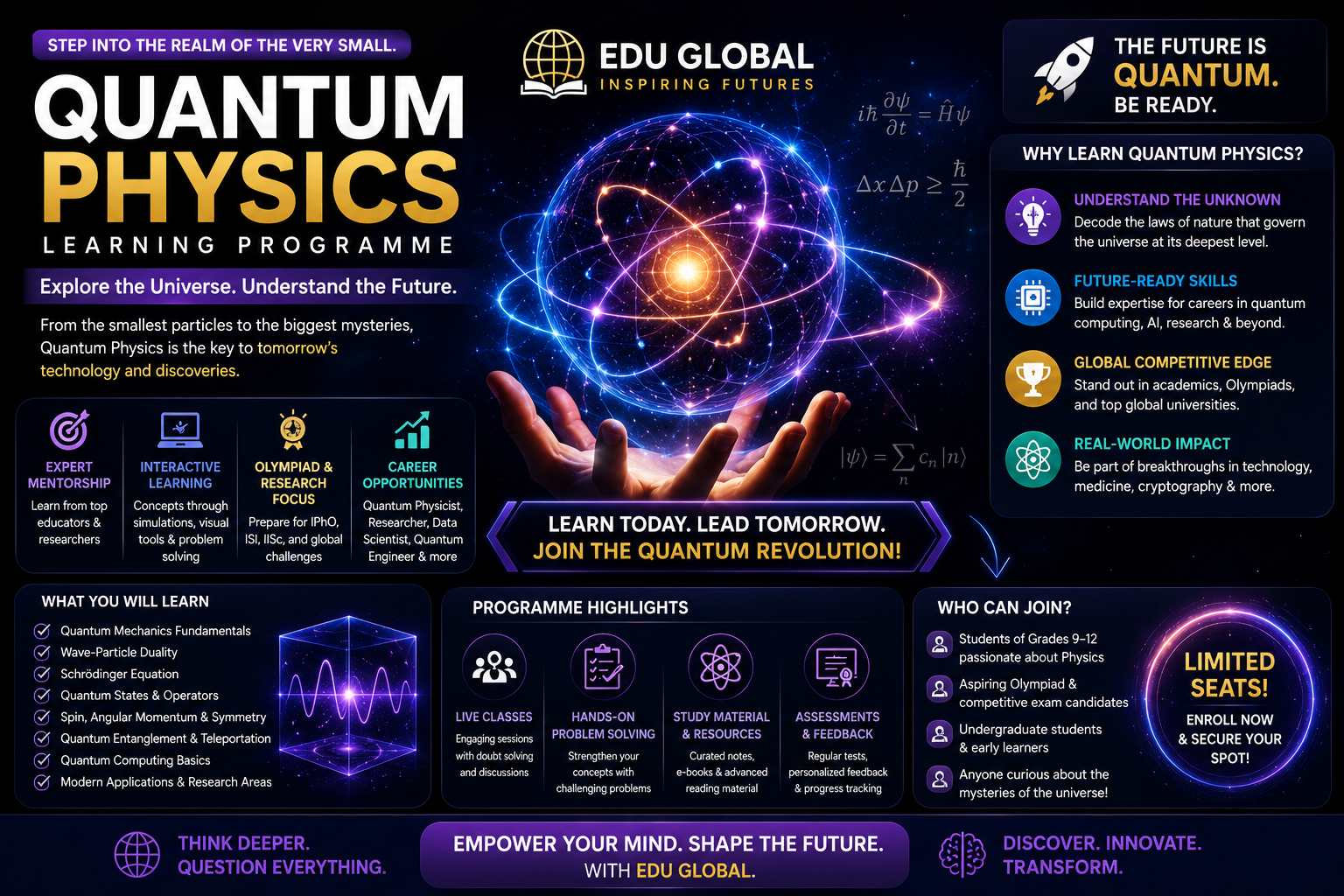
Quantum Physics & Computing Learning Programme
Bridge the gap between deep theoretical quantum mechanics and cutting-edge computational algorithms. Build a future-proof career in the next paradigm of technology with elite global certification.
Program Overview
The global quantum technology ecosystem is undergoing an unprecedented shift. No longer confined to theoretical academic loops, quantum systems are actively disrupting cryptography, financial modeling, molecular simulations, and machine learning architectures.
The Edu Global Institute Quantum Physics Learning Programme is a mathematically rigorous, industry-aligned training framework. Guided by expert physicists and computer scientists, this syllabus takes you seamlessly from quantum baselines up to deploying active algorithms on cloud-based quantum hardware simulators.
Why Train With Edu Global Institute?
Simulated Cloud Labs
Go beyond theory. Program and execute live quantum circuits using open-source SDKs and quantum cloud simulators.
Professional Certification
Earn a blockchain-verifiable Quantum Specialist Credential recognized globally by tech enterprises and research tracks.
Flexible Hybrid Design
Access on-demand foundational models alongside high-intensity weekend mastery sessions tailored for working professionals.
Curriculum & Detailed Syllabus
Module 1: Foundations of Quantum Mechanics & Mathematics Baseline
Objective: Master the fundamental mathematical language of the quantum universe.
- Linear Algebra Foundations: Hilbert Spaces, Bra-Ket (Dirac) notation, Operators, and Eigenstates.
- Wave Mechanics & Historical Baselines: Wave-particle duality, De Broglie relations, and the Photoelectric effect.
- The Schrödinger Equation: Time-dependent and time-independent forms applied to potential wells.
- Postulates of Quantum Mechanics: Superposition principles, state vectors, and the measurement problem.
Module 2: Quantum Information Theory & Qubit Architectures
Objective: Transition from classical bits to quantum information systems.
- The Qubit Paradigm: Geometry of the Bloch Sphere and state visualization.
- Multi-Qubit Systems: Quantum entanglement, Bell States, and composite space tensor products.
- Quantum Logic Gates: Single-qubit operations (Pauli X, Y, Z, Hadamard, Phase) and multi-qubit controls (CNOT, Toffoli).
- Hardware Topologies Overview: Superconducting qubits, trapped ions, and photonic network platforms.
Module 3: Advanced Quantum Algorithms & Architecture
Objective: Learn to design, program, and scale mathematical quantum routines.
- Quantum Parallelism: Harnessing constructive interference for exponential computational scale.
- Deutsch-Jozsa and Simon’s Algorithms: Structural proofs of quantum advantage.
- Shor’s Algorithm: Period finding, Quantum Fourier Transform (QFT), and implications for modern RSA cryptography.
- Grover’s Search Algorithm: Quadratic acceleration protocols for unstructured data parsing.
- Variational Quantum Eigensolvers (VQE) and Optimization Tools for NISQ-era devices.
Module 4: Real-World Industry Applications & Cryptography
Objective: Deploy quantum solutions to real market bottlenecks.
- Quantum Key Distribution (QKD): Bulletproof secure networks using the BB84 communication protocol.
- Post-Quantum Cryptography (PQC): Building defenses against systemic decryption vectors.
- Quantum Machine Learning: Feature mapping, quantum-enhanced neural structures, and classification maps.
- Molecular & Material Simulations: Accelerating drug discovery paths and solid-state physics modeling.
Ready to Pivot to the Quantum Era?
Seats are tightly capped to ensure direct computational access and elite project mentorship. Secure your baseline roadmap review today.
Apply for Enrollment →Book a trial
Three sessions with the mentor who would teach the full course. Nothing is charged until your slot is confirmed.
- A diagnostic, a taught class and written feedback
- Taught by the mentor who leads the course
- You pick the slot from our live calendar
- Pay only after the slot is confirmed
- For
- Class 9 - Class 12
- Level
- Intermediate
- Duration
- 16 weeks
- Each week
- 3 hours
- Mode
- Online
- Fee
- Free
Ask a question, or book a trial
Tell us about the student and we will reply with an honest view of whether this programme fits. If you would like to see the teaching first, add a trial class.
- No obligation - send the enquiry without booking anything
- Three sessions if you do book: a diagnostic, a taught class and feedback
- Taught by the mentor who would lead the full course
- You choose the slots from our calendar after payment
| Class 1 to 5 | 3 sessions | INR 599 |
| Class 6 to 8 | 3 sessions | INR 799 |
| Class 9 and 10 | 3 sessions | INR 899 |
| Class 11 and 12 | 3 sessions | INR 999 |
| Graduation and above | 4 sessions | INR 1,099 |
Sending an enquiry is free. The fee applies only if you tick the trial box below.