
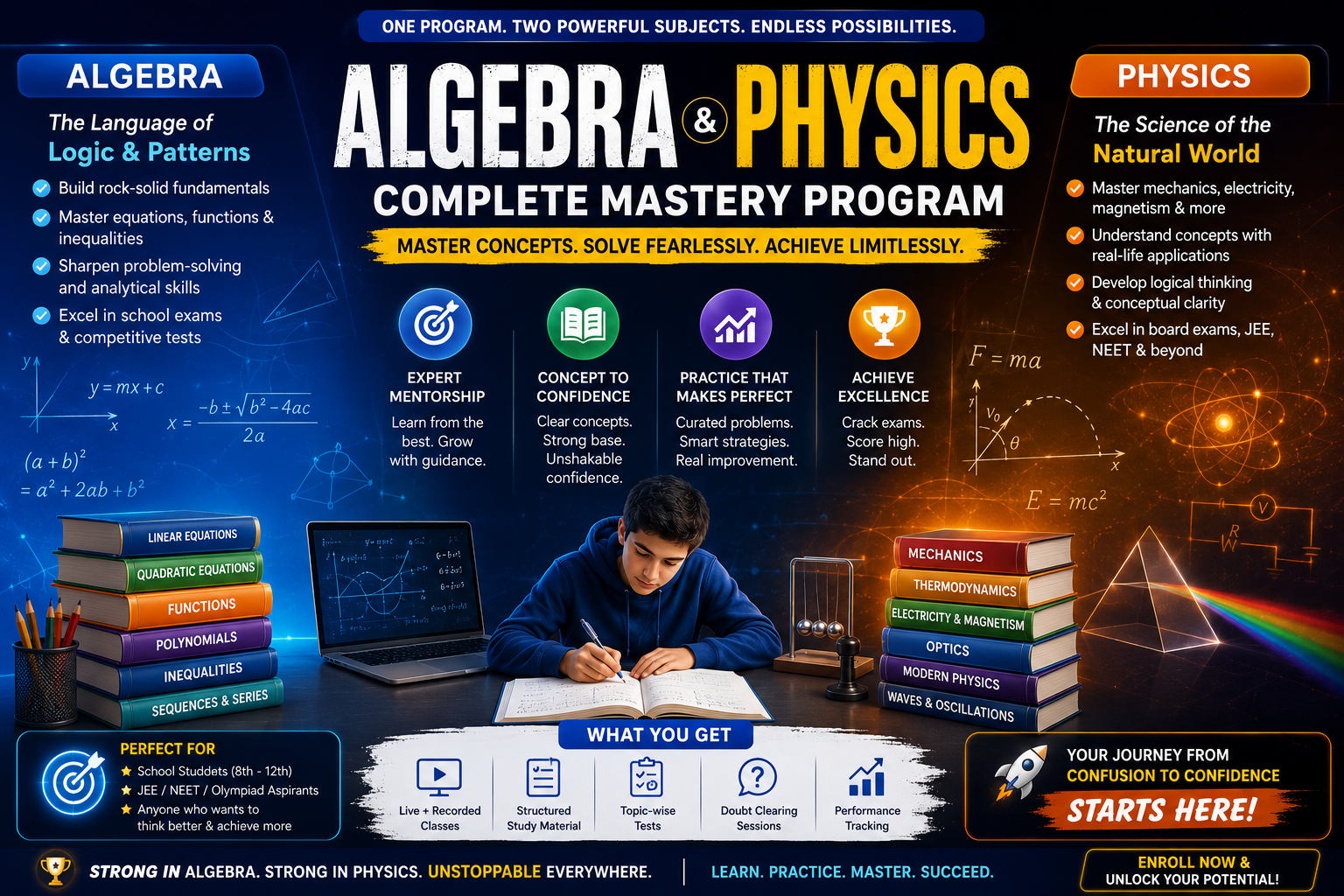
Algebra Physics Complete Mastery Program
- For
- Class 9 - Class 12
- Level
- Intermediate
- Duration
- 16 weeks
- Each week
- 3 hours
- Mode
- Online
- Fee
- Free
Master Algebra Physics — From Zero to Hero in 40 Weeks
The most comprehensive, research-based algebra physics program designed for students with no calculus background. Covers the entire AP Physics 1 + AP Physics 2 syllabus with 100% free digital tools, hands-on labs, and zero topic omissions.
Course Overview
Algebra Physics Complete Mastery is a rigorous, two-semester program that teaches introductory physics entirely through algebra and trigonometry. Built for high school students, homeschoolers, and adult learners, this course bridges the gap between "I've never done physics" and "I'm ready for AP Physics or college-level STEM."
- No calculus required: Only Algebra II & Geometry
- 25 fully-researched chapters: Zero topic gaps
- 100% free teaching tools: PhET, Physics Classroom, Khan Academy, HyperPhysics
- Hands-on labs: Using household items + smartphone sensors
- AP Physics Aligned: Covers AP Physics 1 & 2 curriculum
What You Will Learn
- Solve any 1D or 2D kinematics problem using the five kinematic equations
- Draw and analyze free-body diagrams for complex multi-object systems
- Apply Newton's Three Laws to inclined planes, pulleys, circular motion, and orbits
- Use conservation of energy and momentum to solve collision and explosion problems
- Analyze rotational motion, torque, and angular momentum
- Explain wave behavior, standing waves, and the Doppler effect mathematically
- Solve DC circuit problems using Ohm's Law and Kirchhoff's Rules
- Calculate electric fields, potentials, and capacitor energy
- Apply the laws of thermodynamics and ideal gas behavior
- Trace light rays through mirrors and lenses using the thin-lens equation
- Explain quantum phenomena: photoelectric effect, Bohr model, wave-particle duality
- Calculate radioactive decay, half-life, and nuclear binding energy
- Understand special relativity: time dilation, length contraction, E=mc²
Complete Module Breakdown (25 Chapters | 40 Weeks)
Semester 1: Mechanics, Fluids & Waves (20 Weeks)
Module 0 — Math Foundations for Physics (2 Weeks)
- Scientific notation, SI prefixes, unit conversions
- Algebraic manipulation, literal equations, inverse-square relationships
- Right-triangle trigonometry (SOH CAH TOA)
- Vectors: components, addition, resultant magnitude/direction
Module 1 — Introduction to Physics (1 Week)
- Scientific method, models vs. theories vs. laws
- SI units, dimensional analysis, uncertainty & error propagation
- Problem-solving methodology (GUESS method)
Module 2 — One-Dimensional Kinematics (2 Weeks)
- Position, displacement, velocity, acceleration
- Position-time, velocity-time, acceleration-time graphs
- Five kinematic equations for constant acceleration
- Free-fall motion, symmetry, g on other planets
Module 3 — Vectors & Two-Dimensional Kinematics (2 Weeks)
- Coordinate systems, component method
- Projectile motion: independence of horizontal/vertical motion
- Trajectory equation, time of flight, max height, range
- Uniform circular motion & relative velocity
Module 4 — Newton's Laws of Motion (2 Weeks)
- Newton's Three Laws & Free-body diagrams
- Complete force catalog: gravity, normal, friction, tension, spring
- Atwood machines, inclined planes, elevators, multi-body systems
Module 5 — Forces in Two Dimensions (1 Week)
- Equilibrium conditions: ΣFx=0, ΣFy=0
- Non-equilibrium with angled forces
- Advanced friction & Pulley systems
Module 6 — Work, Energy & Power (2 Weeks)
- Work: W=Fdcosθ, Work-Energy Theorem
- Kinetic energy & Gravitational/elastic potential energy
- Conservation of mechanical energy & Power
Module 7 — Linear Momentum & Collisions (1 Week)
- Momentum, impulse, force-time graphs
- Conservation of linear momentum
- Elastic, inelastic, perfectly inelastic collisions & explosions
Module 8 — Circular Motion & Gravitation (2 Weeks)
- Centripetal force sources & Vertical circular motion
- Newton's Law of Universal Gravitation
- Kepler's Three Laws & Orbital velocity
Module 9 — Rotational Motion & Torque (2 Weeks)
- Angular kinematics & Torque (τ=rFsinθ)
- Moment of inertia & Newton's Second Law for rotation
- Rotational kinetic energy & Angular momentum conservation
Module 10 — Simple Harmonic Motion (1 Week)
- SHM characteristics: amplitude, period, frequency
- Mass on spring & Simple pendulum equations
- Damped & driven oscillations, resonance
Module 11 — Mechanical Waves & Sound (2 Weeks)
- Wave types, Wave equation, behavior at boundaries
- Superposition, interference, standing waves
- Sound waves, Doppler effect, intensity
Module 12 — Fluid Mechanics (2 Weeks)
- Density, pressure, Pascal's principle
- Archimedes' Principle & buoyancy
- Ideal fluid flow, continuity equation, Bernoulli's equation
Semester 2: E&M, Thermodynamics, Optics & Modern Physics (20 Weeks)
Module 13 — Static Electricity & Charge (1 Week)
- Electric charge, conductors, insulators
- Coulomb's Law & superposition of electric forces
- Electric field lines & Faraday cages
Module 14 — Electric Potential & Capacitance (1 Week)
- Electric potential energy & voltage
- Equipotential surfaces
- Capacitors: capacitance, energy storage, dielectrics
Module 15 — Electric Circuits (2 Weeks)
- Current, resistance, Ohm's Law
- Series & parallel combination circuits
- Kirchhoff's Junction & Loop Rules
- RC circuits
Module 16 — Magnetism (2 Weeks)
- Magnetic poles & Earth's magnetic field
- Lorentz force on moving charges
- Magnetic field sources: wire, loop, solenoid
Module 17 — Electromagnetic Induction (1 Week)
- Magnetic flux, Faraday's Law, Lenz's Law
- Motional EMF & self-inductance
- AC basics & transformers
Module 18 — Temperature & Heat (1 Week)
- Temperature scales & thermal expansion
- Internal energy, specific heat, calorimetry
- Latent heat of fusion & vaporization
Module 19 — Thermodynamics (2 Weeks)
- Ideal Gas Law & kinetic theory of gases
- First Law of Thermodynamics & PV diagrams
- Second Law, entropy, Carnot efficiency
Module 20 — Reflection & Mirrors (1 Week)
- Law of reflection & plane mirrors
- Spherical mirrors: concave & convex
- Ray tracing & image characteristics
Module 21 — Refraction & Lenses (2 Weeks)
- Index of refraction, Snell's Law, dispersion
- Total internal reflection & fiber optics
- Thin lenses: converging & diverging, lens equation
Module 22 — Physical Optics (1 Week)
- Interference: Young's double-slit, thin films
- Diffraction & Diffraction gratings
- Polarization & Malus's Law
Module 23 — Quantum Physics (2 Weeks)
- Planck's quantum hypothesis & Photoelectric effect
- Wave-particle duality & de Broglie wavelength
- Atomic spectra & Bohr model
Module 24 — Atomic & Nuclear Physics (2 Weeks)
- Atomic structure, isotopes, nuclear forces
- Binding energy, mass defect, E=mc²
- Radioactivity (alpha, beta, gamma) & Half-life
- Nuclear fission & fusion
Module 25 — Special Relativity (1 Week)
- Postulates of special relativity
- Time dilation & length contraction
- Relativistic momentum & mass-energy equivalence
Free Tools & Resources Included (Zero Additional Cost)
Every student receives unlimited access to our curated toolkit:
- Simulations: PhET Interactive Simulations, Physics Classroom, HyperPhysics, oPhysics, Falstad Circuit Simulator
- Textbooks & Courses: OpenStax College Physics, Khan Academy Physics, CK-12 Physics, MIT OpenCourseWare
- Mobile Lab Tools: phyphox (Smartphone sensor suite), Physics Toolbox Suite, Tracker Software, Audacity
- Video Channels: Veritasium, MinutePhysics, Flipping Physics, Professor Dave Explains
What students will be able to do
- Apply Newtonian mechanics to unfamiliar situations rather than standard templates
- Use algebra and vectors fluently in a physical context
- Set up problems from a physical description instead of a formula
- Check answers by dimensional analysis and limiting cases
- Progress from school questions to olympiad-style reasoning
Common questions
What level does this start from?
Class 9 to 10 physics. The emphasis is on reasoning from principles rather than memorising formulae.
Is calculus required?
Not at the start. Calculus is introduced where it genuinely simplifies a problem, typically in later modules.
Does this prepare for physics olympiads?
It builds the mechanics foundation that F=ma and NSEP assume. Dedicated olympiad training follows.
How is problem solving taught?
By working from the physical situation to the equations, so the method transfers to problems never seen before.
What mathematics is assumed?
Algebra, trigonometry and vectors at Class 10 level.
Book a trial
Three sessions with the mentor who would teach the full course. Nothing is charged until your slot is confirmed.
- A diagnostic, a taught class and written feedback
- Taught by the mentor who leads the course
- You pick the slot from our live calendar
- Pay only after the slot is confirmed
- For
- Class 9 - Class 12
- Level
- Intermediate
- Duration
- 16 weeks
- Each week
- 3 hours
- Mode
- Online
- Fee
- Free
Ask a question, or book a trial
Tell us about the student and we will reply with an honest view of whether this programme fits. If you would like to see the teaching first, add a trial class.
- No obligation - send the enquiry without booking anything
- Three sessions if you do book: a diagnostic, a taught class and feedback
- Taught by the mentor who would lead the full course
- You choose the slots from our calendar after payment
| Class 1 to 5 | 3 sessions | INR 599 |
| Class 6 to 8 | 3 sessions | INR 799 |
| Class 9 and 10 | 3 sessions | INR 899 |
| Class 11 and 12 | 3 sessions | INR 999 |
| Graduation and above | 4 sessions | INR 1,099 |
Sending an enquiry is free. The fee applies only if you tick the trial box below.