
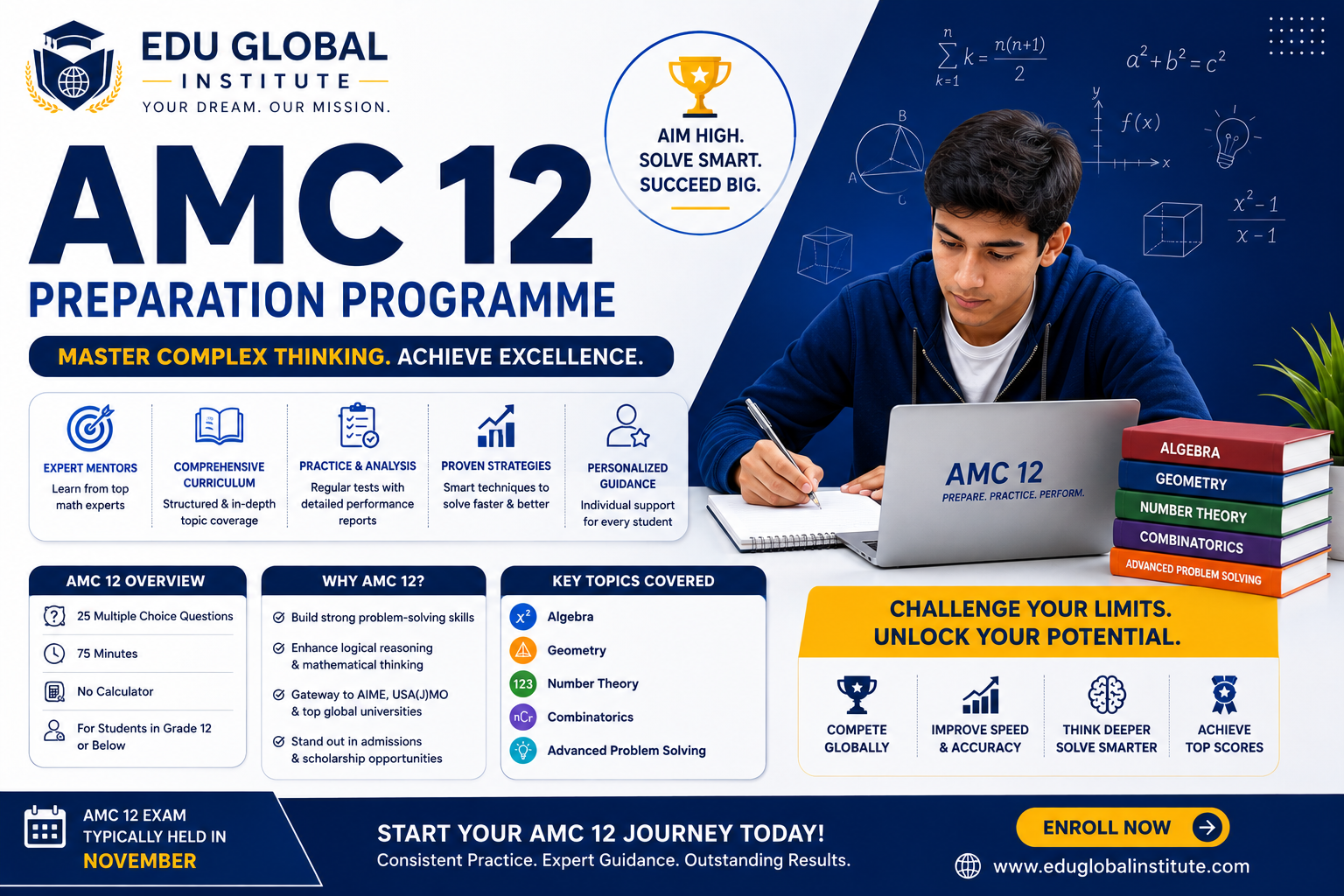
AMC 12 Preparation Course: The Route to AIME and USAMO
- For
- Class 11 - Class 12
- Level
- Advanced
- Duration
- 24 weeks
- Each week
- 3 hours
- Batch
- 1-on-1 or small group of 2-6
- Mode
- Online
85 points, and a fixed target for the first time
From the 2026-27 cycle the MAA sets fixed AIME qualification thresholds rather than percentile cutoffs. On the AMC 12 the threshold is 85 points — fifteen below the AMC 10 threshold, because the AMC 12 paper is harder and the qualifying pool has always been proportionally larger.
85 out of 150 is roughly 14 correct answers with the remaining questions left blank, or 13 correct with a careful blanking strategy. Put that way, the AMC 12 is a more achievable route to the AIME than most students assume — and it is the only route to the USA Mathematical Olympiad.
AMC 12 2026 dates and deadlines
- AMC 12A — Thursday 5 November 2026
- AMC 12B — Friday 13 November 2026
- Registration closes — 15 October 2026 (late deadline 28 October, returning competition managers only)
- AIME I and II — 5 and 6 February 2027, at Pearson test centres
Both sittings may be entered and only the higher score counts. A student in Grade 10 who is eligible for both papers should think carefully about which to take: the AMC 10 threshold is higher, but the paper is easier, and the AMC 12 is the only one that leads to the USAMO.
Format, scoring and eligibility
25 multiple-choice questions in 75 minutes, no calculator, scored 6 / 1.5 / 0 for correct, blank and wrong. Open to students in Grade 12 and below who are under 19.5 years of age on the day.
The blank rule carries more weight here than on the AMC 10, precisely because 85 is reachable without answering everything. A student who secures fourteen questions and leaves the rest blank scores 84 plus 16.5 from eleven blanks — comfortably past the threshold. Understanding that arithmetic changes how the paper is sat.
What the AMC 12 adds over the AMC 10
The AMC 12 covers the entire high-school curriculum short of calculus. Beyond the AMC 10 syllabus it adds:
- Trigonometry — identities, the laws of sines and cosines, equations
- Logarithms and exponentials — change of base, logarithmic equations
- Complex numbers — polar form, De Moivre, roots of unity
- Advanced algebra — polynomial theory, Vieta's relations on higher-degree equations, sequences and series
- Conic sections and analytic geometry
- Deeper combinatorics and number theory — recursions, generating-function ideas, modular techniques
Roots of unity and polynomial manipulation deserve particular attention. They appear repeatedly in the 15-to-22 band, they are rarely taught properly in school, and they are where a well-prepared student picks up the marks that a merely capable one leaves behind.
The pathway beyond
Qualifying for the AIME opens the route that runs through the USAMO — for AMC 12 students — or the USAJMO for AMC 10 students, and from there to the International Mathematical Olympiad. Admissions offices at competitive universities read AMC and AIME results as one of the few genuinely comparable signals of mathematical ability across school systems, which is why the competition matters well beyond the mathematics itself.
What we do differently: diagnosis, not just mocks
Setting mock papers is the easy part. The programme is built around what happens after each one. Every wrong or blank answer is classified by cause — concept gap, careless slip, slow method, misread, or poor question selection — and the following week is planned from that classification rather than from a generic syllabus.
The practice engine on this site records per-question timing, so "you are too slow on geometry" becomes a measured fact rather than an impression. A student targeting 85 who is losing ten marks a paper to arithmetic slips has a completely different next month from one who genuinely cannot handle complex numbers, and treating them the same is why a lot of preparation stalls.
Each student keeps a running error log across every mock. The pattern is usually clear within a handful of papers, and it is what the sessions are then built around.
A realistic timeline
Six to twelve months of structured preparation gives the strongest results. For a student aiming at 85 rather than a perfect score, the most productive final phase is not new material at all — it is timed papers, error-log review, and deciding in advance which questions to leave. That last decision is worth more marks than almost any topic revision.
How the programme runs
Two to three live sessions a week, each one hour. The AMC 12 is a 75-minute paper, so sessions build from technique work to full-length timed papers as the contest approaches. Sessions are scheduled around Indian, Gulf and UK evenings, and every one is recorded so a missed class is never a lost week.
You choose the format that suits the student:
- One-to-one — the whole hour is spent on this student's specific weaknesses. Suits a student with an uneven profile, or one preparing on a short timeline.
- Small group of two to six — students see how others attack the same problem, which is often how a faster method is learned. Costs the same per session.
Rs 650 per session. At two sessions a week that is about Rs 5,200 a month; at three, about Rs 7,800. You pay for the sessions you take. There is no admission fee, no material fee and no annual lock-in, which is unusual in this market — most AMC 12 programmes sell a fixed cohort of eight to sixteen classes for a single upfront payment of well over Rs 50,000.
What is included
- Two to three live hours a week with a coach who has worked through these papers
- Recordings of every session
- The full practice bank on this site, with worked solutions to every question
- A written diagnostic after each mock, naming what to fix and in what order
- Marked homework between sessions — the work between classes is where the score moves
- Guidance on registration, which for most families is the confusing part
Registration is separate from tuition
The MAA does not register individual students. Entry runs through a school or an approved test centre with a competition manager. If the student's school does not offer the AMC 12, we will help find a centre that does — this catches out a large number of well-prepared students every year, and it is worth sorting out months before the deadline rather than in the final week.
Start with a free trial session
The first session is free and is a working session, not a sales call. The student sits a short diagnostic, we mark it together, and you leave with a written view of where the score currently stands and what would move it fastest. If the programme is not right for the student, we will say so.
What students will be able to do
- Reach the fixed AIME qualification threshold of 85 points
- Handle all 25 problems inside the 75-minute limit
- Work confidently with trigonometry, logarithms and complex numbers, which the AMC 10 excludes
- Use roots of unity and polynomial theory, which recur in the 15-22 band and are rarely taught in school
- Apply the 6 / 1.5 / 0 scoring rule to reach 85 without answering every question
- Classify every lost mark by cause and plan the next week from the diagnosis
- Understand the route through AIME to the USAMO
Course structure
- Weeks 1-2: Baseline and the arithmetic of 85 — A full diagnostic mock, then the scoring plan: which fourteen questions to secure and which to leave blank on purpose.
- Weeks 3-6: Advanced algebra — Polynomial theory, Vieta on higher-degree equations, sequences and series, functional equations and inequality techniques.
- Weeks 7-10: Trigonometry and logarithms — Identities, the laws of sines and cosines, trigonometric equations, change of base and logarithmic manipulation.
- Weeks 11-14: Complex numbers and roots of unity — Polar form, De Moivre, roots of unity and their use in counting and geometry problems. The highest-value block on the course.
- Weeks 15-18: Combinatorics and number theory — Recursions, generating-function ideas, modular techniques, and the counting arguments that appear late in the paper.
- Weeks 19-20: Geometry and conics — Analytic geometry, conic sections, and the coordinate methods that turn a hard synthetic problem into an easy algebraic one.
- Weeks 21-22: Full timed mocks — Complete papers under contest conditions, each followed by a written diagnostic classifying every wrong and blank answer.
- Weeks 23-24: Error-log work and contest routine — Work driven by the log rather than the syllabus, question-selection rehearsal, and the plan for both the A and B sittings.
Who this is for
Comfortable with Class 11 algebra and trigonometry. Students who have sat the AMC 10 will find the transition natural.
Students join this programme from India, United States, United Kingdom, United Arab Emirates and Singapore.
Common questions
What score qualifies for the AIME?
From the 2026-27 cycle the MAA uses a fixed threshold of 85 points on the AMC 12, replacing the old percentile system. That is fifteen points below the AMC 10 threshold, because the AMC 12 paper is harder. 85 out of 150 is roughly fourteen correct answers with the rest left blank.
How does the AMC 12 differ from the AMC 10?
The AMC 12 covers the whole high-school curriculum short of calculus, adding trigonometry, logarithms, complex numbers, conic sections and deeper polynomial theory. The format and scoring are identical: 25 questions, 75 minutes, 6 / 1.5 / 0.
Should a Grade 10 student sit the AMC 10 or the AMC 12?
If AIME qualification is the goal, the AMC 10 is usually the easier route — the paper is more approachable even though the threshold is higher. If the USAMO is the goal, the AMC 12 is the only path, since AMC 10 qualifiers are routed to the USAJMO instead. Many students sit both.
When is the AMC 12 in 2026?
AMC 12A is on Thursday 5 November 2026 and AMC 12B on Friday 13 November 2026. Registration closes 15 October, late deadline 28 October. Both sittings may be entered and only the higher score counts. AIME I and II follow on 5 and 6 February 2027.
Who is eligible?
Students in Grade 12 or below who are under 19.5 years of age on the day of the contest. Entry runs through a school or approved test centre rather than individually, and we will help you find a centre if needed.
How much does the programme cost?
Rs 650 per session with two to three sessions a week — about Rs 5,200 to Rs 7,800 a month. No admission fee, no annual lock-in, and you pay for the sessions you take. Comparable AMC programmes typically charge over Rs 50,000 upfront. The first session is free.
What makes this different from other AMC 12 courses?
After each mock, every wrong and blank answer is classified by cause — concept gap, careless slip, slow method, misread, or poor question selection — and the next week is planned from that rather than from a fixed syllabus. The practice engine records per-question timing, so the diagnosis is measured. A student losing ten marks a paper to arithmetic needs a completely different month from one who cannot handle complex numbers.
Which leads to the USAMO?
Only the AMC 12. Students who qualify for the AIME through the AMC 12 are considered for the USA Mathematical Olympiad; those who qualify through the AMC 10 are routed to the USA Junior Mathematical Olympiad. Both lead onward toward the International Mathematical Olympiad.
Book a trial
Three sessions with the mentor who would teach the full course. Nothing is charged until your slot is confirmed.
- A diagnostic, a taught class and written feedback
- Taught by the mentor who leads the course
- You pick the slot from our live calendar
- Pay only after the slot is confirmed
- For
- Class 11 - Class 12
- Level
- Advanced
- Duration
- 24 weeks
- Each week
- 3 hours
- Batch
- 1-on-1 or small group of 2-6
- Mode
- Online
Ask a question, or book a trial
Tell us about the student and we will reply with an honest view of whether this programme fits. If you would like to see the teaching first, add a trial class.
- No obligation - send the enquiry without booking anything
- Three sessions if you do book: a diagnostic, a taught class and feedback
- Taught by the mentor who would lead the full course
- You choose the slots from our calendar after payment
| Class 1 to 5 | 3 sessions | INR 599 |
| Class 6 to 8 | 3 sessions | INR 799 |
| Class 9 and 10 | 3 sessions | INR 899 |
| Class 11 and 12 | 3 sessions | INR 999 |
| Graduation and above | 4 sessions | INR 1,099 |
Sending an enquiry is free. The fee applies only if you tick the trial box below.