
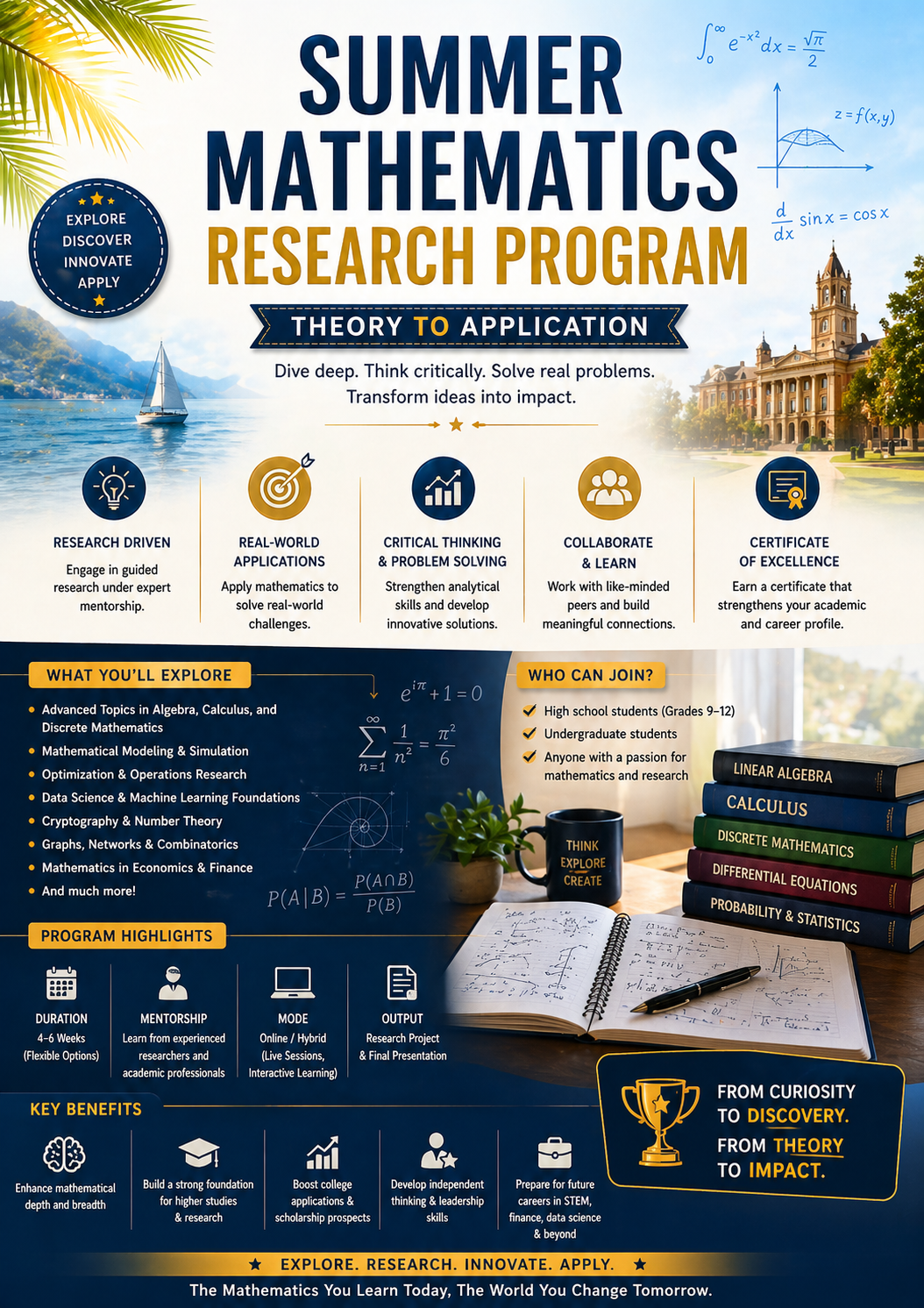
Summer Mathematics Research Program : Theory to Application
- Level
- Intermediate
- Duration
- 8 weeks
- Each week
- 6 hours
- Mode
- Online
- Fee
- Free
Program Overview: Execute Real Mathematical Research
Traditional mathematics education teaches students to solve established problems. True mathematical research challenges them to formulate new questions, model real-world phenomena, and build quantifiable proofs. Launching on 15 May 2026, the Edu Global Institute Summer Mathematics Research Program is a rigorous, 8-week project-based intensive designed for ambitious high school and intermediate students.
We do not accept vague, school-level projects like "A Study of Graph Theory." Every student in this program will operate like a university researcher. You will define a strict research question, apply computational or theoretical methods, analyze data, and produce a tangible, high-level deliverable.
Student Cohort Levels
To ensure students are appropriately challenged, incoming researchers are placed into one of three capability tracks:
- Level 1 (Exploratory Research): For younger students comfortable with school-level algebra. Focuses on visual mathematics and foundational modeling.
- Level 2 (Applied Research): For students comfortable with Python/Excel and statistics. Focuses on algorithm application and real-world data analysis.
- Level 3 (Advanced Research): For students with strong programming and math foundations. Focuses on cryptography, advanced algorithms, and rigorous proofs.
The 5 Flagship Research Tracks
Students must select one of the following highly specific research tracks to execute during the 8-week program.
Track A: Measuring the Fractal Dimension of Natural Patterns (Level 2)
- The Question: Can the fractal dimension of natural structures (coastlines, leaves, lightning) be estimated using box-counting algorithms?
- Methodology: Convert high-resolution images to binary arrays and apply the box-counting method using Python to estimate the fractal dimension from a log-log slope.
Track B: Graph Theory for Local Route Optimization (Levels 2 & 3)
- The Question: Can weighted graph algorithms reduce travel time or distance in a specific, local transit network (e.g., school buses or delivery paths)?
- Methodology: Model physical locations as nodes and roads as weighted edges. Apply Dijkstra's algorithm via NetworkX to find optimal paths and mathematically compare them to standard routes.
Track C: Prime Numbers and RSA Cryptography (Level 3)
- The Question: How does RSA encryption depend on prime factorization, and how does increasing key size alter the time required for brute-force factorization?
- Methodology: Build a working model of RSA encryption from scratch. Write brute-force factorization scripts for progressively larger semiprimes to test computational limits.
Track D: Pascal’s Triangle Modulo Primes (Levels 1 & 2)
- The Question: How do modular reductions of Pascal’s Triangle (modulo 2, 3, 5, 7) reveal predictable number-theoretic and geometric, fractal-like structures?
- Methodology: Use Python to generate massive iterations of Pascal's Triangle, apply modular arithmetic, and map the results to color grids to analyze the emergence of self-similar geometries.
Track E: Game Theory Models of Strategic Decision Making (Level 1)
- The Question: Can Nash Equilibrium predict rational strategies in simple, real-world competitive scenarios (e.g., local pricing competition or sports strategies)?
- Methodology: Define players/strategies, construct mathematical payoff matrices, calculate dominant strategies, and test theoretical equilibrium against simulated human behavior.
Program Deliverables & Evaluation
At the conclusion of the 8-week period, every student is required to submit a comprehensive research package to be used for university admissions portfolios. This includes:
- Code/Data Repository: A clean, documented GitHub repository or Colab notebook containing all simulations and scripts.
- Final Research Paper: A professionally formatted document including Background, Methodology, Results (Graphs/Tables), Error Analysis, and Conclusion.
- Final Presentation: A verbal defense of the research findings.
What students will be able to do
- Frame a research question narrow enough to complete in a single programme
- Carry out a literature review and cite sources correctly
- Produce original analysis rather than a summary of existing work
- Write up findings in the structure academic reviewers expect
- Prepare a submission for a recognised high-school research outlet
Common questions
Do students produce a publishable paper?
Students complete a full research paper. Whether it is accepted depends on the venue and the work itself; we prepare the submission but cannot guarantee publication.
What background is needed?
Comfort with the subject at Class 11 level and the discipline to work independently between sessions. Prior research experience is not required.
How long does a research project take?
Most take eight to twelve weeks from question to written paper. Rushing the literature review is the most common reason a project stalls.
Where can high-school research be submitted?
Options include the Journal of Emerging Investigators, journals run by universities, and science-fair routes such as ISEF affiliates.
Does research help university applications?
Admissions officers value demonstrated independent enquiry. A completed paper evidences that far better than a stated interest.
Book a trial
Three sessions with the mentor who would teach the full course. Nothing is charged until your slot is confirmed.
- A diagnostic, a taught class and written feedback
- Taught by the mentor who leads the course
- You pick the slot from our live calendar
- Pay only after the slot is confirmed
- Level
- Intermediate
- Duration
- 8 weeks
- Each week
- 6 hours
- Mode
- Online
- Fee
- Free
Ask a question, or book a trial
Tell us about the student and we will reply with an honest view of whether this programme fits. If you would like to see the teaching first, add a trial class.
- No obligation - send the enquiry without booking anything
- Three sessions if you do book: a diagnostic, a taught class and feedback
- Taught by the mentor who would lead the full course
- You choose the slots from our calendar after payment
| Class 1 to 5 | 3 sessions | INR 599 |
| Class 6 to 8 | 3 sessions | INR 799 |
| Class 9 and 10 | 3 sessions | INR 899 |
| Class 11 and 12 | 3 sessions | INR 999 |
| Graduation and above | 4 sessions | INR 1,099 |
Sending an enquiry is free. The fee applies only if you tick the trial box below.