How to Prepare for AMC 8: Study Plan, Tips & Strategy
If you want to prepare for AMC 8...
How to Prepare for AMC 8
If you want to prepare for AMC 8 properly, stop looking for shortcuts. There is no magic book, trick list, or last-minute hack that replaces disciplined practice. Students improve when they combine concept mastery, problem-solving repetition, timed testing, and honest mistake analysis.
The AMC 8 rewards students who can think clearly under pressure. That means preparation should not be random. A strong AMC 8 study plan must cover the right topics, build speed gradually, and train students to handle unfamiliar problems without panicking.
Step 1: Understand the Exam First
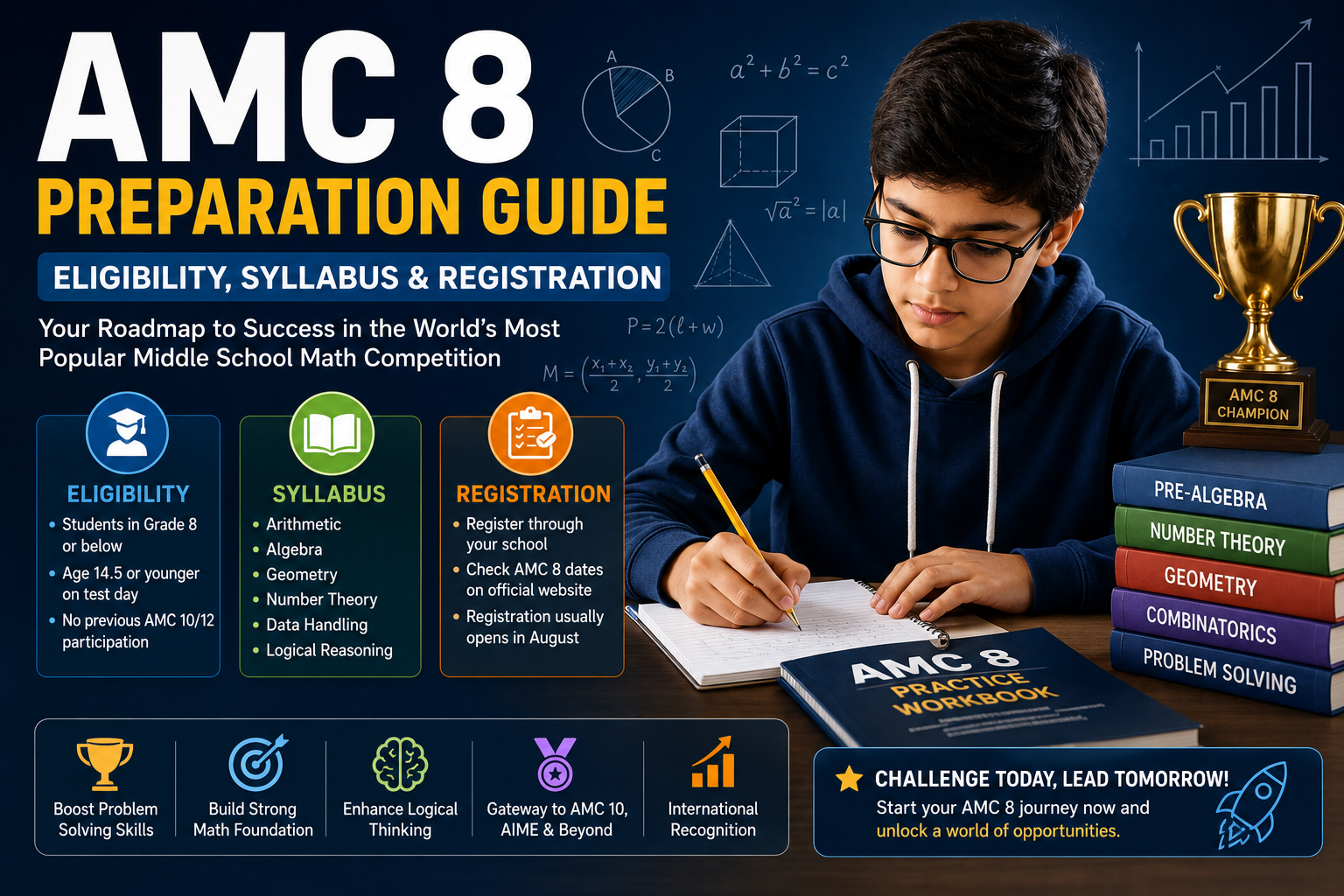
Before creating a study plan, students need to understand what they are preparing for. The AMC 8 is a timed multiple-choice contest that tests middle school mathematics in a competition setting. That changes everything. It is not enough to know formulas. Students must know how to apply them quickly and flexibly.
Step 2: Build a Topic-Based Foundation
Preparation should begin with the major AMC 8 topic areas: arithmetic, number theory, algebra, geometry, counting, probability, graphs, tables, and logical reasoning. Students who skip this foundation and jump straight to full papers usually plateau early.
- Strengthen weak arithmetic first
- Study number theory and counting early, not at the end
- Practice algebra through structured word problems
- Use geometry diagrams actively instead of memorizing formulas blindly
Step 3: Use a Real Study Plan
6-Month AMC 8 Study Plan
This is the most effective timeline. Spend the first half on topic mastery and the second half on mixed practice and mock exams. Students with six months can improve steadily without cramming.
- Months 1 to 2: Build fundamentals by topic
- Months 3 to 4: Solve mixed sets and moderate-difficulty contest problems
- Months 5 to 6: Take timed tests, review errors, and sharpen strategy
3-Month AMC 8 Study Plan
This is enough time if the student already has decent fundamentals. Focus on high-yield topics, regular timed sets, and aggressive error correction.
- Month 1: Review syllabus and repair weak areas
- Month 2: Mixed-topic practice and medium-level problems
- Month 3: Full mock tests and targeted revision
1-Month AMC 8 Study Plan
One month is not ideal, but it is still enough to improve if the student works intelligently. Focus on high-frequency topics, pacing, and mistake reduction. Do not waste time pretending you can master everything from scratch.
- Prioritize arithmetic, number theory, geometry, and counting
- Take short timed sets every week
- Review every error in detail
- Finish with 2 to 4 full-length mock exams
Step 4: Practice in Layers
Good preparation uses three layers of practice.
- Topic practice to build understanding
- Mixed problem sets to improve flexibility
- Timed mock exams to simulate real conditions
Students who only do one of these will underperform. Topic practice without timing creates false confidence. Timed tests without foundation create frustration. You need both.
Step 5: Review Mistakes Ruthlessly
Most students waste mistakes. They look at the answer, say “I get it,” and move on. That is nonsense. A mistake should be classified, corrected, and revisited.
- Concept mistake: you did not know the math
- Strategy mistake: you chose a poor method
- Careless mistake: you rushed or misread
- Timing mistake: you spent too long on one problem
Step 6: Learn Test Strategy
AMC 8 is short enough that poor pacing can ruin a good student. Strategy matters. Students should learn how to move quickly through easy questions, protect time for medium problems, and avoid getting trapped by one hard question too early.
- Do not obsess over one difficult problem too early
- Secure easier points first
- Mark and return instead of freezing
- Use estimation and elimination when useful
- Leave time for checking avoidable mistakes
Best Resources to Prepare for AMC 8
The strongest prep systems combine topic instruction, structured worksheets, timed practice tests, past papers, and detailed solutions. Students do better when all of these are connected in one plan rather than scattered across random websites and videos.
Common Preparation Mistakes
- Starting too late
- Studying passively instead of solving problems
- Ignoring weak topics because they feel uncomfortable
- Doing too many hard problems too soon
- Not taking timed mock exams
- Failing to track repeated errors
The Right Way to Prepare
The right AMC 8 preparation plan is simple: learn the topics, solve many problems, train under time pressure, and review mistakes properly. That is how scores improve. Not through wishful thinking, not through random browsing, and not through last-minute panic.
Join the AMC 8 Preparation Program | Review the AMC 8 Syllabus | Practice With AMC 8 Past Papers
What the scoring means for your preparation
The AMC 8 gives one mark per correct answer, nothing for a wrong one, and nothing for a blank. Because a blank and a wrong answer are worth the same, the correct exam behaviour is to answer all 25 questions without exception — and that is a habit you build in practice, not something you decide on the day.
Build it deliberately: on every practice paper, spend the final minute filling in every empty box, even when you are guessing. Students who leave blanks in practice leave them in the hall.
How to review a practice paper properly
Most students mark a paper, note the score, and move on. That teaches almost nothing. A review that changes your next score has four steps:
- Mark your confidence, not just your answer. Put a dot next to anything you were unsure of. A dotted question you got right is a warning, not a win.
- Redo every wrong question untimed, before reading the solution. If it comes out in four quiet minutes the problem was pace, not knowledge — and pace is fixed by different work.
- Log the cause, not the topic. "Geometry" is useless. "Misread which angle was asked for" is actionable. Most students find three or four causes repeat on every paper.
- Re-read the log before the next paper. The point of the log is to change the next attempt, not to record the last one.
Pacing across 40 minutes
Forty minutes across 25 questions is 1.6 minutes each, but the paper is not uniform. A workable distribution is to clear questions 1 to 10 in about twelve minutes, work 11 to 20 in about twenty, and use the remainder on the last five plus a sweep for blanks.
The discipline that matters most is abandoning a question. If a problem has taken three minutes with no route in sight, mark it and move — there may be two easier questions behind it worth the same marks.
Where to practise
Official past papers from the MAA are free and should be used, but there is a finite supply and each can only be sat cold once. Our AMC 8 practice test series adds twenty original papers written to the same specification, with worked solutions and two free papers, and the score calculator shows what any answer pattern is worth.
Questions people ask
How should you prepare for AMC 8?
If you want to prepare for AMC 8 properly, stop looking for shortcuts. There is no magic book, trick list, or last-minute hack that replaces disciplined practice. Students improve when they combine concept mastery, problem-solving repetition, timed testing, and honest mistake analysis.
What mistakes should you avoid in AMC 8?
Most students waste mistakes. They look at the answer, say “I get it,” and move on. That is nonsense. A mistake should be classified, corrected, and revisited.
What are the best resources for AMC 8?
The strongest prep systems combine topic instruction, structured worksheets, timed practice tests, past papers, and detailed solutions. Students do better when all of these are connected in one plan rather than scattered across random websites and videos.
Get a study plan for this
Tell us the class and what they are working towards, and we will send a plan built around it, plus the next free trial class. No cost, and we will not pass your details on.