AMC 8 Syllabus: Full Topic List, Weightage & Prep Guide
The AMC 8 syllabus covers a broad range...
AMC 8 Syllabus
The AMC 8 syllabus covers a broad range of middle school mathematics topics, but students make a serious mistake when they assume school math is enough. It is not. The AMC 8 tests familiar concepts in unfamiliar ways. Students are expected to reason carefully, spot patterns quickly, and solve problems efficiently under time pressure.
A proper AMC 8 syllabus guide should do more than list topics. It should explain what students actually need to know, which areas appear frequently, and how to turn the syllabus into a practical study plan. That is what this page does.
What the AMC 8 Syllabus Covers
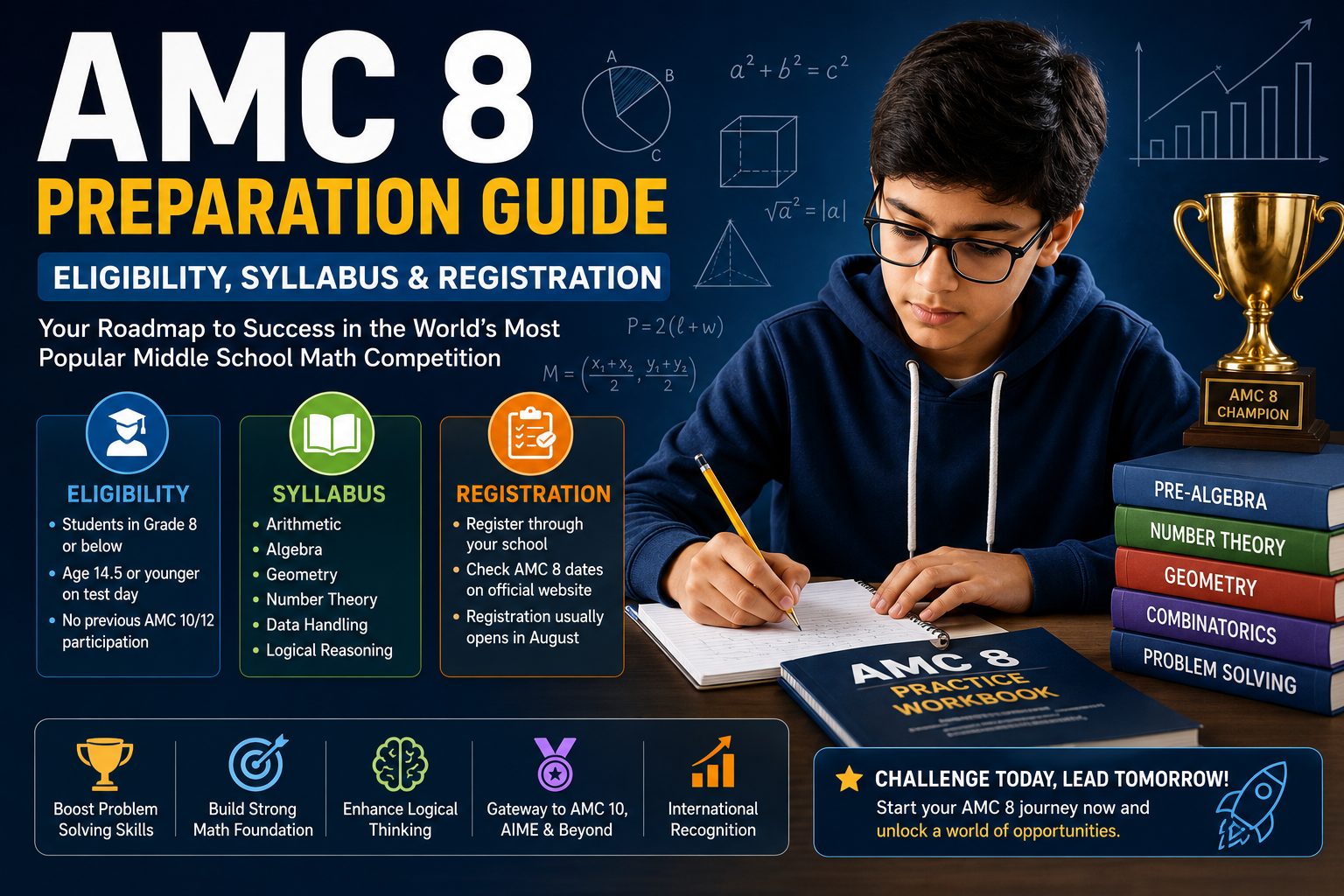
The AMC 8 focuses on middle school mathematics, including arithmetic, number theory, algebra, geometry, counting, probability, logic, graphs, tables, and spatial reasoning. Some of the later questions may involve beginning algebra and coordinate geometry, but the exam does not require advanced high school mathematics.
Core AMC 8 Topic Areas
1. Arithmetic and Number Sense
This is the base layer. Weak arithmetic destroys performance everywhere else. Students need fluency with fractions, decimals, percentages, ratios, rates, averages, estimation, and proportional reasoning. They must also be comfortable translating word problems into clean mathematical structure.
- Fractions, decimals, and percents
- Ratios, proportions, and rates
- Averages and weighted thinking
- Estimation and numerical reasoning
2. Number Theory
Number theory is a high-value scoring area because many students are weak at it. Strong AMC 8 preparation includes divisibility, primes, factors, multiples, remainders, parity, units digits, and integer patterns.
- Factors and multiples
- Prime factorization, GCF, and LCM
- Divisibility rules
- Remainders and modular thinking
- Odd-even patterns and digit properties
3. Algebra and Patterns
AMC 8 algebra is less about complicated formulas and more about clean thinking. Students should know how to simplify expressions, solve equations, interpret patterns, and use variables without getting lost in symbols.
- Expressions and equations
- Linear relationships
- Patterns and sequences
- Basic functional thinking
- Coordinate geometry foundations
4. Geometry
Geometry is one of the most visible AMC 8 categories. Students must be able to reason from diagrams, use area and perimeter relationships, and apply the Pythagorean Theorem when needed. Memorizing formulas without understanding them is not enough.
- Angles, lines, and triangles
- Quadrilaterals and polygons
- Area, perimeter, and geometric decomposition
- Circles and arcs
- Pythagorean Theorem
- Symmetry, transformations, and coordinate geometry
5. Counting and Combinatorics
Counting problems are often mishandled because students try to guess instead of organizing cases systematically. This section rewards logic, structure, and discipline.
- Counting principles
- Arrangements and selections
- Casework and pattern counting
- Overcounting and undercounting traps
6. Probability
AMC 8 probability is usually straightforward in theory and surprisingly tricky in execution. Students need to understand sample spaces, favorable outcomes, and how counting and probability work together.
- Basic probability concepts
- Simple and compound events
- Counting-based probability questions
- Logical setup of outcomes
7. Graphs, Tables, and Word Problems
Students are expected to interpret data and convert verbal information into equations, ratios, diagrams, or logical structures. These questions punish sloppy reading.
- Reading graphs and tables
- Multi-step word problems
- Distance, work, money, and rate problems
- Applied reasoning in everyday contexts
8. Spatial Visualization and Logical Reasoning
Some AMC 8 questions test how well students can picture shapes, transformations, nets, and hidden structures. Others require pure logical elimination and pattern recognition.
- Nets and 3D visualization
- Symmetry and transformations
- Pattern logic
- Constraint-based reasoning
How to Use the AMC 8 Syllabus Properly
A syllabus is not a checklist to read once and ignore. Students should use it as a working map. First, identify strong and weak categories. Then assign regular practice blocks by topic. Finally, use timed tests to see whether the knowledge actually transfers into performance.
- List all topic areas and rate confidence honestly.
- Strengthen weak foundations before chasing hard problems.
- Study one topic at a time with focused practice.
- Mix topics regularly once basic mastery is built.
- Use timed mock tests to test recall, speed, and accuracy.
Big Mistakes Students Make With the Syllabus
- Ignoring number theory and counting until the end
- Doing only geometry because it feels familiar
- Jumping to past papers without topic preparation
- Confusing passive reading with active mastery
- Not reviewing mistakes after practice
Use the Syllabus as a Training Plan
The AMC 8 syllabus is manageable if studied intelligently. It becomes difficult only when students prepare randomly. Use this topic map to build a disciplined study schedule, combine concept review with targeted problem solving, and turn broad coverage into real exam readiness.
See the AMC 8 Preparation Program | Practice With AMC 8 Mock Tests | Learn How to Prepare for AMC 8
How the AMC 8 is scored, and why it changes what you revise
The AMC 8 is 25 questions in 40 minutes. Each correct answer scores one mark, a wrong answer scores nothing, and a blank also scores nothing. There is no penalty anywhere on the paper.
That single rule has a direct consequence for revision. Because a blank is worth exactly the same as a wrong answer, every question should be answered. On a five-option question a blind guess is worth 0.2 marks on average, and eliminating two options raises that to about 0.33. Students still hand in papers with three or four blanks, and each one is a free expected mark discarded.
It also means every topic in the AMC 8 syllabus is worth the same. Question 3 and question 24 both pay one mark, so a student who spends eight minutes on a hard counting problem and never reaches four easy questions at the end has lost more than they gained. Revision should therefore be broad rather than deep: securing accuracy across all eight topic areas beats mastering one.
Topic weighting in practice
The MAA does not publish a fixed weighting, and it varies year to year. Across recent papers the rough shape is consistent enough to plan against:
- Arithmetic, number sense and word problems — the largest single group, and the most reliable marks on the paper.
- Geometry — consistently present, and the area where careless reading costs the most.
- Counting and probability — fewer questions, but they cluster in the harder half.
- Number theory — divisibility, remainders and factors, usually in the middle band.
- Logic, patterns and spatial reasoning — a handful of questions that reward practice more than knowledge.
The practical reading is that arithmetic and geometry decide most scores, while counting and probability decide whether a strong student reaches the Honor Roll band.
Turning the syllabus into a revision order
Work the topics in the order that pays. Secure arithmetic and word problems first, because they carry the most questions and the errors there are avoidable. Then geometry, then counting and probability, then number theory. Leave logic and spatial reasoning to mixed practice rather than studying them as a topic — they are recognition skills, not knowledge.
Once a topic is solid, stop revising it and start sitting mixed papers. The syllabus tells you what can appear; only a full timed paper tells you whether you can recognise it when it does. Our AMC 8 practice test papers include free topic-wise and full mock papers, and the AMC score calculator converts any answer pattern into a score.
Questions people ask
What topics are on the AMC 8 syllabus?
The AMC 8 draws on arithmetic and number sense, number theory, algebra and patterns, geometry, counting and combinatorics, probability, graphs and word problems, and spatial or logical reasoning. There is no calculus, no trigonometry and no formal algebra beyond linear relationships. What makes the paper hard is not the topic list but that questions combine two ideas and never announce which.
How many questions are on the AMC 8 and how long is it?
25 multiple-choice questions in 40 minutes, which is 1.6 minutes per question. Each correct answer scores one mark, and there is no penalty for a wrong answer, so every question should be answered rather than left blank.
Is there any calculus or trigonometry on the AMC 8?
No. The AMC 8 is aimed at students in grade 8 and below, and stays within arithmetic, elementary number theory, basic algebra, plane geometry, counting and probability. Students sometimes over-prepare with high-school material and under-prepare on careful arithmetic, which is where most marks are actually lost.
How should I use the syllabus to revise?
Work the topics in the order that pays: arithmetic and word problems first, then geometry, then counting and probability, then number theory. Once a topic is secure, stop revising it and switch to mixed timed papers - the syllabus tells you what can appear, but only a full paper tells you whether you recognise it under time pressure.
Get a study plan for this
Tell us the class and what they are working towards, and we will send a plan built around it, plus the next free trial class. No cost, and we will not pass your details on.