ISI-CMI vs JEE Advanced: Comprehensive Guide to Difficulty, Preparation, and Career Prospects
For aspiring mathematics and science students in India, the choice between pursuing ISI-CMI and JEE Advanced is a critical decision that shapes their academic and professional trajectory. The ISI-CMI vs JEE Advanced difficulty comparison has been a topic of intense debate among students, educators, and professionals. This comprehensive guide delves into every aspect of these prestigious examinations, including ISI-CMI preparation while continuing JEE preparation, ISI-CMI eligibility criteria, ISI-CMI admission process, ISI-CMI previous year question papers, ISI-CMI exam pattern, and ISI-CMI syllabus analysis. We'll also explore ISI-CMI preparation strategies for limited timeframes, ISI-CMI vs IIT career prospects, and specialized approaches for ISI-CMI preparation for class 11 students.
Understanding ISI-CMI and JEE Advanced
The Indian Statistical Institute (ISI) and the Chennai Mathematical Institute (CMI) are premier institutions offering undergraduate programs in mathematics, statistics, and computer science. Their entrance examinations are renowned for their rigorous assessment of analytical thinking and problem-solving abilities. In contrast, JEE Advanced is the gateway to the prestigious Indian Institutes of Technology (IITs), focusing on physics, chemistry, and mathematics. While both pathways lead to excellent career opportunities, they differ significantly in approach, difficulty, and focus areas.
"According to recent data, approximately 1.5 lakh students appear for ISI-CMI entrance exams annually, while over 1.5 lakh students compete for JEE Advanced, making both highly competitive in their own right."
ISI-CMI vs JEE Advanced Difficulty Comparison
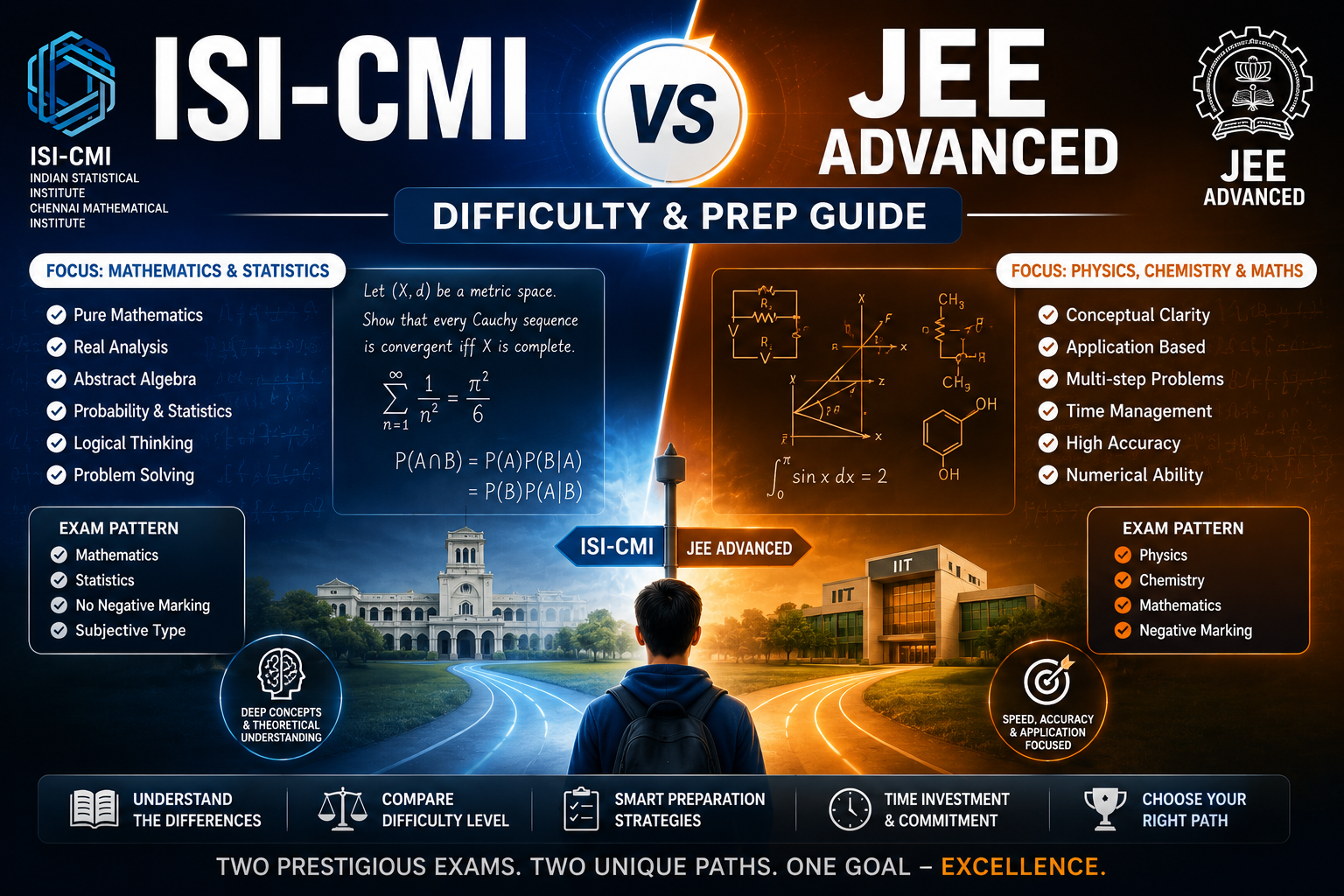
The ISI-CMI vs JEE Advanced difficulty comparison reveals distinct characteristics between these examinations. ISI-CMI exams place greater emphasis on conceptual understanding and theoretical foundations, particularly in mathematics and statistics. The questions often require students to construct proofs, derive results from first principles, and demonstrate deep mathematical intuition. On the other hand, JEE Advanced, while challenging, focuses more on application-based problem-solving across physics, chemistry, and mathematics within a fixed timeframe.
When examining ISI vs CMI which is tougher, it's important to note that ISI entrance exams generally have a higher mathematical rigor, while CMI places greater emphasis on computer science applications. Both are considered more mathematically demanding than JEE Advanced, which tests a broader range of subjects but with less depth in pure mathematics.
Key Differences in Difficulty Levels
- Mathematical Rigor: ISI-CMI exams demand deeper theoretical knowledge and proof-writing skills compared to JEE Advanced
- Problem Type: ISI-CMI focuses more on open-ended problems with multiple solution approaches, while JEE Advanced typically has well-defined problems
- Syllabus Depth: ISI-CMI explores fewer topics but with greater depth, whereas JEE Advanced covers a broader curriculum
- Time Pressure: JEE Advanced is known for its tight time constraints, while ISI-CMI allows more time per question
ISI-CMI Preparation While Continuing JEE Preparation
Many students aim to prepare for both ISI-CMI and JEE Advanced simultaneously, leveraging their overlapping mathematical content. Effective ISI-CMI preparation while continuing JEE preparation requires strategic planning and resource allocation. The key is to identify common topics between both syllabi while dedicating additional time to the unique requirements of each exam.
For students pursuing this dual preparation path, it's essential to prioritize conceptual understanding over rote learning. While JEE preparation builds strong problem-solving skills, ISI-CMI requires additional focus on theoretical foundations and proof-writing techniques. Students should allocate specific time slots for ISI-CMI-specific preparation, particularly focusing on areas where JEE Advanced preparation falls short.
Strategic Approach for Dual Preparation
Begin by creating a comprehensive schedule that allocates time based on the relative importance of topics in both exams. For subjects like mathematics, where both exams share significant content, focus first on mastering fundamental concepts deeply before moving to application-based problems. Allocate dedicated time for ISI-specific preparation, particularly in areas like statistics, abstract algebra, and real analysis that may not be covered extensively in JEE preparation.
ISI-CMI Eligibility Criteria and Admission Process
Understanding the ISI-CMI eligibility criteria is crucial for prospective applicants. For ISI undergraduate programs, candidates must have completed their 10+2 education with mathematics as a compulsory subject. The minimum percentage requirement varies across categories and programs, typically ranging from 60% to 85% in aggregate and mathematics. For CMI, candidates should have passed 10+2 with mathematics and physics, with similar percentage requirements.
The ISI-CMI admission process typically involves multiple stages. Initially, candidates must appear for the written examination, followed by an interview for shortlisted candidates. ISI often conducts a preliminary written test followed by a main written test and interview, while CMI usually has a single written test followed by an interview. Both institutes place significant emphasis on the interview stage, assessing candidates' conceptual understanding and problem-solving approach.
Document Requirements and Application Process
Applicants must ensure they have all necessary documents ready, including mark sheets, identity proof, category certificates (if applicable), and passport-sized photographs. The application process is primarily online, with deadlines typically falling in March-April for the May-June examinations. It's advisable to regularly check the official websites of ISI and CMI for any updates in the ISI-CMI eligibility requirements or application procedures.
ISI-CMI Previous Year Question Papers and Solutions
Accessing and analyzing ISI-CMI previous year question papers is one of the most effective preparation strategies. These papers provide valuable insights into the exam pattern, question types, and difficulty levels. Many students find ISI-CMI question papers with solutions particularly helpful as they offer detailed explanations of problem-solving approaches.
When working with past papers, it's important to simulate exam conditions by timing yourself and attempting problems without referring to solutions initially. After solving, carefully review the provided solutions to understand alternative approaches and identify areas of weakness. Creating a personal repository of solved problems can serve as an excellent reference during revision.
Where to Find ISI-CMI Question Papers
Official ISI and CMI websites often provide past papers and sample questions. Additionally, educational platforms, coaching institutes specializing in mathematical entrance exams, and student forums share valuable resources. When using unofficial sources, verify the authenticity of the papers and solutions, as some may contain errors or outdated information.
ISI-CMI Exam Pattern and Syllabus Analysis
A thorough ISI-CMI exam pattern analysis reveals significant differences from JEE Advanced. ISI typically conducts separate exams for different programs (B.Stat, B.Math, B.M.S, etc.), each with its own structure. Most ISI-CMI exams consist of multiple-choice questions, short answer questions, and longer descriptive problems. The duration generally ranges from 2 to 4 hours, with varying numbers of questions.
The ISI-CMI syllabus analysis shows that ISI exams focus heavily on pure mathematics, including algebra, calculus, geometry, and statistics. CMI, while also emphasizing mathematics, places greater focus on computer science topics for its B.Sc. Computer Science program. Both institutes expect students to have a strong foundation in mathematical reasoning and problem-solving.
Syllabus Comparison with JEE Advanced
While there's significant overlap in mathematics syllabus between ISI-CMI and JEE Advanced, the former explores topics with greater depth and theoretical rigor. JEE Advanced covers a broader range of subjects (physics, chemistry, mathematics), while ISI-CMI focuses intensely on mathematics and statistics. Students preparing for both should prioritize mastering mathematical concepts deeply before diversifying attention to other subjects required for JEE Advanced.
ISI-CMI Preparation Strategies for Limited Timeframes
For students with ISI-CMI preparation for limited timeframes, prioritization becomes crucial. Begin by identifying high-weightage topics that appear frequently in past papers. Allocate more time to these areas while ensuring coverage of fundamental concepts across the syllabus. Intensive problem-solving sessions should form the core of your preparation, supplemented by regular revision of key concepts and theorems.
For those with extremely limited time (1-2 months), focus exclusively on past papers and mock tests. Analyze your performance to identify weak areas and concentrate improvement efforts there. Time management during preparation is as important as during the exam itself. Allocate specific time slots for different topics and adhere strictly to this schedule.
Time-Efficient Preparation Techniques
Create a structured study plan that allocates time based on the difficulty and importance of topics. Use the ISI-CMI preparation online resources to access video lectures and tutorials that can accelerate learning. Form or join study groups to discuss complex problems and share insights. Focus on understanding underlying principles rather than memorizing solutions, as this approach yields better results in the long run.
ISI-CMI vs IIT Career Prospects and Future Opportunities
The ISI-CMI vs IIT career prospects differ significantly based on individual interests and career goals. Graduates from ISI and CMI often pursue advanced studies in mathematics, statistics, computer science, and data science at premier institutions worldwide. They find opportunities in research, academia, data analysis, and quantitative finance.
IIT graduates, on the other hand, have a broader range of industry opportunities, particularly in engineering, technology, and management. While both pathways lead to successful careers, the ISI-CMI future opportunities are more specialized in quantitative and theoretical fields, while IIT graduates have wider industry options.
Salary Comparison and Industry Recognition
According to recent placement data, ISI-CMI vs IIT salary comparison shows that initial salaries may be comparable, with both institutions placing graduates in prestigious roles. However, career trajectories often diverge based on specialization. ISI and CMI graduates typically excel in research-oriented positions, quantitative analysis, and academia, while IIT graduates have broader representation across engineering and technology sectors.
Industry recognition for both pathways is high, but in different domains. ISI and CMI graduates are highly regarded in mathematical research, statistics, and theoretical computer science, while IIT graduates have strong recognition across the engineering and technology landscape. The choice between these pathways should align with individual interests and career aspirations.
ISI-CMI Preparation for Class 11 Students
For students in class 11, ISI-CMI preparation for class 11 should focus on building strong fundamentals in mathematics and developing problem-solving skills. Early preparation allows for a more comprehensive understanding of concepts and reduces last-minute pressure. Students should begin by mastering the NCERT curriculum thoroughly before progressing to more advanced topics.
Class 11 is an ideal time to develop mathematical thinking beyond the school curriculum. Explore additional resources like problem-solving books, online courses, and Olympiad preparation materials. Participating in mathematics competitions can provide valuable exposure to different problem types and enhance analytical skills.
Building a Strong Foundation
Start by identifying the core mathematical concepts that form the foundation of ISI-CMI exams, including algebra, calculus, and number theory. Dedicate regular time to practice problems of varying difficulty levels. Develop the habit of maintaining a problem journal to track your progress and record challenging problems for future revision.
For ISI CMI vs JEE Advanced mathematics preparation, class 11 students should focus on building a deep understanding of mathematical principles rather than just solving problems. This approach will benefit both exams but is particularly crucial for ISI-CMI, which emphasizes conceptual understanding and proof-writing skills.
ISI-CMI Preparation Tips for Success
Several ISI-CMI preparation tips can significantly enhance your chances of success. First, develop a habit of regular revision to reinforce concepts and prevent forgetting. Second, focus on understanding the underlying principles of mathematical concepts rather than memorizing formulas. Third, practice writing detailed solutions to problems, as this skill is crucial for descriptive questions in the exam.
Additionally, cultivate the ability to approach problems from multiple angles. ISI-CMI exams often reward creative and unconventional problem-solving methods. Join study groups or online forums to discuss problems and learn from peers. Finally, maintain a healthy balance between preparation and rest, as consistent, focused study is more effective than sporadic, intensive sessions.
Conclusion: Choosing the Right Path for Your Future
The decision between ISI-CMI and JEE Advanced depends on your academic interests, career aspirations, and learning style. If you have a passion for mathematics and theoretical computer science with a inclination toward research and advanced studies, ISI-CMI might be the ideal pathway. If you prefer a broader engineering education with diverse career options in technology and industry, JEE Advanced could be more suitable.
Regardless of your choice, thorough preparation is essential. Whether you're pursuing ISI-CMI preparation while continuing JEE preparation or focusing exclusively on one exam, consistent effort, strategic planning, and a strong conceptual foundation will lead to success. Remember that both pathways offer excellent opportunities for growth and achievement in their respective domains.
For those interested in ISI-CMI, begin by thoroughly understanding the ISI-CMI eligibility criteria and ISI-CMI admission process. Analyze ISI-CMI previous year question papers to familiarize yourself with the exam pattern. Develop a structured preparation plan that aligns with your timeframe and academic background. Most importantly, cultivate a genuine interest in mathematics and problem-solving, as this intrinsic motivation will be your greatest asset in the journey toward ISI or CMI.
Are you ready to take the next step in your academic journey? Start by exploring ISI-CMI question papers with solutions to assess your current level. Create a preparation timeline that allows you to systematically cover the ISI-CMI syllabus while building problem-solving skills. Remember, success in these prestigious examinations is not just about hard work but about smart, strategic preparation aligned with your strengths and interests.