NSEP 2025 Preparation Guide: India Physics Olympiad
The National Standard Examination in...
NSEP Preparation Guide: Your Complete Roadmap to Success in the National Standard Examination in Physics 2025
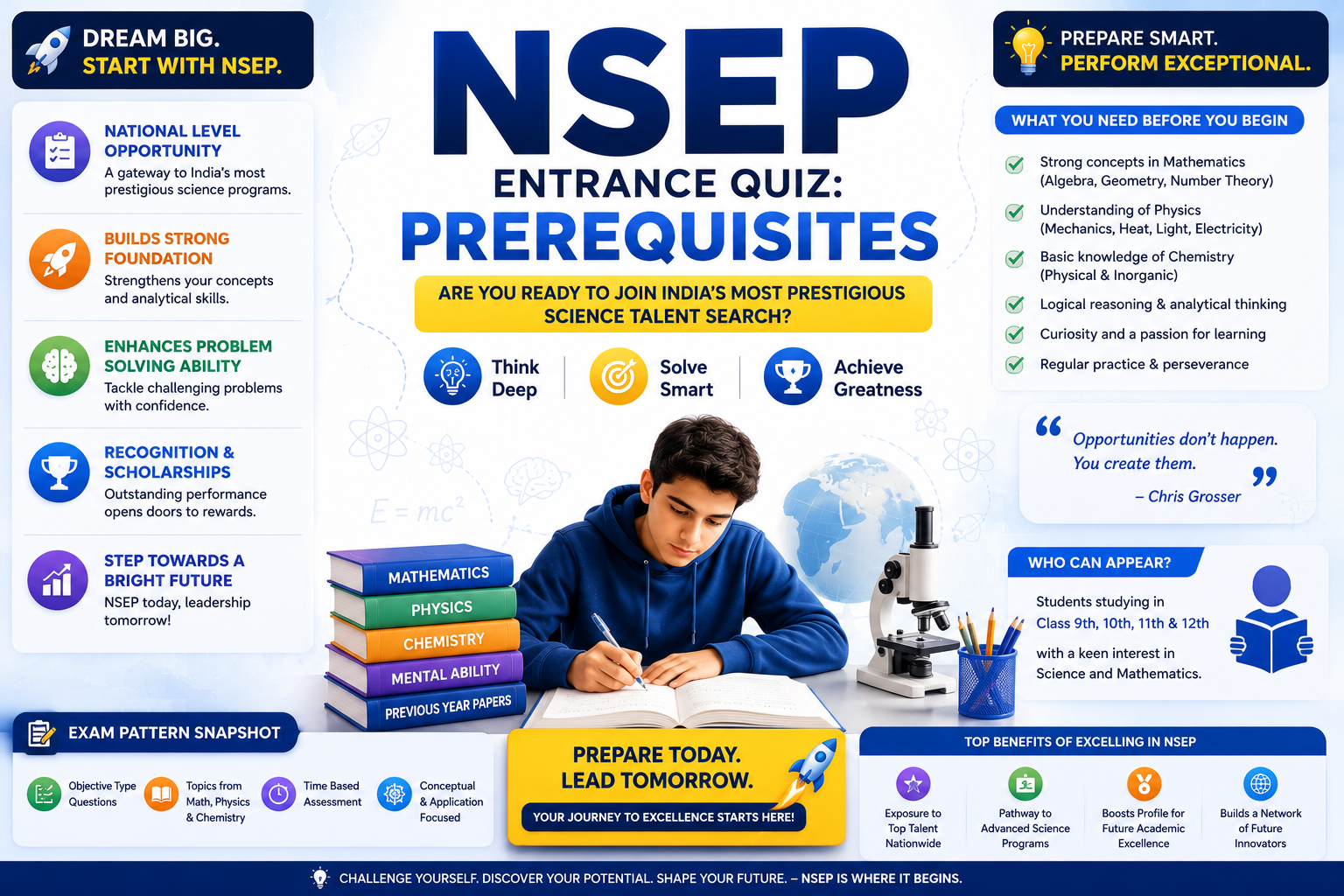
The National Standard Examination in Physics (NSEP) stands as one of India's most prestigious physics olympiads, opening doors to international recognition and advanced scientific opportunities. For aspiring physicists across India, excelling in NSEP is not just about academic achievement—it's about joining a community of brilliant minds, gaining exposure to advanced concepts, and potentially representing India on the global stage. This comprehensive NSEP preparation guide will walk you through every aspect of how to prepare for NSEP 2025, from understanding the exam structure to mastering the National Standard Examination in Physics syllabus and beyond.
Understanding the NSEP: India's Gateway to Physics Excellence
The National Standard Examination in Physics is organized by the Indian Association of Physics Teachers (IAPT) and serves as the first stage for selection to the International Physics Olympiad (IPhO). Each year, thousands of students participate, but only a select few advance to subsequent stages. The examination tests not just theoretical knowledge but also problem-solving abilities, analytical thinking, and conceptual clarity—qualities that distinguish exceptional physicists from the rest.
According to recent statistics, over 50,000 students participate in NSEP annually, with approximately 300-400 qualifying for the next stage. This competitive landscape makes thorough preparation essential. Unlike conventional board examinations, NSEP demands a deeper understanding of physics principles and their applications in complex scenarios.
"NSEP isn't merely an examination; it's a celebration of physics that challenges students to think beyond textbooks and apply concepts in innovative ways. The journey of NSEP preparation transforms how students perceive physics." - Dr. Ramesh Kumar, National Coordinator, Physics Olympiad
Exam Pattern and Structure: What to Expect in NSEP 2025
Understanding the NSEP exam pattern is crucial for effective preparation. The examination typically consists of 80 multiple-choice questions with negative marking, designed to test both fundamental knowledge and advanced problem-solving skills. The questions are divided into sections with varying difficulty levels, requiring candidates to demonstrate versatility in their physics knowledge.
The time allocation is another critical aspect. With approximately 120 minutes to complete 80 questions, effective time management becomes paramount. Successful candidates develop strategies to allocate time wisely, ensuring they can address all questions without compromising accuracy. The examination also emphasizes conceptual understanding over rote memorization, aligning with the philosophy of the International Physics Olympiad.
Key Components of the NSEP Examination
- Multiple-choice questions with single correct answers
- Negative marking (typically 1/3rd marks deducted for wrong answers)
- Questions based on the Class 11 and 12 physics syllabus
- Emphasis on application-based and conceptual problems
- Time constraint of approximately 90 seconds per question
Mastering the National Standard Examination in Physics Syllabus
The National Standard Examination in Physics syllabus primarily covers topics from the Class 11 and 12 CBSE curriculum, but with greater depth and complexity. While the core topics remain consistent, NSEP questions often require students to apply concepts in novel situations, making thorough understanding rather than superficial knowledge essential.
Key areas of focus include Mechanics, Electromagnetism, Optics, Thermodynamics, and Modern Physics. However, the examination typically includes a few questions beyond the standard curriculum, introducing students to fundamental concepts that bridge to higher physics. This is why a strategic approach to syllabus coverage is vital for NSEP success.
Core Subject Areas in NSEP
Mechanics
Mechanics forms a significant portion of the NSEP examination, covering topics like kinematics, laws of motion, work, energy, power, rotational motion, gravitation, and oscillations. Success in this section requires not just formula memorization but a deep understanding of physical principles and their mathematical representations.
Electromagnetism
Electromagnetism encompasses electric charges, fields, potential, capacitance, current electricity, magnetic effects of current, electromagnetic induction, and alternating currents. This section often includes challenging problems that require applying multiple concepts simultaneously, testing students' ability to synthesize information.
Optics
Geometrical and wave optics constitute another important area, covering reflection, refraction, dispersion, interference, diffraction, and polarization. The questions in this section frequently involve complex ray diagrams and wave phenomena, demanding both conceptual clarity and mathematical precision.
Thermodynamics
Thermodynamics questions typically focus on laws of thermodynamics, kinetic theory, calorimetry, and heat transfer. The problems often require students to apply thermodynamic principles to various scenarios, emphasizing the practical applications of theoretical concepts.
Modern Physics
Modern Physics includes atomic structure, dual nature of matter and radiation, nuclei, and electronic devices. This section frequently includes questions that bridge fundamental physics with contemporary applications, reflecting the evolving nature of the discipline.
Strategic NSEP Preparation: Building Your Roadmap to Success
Effective NSEP preparation strategy requires a structured approach that balances conceptual understanding, problem-solving practice, and time management. Whether you're starting preparation six months in advance or have just one month, a clear roadmap can maximize your chances of success.
The ideal preparation journey begins with a thorough assessment of your current knowledge level, followed by systematic coverage of the syllabus, and finally, intensive practice with previous years' papers and mock tests. This three-phase approach ensures comprehensive preparation while allowing for flexibility based on individual strengths and weaknesses.
6-Month NSEP Preparation Roadmap
- Phase 1 (Months 1-2): Complete syllabus coverage with conceptual understanding
- Phase 2 (Months 3-4): Topic-wise practice with increasing difficulty
- Phase 5 (Month 5): Full-length mock tests and error analysis
- Phase 6 (Month 6): Revision and strategy refinement
3-Month Intensive Preparation Plan
For those with less time, a focused 3-month plan can still yield excellent results. Begin by identifying your strengths and weaknesses, then prioritize topics accordingly. Allocate approximately 2-3 hours daily, focusing on conceptual understanding during initial weeks and shifting to problem-solving as the exam approaches.
1-Month Crash Course for NSEP
Even with just one month, strategic preparation can make a significant difference. Focus on high-yield topics, solve at least one previous paper daily, and dedicate time to error analysis. This intensive approach requires discipline but can effectively boost your performance if executed properly.
Essential Resources: NSEP Preparation Books and Materials
Selecting the right NSEP preparation books is crucial for comprehensive preparation. While standard NCERT textbooks form the foundation, advanced resources are necessary to tackle the challenging problems that characterize NSEP. The best books for NSEP preparation combine conceptual clarity with rigorous problem-solving exercises.
When choosing resources, prioritize books that align with the NSEP exam pattern and provide detailed explanations for solutions. Quality over quantity is key—mastering a few excellent resources is more effective than superficially covering many books. Additionally, supplement written materials with online resources to gain multiple perspectives on complex topics.
Recommended Books for NSEP Preparation
- "Concepts of Physics" by H.C. Verma: Volume 1 and 2 provide excellent conceptual understanding and challenging problems
- "Problems in General Physics" by I.E. Irodov: For advanced problem-solving practice
- "Understanding Physics Series" by DC Pandey: Comprehensive coverage with multiple difficulty levels
- "University Physics" by Young and Freedman: For deeper theoretical understanding
- "Fundamentals of Physics" by Halliday, Resnick, and Walker: Another excellent reference for concepts and applications
NSEP Preparation Material Beyond Books
Beyond traditional textbooks, consider incorporating NSEP preparation material such as video lectures, online forums, and study groups. Visual explanations can clarify complex concepts, while peer discussions can provide new insights into problem-solving approaches. Many successful NSEP candidates also maintain personal notebooks with key concepts, formulas, and problem-solving techniques for quick revision.
Leveraging Olympiad Preparation Online India: Digital Resources for Success
The digital age has revolutionized Olympiad preparation online India, providing unprecedented access to resources, expert guidance, and peer communities. Online platforms offer flexibility, allowing students to learn at their own pace while accessing quality instruction from experienced educators.
When selecting online resources, prioritize platforms that offer structured courses aligned with the NSEP syllabus, comprehensive problem sets, and performance analytics. Interactive elements such as doubt-clearing sessions and discussion forums can significantly enhance the learning experience, providing immediate clarification of concepts and exposure to diverse problem-solving approaches.
Benefits of Physics Olympiad Coaching Online
Physics olympiad coaching online offers several advantages over traditional classroom coaching, particularly for NSEP aspirants. These include access to expert faculty regardless of geographical location, flexible scheduling that accommodates academic commitments, and the ability to revisit complex concepts through recorded sessions. Many online platforms also provide personalized learning paths based on diagnostic assessments, ensuring efficient preparation.
Additionally, online coaching often includes features such as regular mock tests with detailed performance analysis, peer interaction through virtual forums, and updated study materials that reflect the latest exam trends. These elements collectively create a comprehensive learning environment that supports both conceptual understanding and exam-specific preparation.
Online Platforms for NSEP Preparation
Several specialized platforms offer physics olympiad preparation online tailored specifically for NSEP aspirants. When evaluating these platforms, consider factors such as faculty expertise, course comprehensiveness, student success rates, and support systems. Many platforms offer free trial periods, allowing you to assess their suitability before committing to a full program.
Beyond structured courses, numerous YouTube channels, educational websites, and online forums provide valuable supplementary resources. These can be particularly useful for clarifying specific doubts or gaining additional practice problems. However, be selective about online resources, prioritizing those from reputable sources to ensure accuracy and relevance.
Mastering Previous Years' Papers: The Key to NSEP Success
One of the most effective strategies for how to crack NSEP is thorough analysis of NSEP previous year papers. These papers provide invaluable insights into the examination pattern, question types, difficulty levels, and recurring themes. Regular practice with past papers helps students familiarize themselves with the examination format, develop effective time management strategies, and identify areas requiring additional focus.
Solving previous years' papers should be approached systematically. Begin by attempting papers under timed conditions to simulate the actual examination environment. After completion, conduct a detailed analysis of performance, identifying both conceptual gaps and recurring errors. This approach transforms practice from mere question-solving to targeted improvement, maximizing preparation efficiency.
Effective Use of NSEP Sample Papers
In addition to previous years' papers, NSEP sample papers designed specifically for practice can provide additional preparation value. These papers often include questions that mirror the style and difficulty of actual examination questions while covering the full spectrum of possible topics. When using sample papers, focus on developing problem-solving techniques rather than merely seeking correct answers.
Consider maintaining a "question journal" where you record particularly challenging problems, along with their solutions and alternative approaches. This resource can prove invaluable during revision, providing a quick reference to complex problem types and effective strategies for addressing them.
Time Management Strategies for NSEP Examination
Effective NSEP time management tips are crucial given the examination's time constraints. With approximately 90 seconds per question, candidates must develop strategies that balance speed with accuracy. Successful NSEP aspirants typically employ a combination of question prioritization, strategic skipping, and systematic review to maximize their scores.
During preparation, practice with a timer to develop a natural sense of time allocation. Many successful candidates report that they initially spend slightly more time on complex questions, then compensate by working more efficiently on straightforward problems. This adaptive approach ensures that all questions receive appropriate attention while maintaining overall pace.
Section-Specific Time Allocation
Different sections of the NSEP examination may require varying time allocations based on question types and individual strengths. For instance, mechanics problems might require more time due to their complexity, while multiple-choice questions on fundamental concepts might be addressed more quickly. Develop a personalized time allocation strategy based on your performance in mock tests, adjusting as needed to optimize overall efficiency.
Managing Pressure During the Examination
Examination pressure can significantly impact performance, regardless of preparation quality. Practice mindfulness techniques during preparation to develop calm focus. Many successful candidates report that maintaining a steady pace and avoiding panic—even when encountering challenging questions—was crucial to their performance. Remember that skipping difficult questions temporarily and returning to them later can be more effective than spending excessive time on a single problem.
Self-Preparation vs. Coaching: Finding Your Optimal NSEP Preparation Path
The question of how to self-prepare for NSEP versus joining a coaching program is a common dilemma among aspirants. Both approaches have distinct advantages, and the optimal choice depends on individual learning styles, available resources, and academic commitments.
Self-preparation offers flexibility and the opportunity to develop independent learning skills—qualities that are valuable beyond the examination. However, it requires significant self-discipline and effective resource management. Coaching programs, on the other hand, provide structured guidance, expert insights, and peer interaction but may offer less flexibility in scheduling and pacing.
Advantages of Self-Preparation for NSEP
Self-preparation allows you to tailor your learning precisely to your needs, focusing more time on challenging areas while quickly mastering concepts you find straightforward. It also develops essential skills such as resource management, self-assessment, and independent problem-solving—qualities that benefit long-term academic and professional development. Many successful NSEP candidates have achieved excellence through well-structured self-preparation, demonstrating its effectiveness when executed properly.
When to Consider NSEP Preparation Course
A structured NSEP preparation course may be particularly beneficial if you prefer guided learning, need regular feedback on performance, or struggle with maintaining study discipline. Coaching programs can also provide access to specialized resources, expert guidance, and peer interaction that might be difficult to obtain through self-preparation alone. When evaluating courses, consider factors such as faculty expertise, course comprehensiveness, student success rates, and support systems to ensure alignment with your learning needs.
Olympiad Preparation for Beginners: Getting Started with NSEP
For those new to olympiad examinations, Olympiad preparation for beginners requires a foundational approach that gradually builds both knowledge and problem-solving skills. Begin by thoroughly understanding the basic concepts before progressing to complex applications. Many successful NSEP candidates report that their initial focus on conceptual clarity—rather than problem-solving techniques—was crucial to their long-term success.
As a beginner, prioritize building a strong conceptual foundation through systematic syllabus coverage. Supplement this with gradually increasing problem-solving practice, starting with simpler problems and progressing to more complex ones. This approach ensures that you develop both the knowledge base and analytical skills necessary for NSEP success.
Building a Strong Foundation
Begin your NSEP journey by thoroughly studying the fundamental concepts in each topic area. Focus on understanding rather than memorization, as NSEP questions typically require applying concepts in novel situations. Create concept maps to visualize relationships between different topics, and regularly revisit foundational principles as you progress to more complex material.
Developing Problem-Solving Skills
Effective problem-solving is developed through consistent practice and reflection. Begin by solving problems step-by-step, ensuring you understand each logical transition. As you gain confidence, gradually increase the complexity of problems and work on developing multiple approaches to the same question. This flexibility in problem-solving is a hallmark of successful NSEP candidates.
Success Stories and Expert Insights: Learning from NSEP Toppers
Understanding the journeys of previous NSEP qualifiers provides valuable insights and inspiration. Many successful candidates emphasize the importance of consistent preparation, conceptual clarity, and strategic practice. They often highlight that NSEP success is not about innate ability but about developing effective learning strategies and maintaining disciplined effort over time.
Expert educators consistently emphasize that NSEP preparation should focus on developing "physics thinking" rather than mere problem-solving techniques. This approach involves understanding the underlying principles that connect different concepts, allowing for flexible application in diverse problem scenarios. Many toppers report that this conceptual approach was particularly valuable when encountering unfamiliar question types during the examination.
Common Success Factors Among NSEP Qualifiers
Analysis of successful NSEP candidates reveals several common factors in their preparation approaches:
- Comprehensive syllabus coverage with emphasis on conceptual understanding
- Regular practice with previous years' papers and mock tests
- Effective time management strategies developed through consistent practice
- Systematic error analysis and targeted improvement
- Balanced preparation that addresses both strengths and weaknesses
Conclusion: Your Journey to NSEP Excellence
Preparing for the National Standard Examination in Physics is a challenging but rewarding journey that extends beyond examination success. The process develops critical thinking, problem-solving abilities, and a deep appreciation for physics that will benefit you throughout your academic and professional life. By following this comprehensive NSEP preparation guide, you can approach your preparation with confidence and clarity.
Remember that how to prepare for NSEP 2025 is not just about covering the syllabus but about developing a genuine understanding of physics principles and their applications. Whether you choose self-preparation or structured coaching, the key is consistent effort, strategic practice, and maintaining a positive mindset throughout your preparation journey.
The path to NSEP success begins with a single step—today. Start by assessing your current knowledge level, setting clear goals, and creating a structured preparation plan. With dedication, strategic preparation, and the right resources, you can join the ranks of successful NSEP qualifiers and open doors to advanced scientific opportunities.
Begin your NSEP preparation journey today, and let your passion for physics guide you toward excellence!
Related reading
Questions people ask
What is the format of NSEP?
Understanding the NSEP exam pattern is crucial for effective preparation. The examination typically consists of 80 multiple-choice questions with negative marking, designed to test both fundamental knowledge and advanced problem-solving skills.
What is the NSEP syllabus?
The National Standard Examination in Physics syllabus primarily covers topics from the Class 11 and 12 CBSE curriculum, but with greater depth and complexity.
How should you prepare for NSEP?
For those with less time, a focused 3-month plan can still yield excellent results. Begin by identifying your strengths and weaknesses, then prioritize topics accordingly.
What are the best resources for NSEP?
Selecting the right NSEP preparation books is crucial for comprehensive preparation. While standard NCERT textbooks form the foundation, advanced resources are necessary to tackle the challenging problems that characterize NSEP.
Why is NSEP worth taking?
Physics olympiad coaching online offers several advantages over traditional classroom coaching, particularly for NSEP aspirants.
Get a study plan for this
Tell us the class and what they are working towards, and we will send a plan built around it, plus the next free trial class. No cost, and we will not pass your details on.