IIT JEE Mains and Advanced Prep Course: Your Complete Guide to JEE 2026 Success
The Indian Institutes of Technology Joint Entrance Examination (IIT JEE) is one of the most challenging engineering entrance exams in the world, opening doors to prestigious institutions like IITs, NITs, and other top engineering colleges in India. With the increasing competition and evolving exam patterns, a well-structured IIT JEE Mains and Advanced Prep Course has become essential for aspirants aiming to secure a top rank in JEE 2026. This comprehensive guide will provide you with all the essential information, strategies, and resources needed to excel in both JEE Main and JEE Advanced, whether you're a school student, dropper, or looking for JEE online classes to supplement your preparation.
Understanding the JEE Exam Structure: JEE Main vs Advanced
Before diving into preparation strategies, it's crucial to understand the differences between JEE Main vs Advanced preparation approaches. The JEE Main is conducted by the National Testing Agency (NTA) and serves as the gateway for admission to NITs, IIITs, and other CFTIs, while JEE Advanced is conducted by one of the IITs for admission to IITs only. Both exams have distinct patterns, difficulty levels, and syllabi, requiring tailored preparation approaches.
The JEE Main exam pattern consists of Paper 1 (B.Tech/B.E) with Physics, Chemistry, and Mathematics, each with 30 multiple-choice questions. Paper 2 is for B.Arch and Paper 3 for B.Planning. In contrast, JEE Advanced difficulty level is significantly higher, with more complex problems and a different question format including multiple correct answers, numerical value answers, and matching column types.
"According to recent data, only about 2.5 lakh candidates qualify for JEE Advanced from the pool of JEE Main aspirants, making the competition ratio extremely competitive."
Key Differences Between JEE Main and JEE Advanced
- Syllabus Depth: While JEE Main focuses on fundamental concepts, JEE Advanced requires deeper understanding and application of these concepts
- Question Type: JEE Main has mostly MCQs with numerical value answers, while JEE Advanced includes more complex question formats
- Time Management: JEE Advanced requires more sophisticated time management strategies due to its complexity
- Cutoff Criteria: JEE Main vs Advanced cutoff varies significantly, with Advanced having much higher percentile requirements
JEE 2026 Preparation Strategy: A Roadmap to Success
Creating an effective JEE 2026 preparation strategy requires careful planning and execution. The ideal preparation period spans 18-24 months, allowing for thorough coverage of the syllabus, adequate practice, and revision. Whether you're starting from scratch or looking to enhance your existing preparation, a structured approach is crucial.
The first step in your preparation journey should be understanding the JEE Main syllabus 2026 and JEE Advanced syllabus 2026. While the core topics remain similar, Advanced often includes more sub-topics and requires deeper conceptual understanding. It's essential to align your preparation with the latest syllabus released by NTA and IITs respectively.
Phase-wise Preparation Plan
Phase 1: Foundation Building (6-8 months)
During this initial phase, focus on building a strong foundation in all three subjects. Start with NCERT books to understand basic concepts thoroughly, then gradually move to more advanced reference books. Allocate equal time to Physics, Chemistry, and Mathematics, ensuring you complete at least 50% of the syllabus in this phase.
Phase 2: Concept Reinforcement and Problem Solving (6-8 months)
In this phase, focus on solving more complex problems and reinforcing your understanding through practice. Regularly take JEE Main mock test to assess your progress and identify weak areas. This is also the time when you should start solving JEE PYQs with solutions to understand the exam pattern and question types.
Phase 3: Revision and Mock Tests (4-6 months)
The final phase should be dedicated to intensive revision and mock tests. Create a JEE time table for preparation that includes daily revision of previously covered topics and regular practice tests. Analyze your performance in each mock test and work on improving speed and accuracy.
Subject-wise Preparation Strategy for JEE 2026
Physics: Mastering the Concepts
Physics in JEE requires both conceptual clarity and problem-solving skills. Focus on high-weightage chapters like Mechanics, Electrodynamics, and Modern Physics. Start with HC Verma Physics for building concepts, then move to DC Pandey Physics for advanced problem-solving. Pay special attention to topics like Kinematics, Rotational Motion, Current Electricity, and Electromagnetic Induction as they consistently appear in both exams.
Chemistry: Balancing Theory and Practice
JEE Chemistry is divided into Physical, Organic, and Inorganic sections. Begin with NCERT for JEE preparation to build a strong foundation, then use reference books like OP Tandon Chemistry for deeper understanding. Pay special attention to high-weightage topics like Mole Concept, Chemical Bonding, p-block elements, and Coordination Compounds. For Organic Chemistry, master General Organic Chemistry (GOC) as it forms the basis for many reactions.
Mathematics: Building Problem-Solving Skills
Mathematics in JEE requires regular practice and problem-solving skills. Start with RD Sharma Mathematics for building concepts, then move to Cengage Maths for advanced problems. Focus on high-weightage chapters like Calculus, Coordinate Geometry, Vectors and 3D Geometry, and Algebra. Create JEE formula sheets for quick revision of important formulas and theorems.
Best Books for JEE Preparation: A Curated List
Selecting the right study materials is crucial for effective JEE preparation. While NCERT books form the foundation, you'll need additional resources for comprehensive preparation. Here's a curated list of best books for JEE preparation:
- Physics: HC Verma Concepts of Physics, DC Pandey's Understanding Physics Series, IE Irodov for Advanced level problems
- Chemistry: NCERT Chemistry Textbooks, OP Tandon for Inorganic and Physical Chemistry, Morrison Boyd for Organic Chemistry
- Mathematics: RD Sharma for Class 11 & 12, Cengage Mathematics by G Tewani, Amit M Agarwal's Skills in Mathematics Series
- Reference: Previous Year Question Papers, JEE Main notes and JEE Advanced notes from reputed coaching institutes
Remember, quality matters more than quantity. Instead of collecting multiple books, focus on mastering a few quality resources. Regularly solving JEE previous year questions is essential as it helps you understand the exam pattern and difficulty level.
JEE Online Classes: The Modern Approach to Preparation
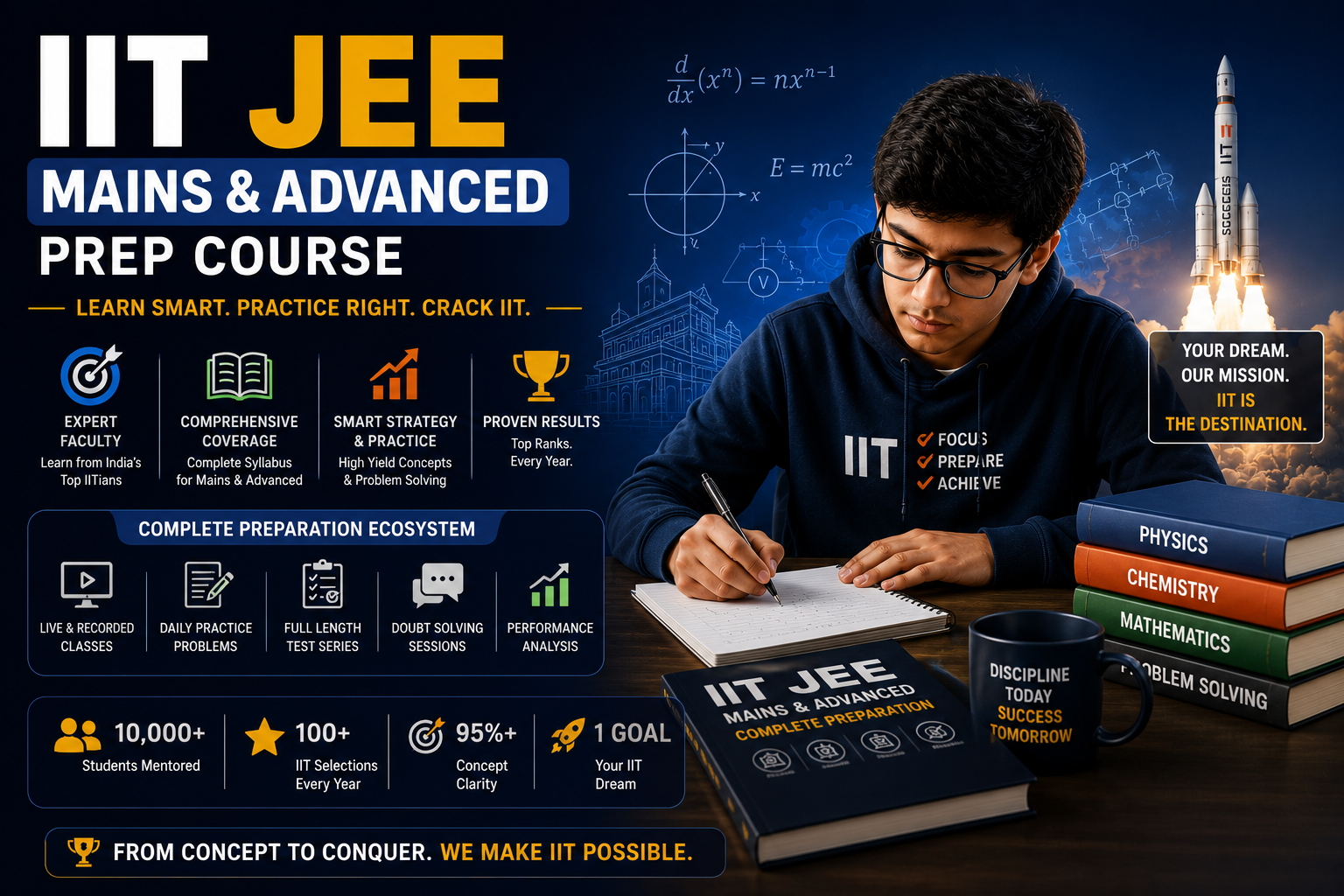
In the digital age, JEE online classes have become an integral part of preparation, offering flexibility, expert guidance, and comprehensive study materials. Edu Global Institute's IIT JEE Mains and Advanced Prep Course provides live interactive classes, recorded lectures, doubt-solving sessions, and regular assessments to ensure comprehensive preparation.
Online learning platforms offer several advantages for JEE aspirants, including access to top faculty regardless of geographical location, flexible study schedules, and interactive learning experiences. For students in UAE, USA, and UK, online classes provide a convenient way to access quality JEE preparation without relocating to India.
Benefits of JEE Online Learning
- Access to recorded lectures for revision and clarification
- Interactive doubt-solving platforms with expert faculty
- Regular JEE Main mock test and performance analysis
- Study materials curated by top educators
- Flexible learning schedules that can be customized according to individual needs
Advanced Preparation Techniques: JEE Main vs Advanced
While both exams share common syllabi, the preparation approach needs to differ based on the exam's requirements. For JEE Main vs Advanced preparation, consider the following advanced techniques:
JEE Main Preparation Focus
JEE Main focuses on speed and accuracy with a large number of questions to be solved in limited time. Your preparation should emphasize:
- Extensive practice through JEE Main mock test series
- Mastering shortcut techniques and quick calculation methods
- Regular revision of JEE Main syllabus 2026 to ensure comprehensive coverage
- Focus on high-weightage chapters with maximum question probability
JEE Advanced Preparation Focus
JEE Advanced requires deeper conceptual understanding and problem-solving skills. Your preparation should emphasize:
- Solving complex problems that require multi-step thinking
- Understanding the application of concepts in various scenarios
- Regular practice with JEE Advanced mock test under timed conditions
- Developing analytical thinking and problem-solving approaches
JEE Daily Practice Problems: Building Consistency
Consistent practice is the key to success in JEE. Incorporating JEE daily practice problems into your study routine helps reinforce concepts, improve problem-solving speed, and identify weak areas. Many successful aspirants solve 30-50 problems daily across all three subjects.
Start with easier problems and gradually increase difficulty. Maintain a JEE time table that allocates specific time slots for daily practice. For each problem solved, ensure you understand the underlying concept and alternative approaches to solve it. This methodical approach helps in building problem-solving skills over time.
Understanding JEE Exam Pattern and Eligibility
Thorough knowledge of the JEE Main exam pattern and IIT eligibility criteria 2026 is essential for effective preparation. The JEE Main consists of three papers: Paper 1 for B.E/B.Tech, Paper 2 for B.Arch, and Paper 3 for B.Planning. Each paper has different sections and marking schemes.
For JEE Advanced, eligibility is determined by performance in JEE Main and requires candidates to be in the top 2.5 lakh rank holders. The Advanced exam consists of two papers (Paper 1 and Paper 2) conducted on the same day, each with three sections of Physics, Chemistry, and Mathematics.
JEE Main Percentile Calculation
Understanding JEE Main percentile calculation is crucial as it determines your rank and eligibility for JEE Advanced. The percentile is calculated based on your relative performance compared to other candidates. The formula normalizes scores across different sessions of the exam, ensuring fair evaluation.
JoSAA Counseling Process: Securing Your Seat
After successfully clearing JEE, the JoSAA counseling process is the final step to secure admission in your desired institute. JoSAA (Joint Seat Allocation Authority) conducts the centralized counseling process for IITs, NITs, IIITs, and other CFTIs based on JEE Main and JEE Advanced ranks.
The counseling process involves multiple rounds of seat allocation, where candidates can select their preferred institutes and courses based on their rank. It's essential to research the top engineering colleges India and understand their seat matrix and previous year cutoffs to make informed choices during counseling.
Special Considerations for International Students
For students in UAE, USA, and UK preparing for JEE, there are specific considerations to keep in mind. Time zone differences may affect your JEE online classes schedule, so choose platforms that offer flexible timings or recorded sessions. Additionally, ensure you have access to required study materials and JEE study material packages that can be delivered internationally.
International students should also familiarize themselves with the IIT eligibility criteria 2026 for foreign nationals and the specific application process for appearing in JEE from abroad. Many online coaching platforms now offer specialized programs for international students with dedicated support for visa and examination logistics.
Psychological Preparation and Stress Management
JEE preparation is not just about academic knowledge; psychological preparedness plays a crucial role in success. The intense pressure of competitive exams can lead to stress and anxiety if not managed properly. Incorporate stress management techniques into your daily routine, such as meditation, exercise, and adequate sleep.
Develop a positive mindset and maintain realistic expectations. Remember that JEE is one of many pathways to a successful career. Join study groups or online communities to share experiences and gain motivation. Regular breaks and hobbies are essential to prevent burnout during the long preparation journey.
JEE Dropper Batch: A Second Chance at Excellence
For those who couldn't achieve their desired rank in the first attempt, a JEE dropper batch offers a structured approach to prepare for another attempt. Dropper programs typically provide comprehensive coverage of the syllabus, regular mock tests, and personalized attention to address specific weaknesses.
If you're considering a dropper year, create a detailed plan that includes:
- A realistic assessment of your previous performance
- Identification of weak areas that need special attention
- A structured study plan with specific milestones
- Regular mock tests and performance analysis
- A healthy balance between study and rest
JEE Block Scheduling Method: Maximizing Efficiency
The JEE block scheduling method is an effective time management technique that involves dividing your study time into focused blocks for each subject. This approach ensures balanced coverage of all three subjects while allowing for deep concentration during each block.
Implement block scheduling by allocating specific time slots for each subject, typically 2-3 hours at a time, with short breaks in between. For example, you might schedule 9-11 AM for Mathematics, 11:30 AM-1:30 PM for Physics, and 3-5 PM for Chemistry. This method prevents fatigue and maintains concentration throughout the day.
JEE High Weightage Chapters: Strategic Focus Areas
Not all chapters in the JEE syllabus carry equal weightage. Identifying JEE high weightage chapters allows you to prioritize your preparation strategically. Based on previous years' question papers, here are some of the most important chapters:
Physics High Weightage Chapters
- Mechanics (especially Laws of Motion, Work Energy Power)
- Electrostatics and Current Electricity
- Magnetism and Electromagnetic Induction
- Optics (Ray Optics and Wave Optics)
- Modern Physics (Atomic Physics, Nuclear Physics)
Chemistry High Weightage Chapters
- Chemical Bonding and Molecular Structure
- p-block elements
- Coordination Compounds
- Chemical Kinetics and Thermodynamics
- General Organic Chemistry (GOC)
Mathematics High Weightage Chapters
- Calculus (Limits, Continuity, Differentiation, Integration)
- Coordinate Geometry (Straight Lines, Conic Sections)
- Algebra (Quadratic Equations, Complex Numbers)
- Vectors and 3D Geometry
- Probability and Statistics
JEE Main Paper 1 Preparation: Key Focus Areas
JEE Main Paper 1 is the most popular paper, taken by candidates seeking admission to B.E/B.Tech programs. It consists of 90 questions (30 each from Physics, Chemistry, and Mathematics) to be completed in 3 hours. Your preparation should focus on:
- Speed and accuracy with regular practice of MCQs
- Numerical value type questions which require precise calculations
- Formula-based questions requiring quick recall
- Application-based questions testing conceptual understanding
Regular practice with JEE Main mock test is essential to build exam temperament and improve time management skills. Analyze your performance in each mock test to identify weak areas and focus on improving them.
JEE Advanced Difficulty Level: Preparing for the Challenge
JEE Advanced difficulty level is significantly higher than JEE Main, requiring deeper conceptual understanding and analytical thinking. To prepare effectively for Advanced:
- Focus on understanding the underlying principles rather than rote learning
- Solve complex problems that require multiple concepts
- Practice with JEE Advanced mock test under exam conditions
- Develop alternative approaches to problem-solving
- Focus on conceptual clarity rather than memorization
Remember that JEE Advanced often includes questions that test your ability to apply concepts in novel situations. Regular practice with previous years' Advanced papers helps in understanding the question patterns and difficulty level.
JEE Study Material: Building Your Resource Library
Comprehensive JEE study material is essential for thorough preparation. Besides standard reference books, include the following resources in your study plan:
- Subject-wise notes from reputed coaching institutes
- Previous years' question papers with detailed solutions
- Formula sheets for quick revision
- Topic-wise assignments for practice
- Online video lectures for difficult concepts
Edu Global Institute's IIT JEE Mains and Advanced Prep Course provides comprehensive study materials curated by top educators, ensuring you have access to quality resources throughout your preparation journey.
JEE Mentorship: Guidance from Experts
Having an experienced IIT JEE mentor can significantly enhance your preparation by providing personalized guidance, doubt resolution, and strategic advice. A good mentor helps you:
- Identify your strengths and weaknesses
- Create a customized study plan based on your current level
- Provide insights into exam trends and question patterns
- Offer motivation and emotional support during challenging times
- Share valuable tips and tricks for effective preparation
Many online coaching platforms now offer mentorship programs where you can connect with experienced educators and IIT alumni for personalized guidance.
JEE Crash Course: Intensive Preparation for Last-Minute Boost
For those with limited time or seeking a final boost before the exam, a JEE Main crash course can be beneficial. These intensive programs typically focus on:
- Quick revision of important concepts
- Solving previous years' questions
- Mock tests and performance analysis
- Doubt-solving sessions
- Last-minute tips and strategies
While a crash course can provide a quick revision, it's most effective when combined with thorough preparation throughout the year. Use crash courses as a supplement to your regular study plan rather than a replacement for comprehensive preparation.
JEE Online Test Series: Assessing Your Preparedness
Regular assessment is crucial to track your progress in JEE preparation. JEE online test series provides a comprehensive evaluation of your knowledge, speed, and accuracy. Look for test series that:
- Mimic the actual exam pattern and difficulty level
- Provide detailed performance analysis
- Include solutions for all questions
- Offer topic-wise and subject-wise tests
- Provide all-India rank comparison
Regular testing helps in identifying weak areas, improving time management, and building exam temperament. Aim to take at least one full-length mock test every week in the final months of preparation.
JEE Doubt Solving: Clarifying Your Concepts
- Live doubt-solving sessions with faculty
- Online forums and communities
- Peer discussion groups
- Video explanations for difficult problems
- One-on-one mentoring sessions
Remember that clearing doubts promptly is crucial as unresolved questions can become roadblocks in understanding more complex topics later in your preparation.
JEE Formula Sheets: Quick Reference for Revision
- Important formulas and equations
- Key concepts and principles
- Commonly used shortcuts and tricks
- Important diagrams and graphs
- Summary of each chapter
Regularly review these formula sheets to reinforce your memory and ensure quick recall during the exam. Keep updating them as you progress through your preparation to include new insights and important points.
Conclusion: Your Path to JEE 2026 Success
Success in JEE requires a combination of thorough preparation, strategic planning, and consistent effort. The IIT JEE Mains and Advanced Prep Course offered by Edu Global Institute provides a comprehensive roadmap to help you navigate the challenges of JEE preparation. By following the strategies outlined in this guide, utilizing the recommended resources, and maintaining a disciplined approach, you can significantly enhance your chances of securing a top rank in JEE 2026.
Remember that JEE preparation is a marathon, not a sprint. Maintain a healthy balance between study and rest, stay motivated, and believe in your abilities. With the right guidance, resources, and dedication, you can overcome the challenges and achieve your dream of studying in India's premier engineering institutes.
Start your JEE 2026 preparation today with Edu Global Institute's expert guidance and comprehensive study materials. Your journey to IIT success begins now!
Related reading
Questions people ask
What is the format of JEE?
Before diving into preparation strategies, it's crucial to understand the differences between JEE Main vs Advanced preparation approaches.
How should you prepare for JEE?
Creating an effective JEE 2026 preparation strategy requires careful planning and execution. The ideal preparation period spans 18-24 months, allowing for thorough coverage of the syllabus, adequate practice, and revision.
What are the best resources for JEE?
Selecting the right study materials is crucial for effective JEE preparation. While NCERT books form the foundation, you'll need additional resources for comprehensive preparation.
Who is eligible for JEE?
Thorough knowledge of the JEE Main exam pattern and IIT eligibility criteria 2026 is essential for effective preparation. The JEE Main consists of three papers: Paper 1 for B.E/B.Tech, Paper 2 for B.Arch, and Paper 3 for B.Planning. Each paper has different sections and marking schemes.
How difficult is JEE?
JEE Advanced difficulty level is significantly higher than JEE Main, requiring deeper conceptual understanding and analytical thinking.
Get a study plan for this
Tell us the class and what they are working towards, and we will send a plan built around it, plus the next free trial class. No cost, and we will not pass your details on.