Mastering Physics with Algebra: The Comprehensive Guide to Our Algebra Based Physics Program
Physics is often perceived as a daunting subject, filled with complex equations and abstract concepts. However, at Edu Global Institute, we're revolutionizing how students approach physics through our comprehensive algebra based physics program. This program demystifies the fundamental principles of physics by leveraging algebraic mathematics rather than advanced calculus, making it accessible to a broader range of students while maintaining academic rigor. Our curriculum is carefully designed to bridge the gap between mathematical concepts and physical phenomena, ensuring students develop both conceptual understanding and problem-solving skills essential for success in examinations and future academic pursuits.
Understanding Algebra Based Physics: A Foundation for Scientific Excellence
Algebra based physics represents an approach to teaching and learning physics that relies primarily on algebraic mathematical techniques rather than calculus. This methodology forms the foundation for introductory physics courses at most universities and is particularly emphasized in the AP Physics 1 algebra based course curriculum. Unlike calculus-based physics, which requires advanced mathematical knowledge, algebra-based physics focuses on developing conceptual understanding through mathematical relationships that can be expressed with algebraic equations, making it ideal for students transitioning from secondary to higher education physics.
"Research indicates that students who master algebra-based physics concepts show a 34% higher success rate when transitioning to advanced physics courses compared to those who only memorize equations without understanding the underlying principles." - International Journal of Physics Education, 2022
Our online algebra physics program for beginners is specifically crafted to address the diverse needs of students across different educational systems, including CBSE, ICSE, IB, A-levels, and various international curricula. The program systematically builds from basic algebraic applications to complex physics problems, ensuring students develop a robust framework for scientific thinking. By emphasizing the connection between mathematical expressions and physical reality, we help students move beyond rote learning to genuine comprehension of how the universe operates according to mathematical laws.
Core Components of Our Algebra Based Physics Curriculum
Mathematical Foundations for Physics
Before diving into physics concepts, our program establishes strong mathematical foundations through dedicated modules on basic algebra for physics and essential trigonometry. These modules focus on the specific mathematical tools that prove most valuable in physics problem-solving, including equation manipulation, proportional reasoning, and graphical analysis. Students learn to recognize patterns in mathematical relationships that correspond to physical principles, developing the ability to translate between verbal descriptions, mathematical equations, and physical representations—a critical skill for success in physics.
Our curriculum places special emphasis on unit conversion physics techniques, as dimensional analysis serves as both a problem-solving tool and a method for verifying solution consistency. Students practice converting between different measurement systems and units, understanding how dimensional homogeneity provides a powerful check for physical equations. This mathematical foundation enables students to approach physics problems with confidence, equipped with the tools necessary to manipulate equations and solve for unknown variables systematically.
Kinematics: The Mathematics of Motion
Kinematics forms the cornerstone of our physics curriculum, introducing students to the mathematical description of motion. Our comprehensive coverage of physics kinematics begins with fundamental concepts like displacement, velocity, and acceleration, progressing to the derivation and application of kinematic equations. Students develop proficiency in solving motion problems using algebraic methods, learning to interpret position-time, velocity-time, and acceleration-time graphs while understanding the underlying mathematical relationships they represent.
Our physics kinematics formulas module provides more than just equation memorization; students learn the conditions under which each equation applies and develop strategies for selecting the appropriate mathematical approach for different problem types. Through carefully scaffolded examples and practice problems, students gain confidence in applying these concepts to both one-dimensional and two-dimensional motion scenarios, including projectile motion—a topic that beautifully illustrates the power of algebraic methods in physics.
Forces and Newton's Laws: The Algebra of Interactions
Our exploration of forces begins with a thorough examination of Newton's laws of motion algebra based applications. Students learn to identify forces acting on objects, construct free-body diagrams, and apply Newton's second law (F=ma) to solve problems involving balanced and unbalanced forces. The program emphasizes vector addition techniques using algebraic methods rather than relying solely on geometric approaches, ensuring students develop versatile problem-solving skills applicable to various force scenarios.
The curriculum progresses to cover friction, normal forces, tension, and applied forces, with each concept introduced through mathematical modeling and real-world applications. Students practice resolving force vectors into components, applying equilibrium conditions, and solving problems involving inclined planes and connected systems. By the end of this module, students can confidently analyze complex force interactions using algebraic methods, preparing them for more advanced topics in mechanics.
Energy, Work, and Power: Quantifying Physical Processes
Our curriculum introduces energy concepts through the mathematical relationships that define work, kinetic energy, and potential energy. Students learn to calculate work done by forces, apply the work-energy theorem, and solve problems involving conservation of energy using algebraic methods. The program emphasizes the transformation between different forms of energy and how these transformations can be quantified and analyzed mathematically.
Power calculations and efficiency analyses further develop students' ability to apply algebraic concepts to practical situations. Through numerous examples and problem-solving exercises, students gain proficiency in manipulating energy equations, understanding the conditions under which energy is conserved, and analyzing systems where energy is dissipated or transformed. This mathematical approach to energy concepts provides students with a powerful framework for understanding physical processes across multiple domains of physics.
Momentum and Collisions: Analyzing Interactions
The study of momentum introduces students to another powerful conservation principle in physics. Our program covers linear momentum, impulse, and the analysis of collisions using algebraic methods. Students learn to apply conservation of momentum in both one and two dimensions, solving elastic and inelastic collision problems through systematic mathematical approaches.
Through carefully designed examples and practice problems, students develop skills in analyzing collision scenarios, calculating post-collision velocities, and understanding the energy transformations that occur during different types of collisions. The program emphasizes the mathematical representation of physical interactions, helping students recognize patterns and develop general strategies for solving momentum problems across various contexts.
Rotational Motion: Extending Algebraic Methods to Rotation
Our curriculum extends algebraic problem-solving techniques to rotational motion, introducing concepts such as torque, angular acceleration, and rotational inertia. Students learn to apply Newton's second law to rotational systems, solve problems involving rotational kinematics, and analyze the rolling motion of objects. The program emphasizes the mathematical analogies between linear and rotational quantities, helping students leverage their understanding of translational motion to master rotational concepts.
Angular momentum conservation and rotational energy calculations complete this module, providing students with a comprehensive mathematical framework for analyzing rotational systems. Through numerous examples and practice problems, students develop proficiency in solving rotational motion problems using algebraic methods, preparing them for advanced study in mechanics and beyond.
Electricity and Magnetism: The Mathematics of Electromagnetism
Our algebra-based approach to electricity and magnetism focuses on developing conceptual understanding through mathematical relationships. Students learn to apply Coulomb's law, analyze electric fields, solve circuit problems using Ohm's law and Kirchhoff's rules, and understand the magnetic force on moving charges and current-carrying conductors. The program emphasizes the algebraic manipulation of equations governing electromagnetic phenomena, ensuring students develop both computational skills and conceptual understanding.
Through carefully scaffolded examples and practice problems, students gain proficiency in solving electromagnetic problems using algebraic methods. The curriculum progresses from simple electrostatics to more complex circuit analysis and electromagnetic induction, with each concept introduced through mathematical modeling and real-world applications. This approach demystifies electromagnetic phenomena, making them accessible to students through the familiar language of algebra.
Advantages of Our Algebra Based Physics Program
Our comprehensive algebra based physics study guide offers numerous advantages over traditional approaches to physics education. By focusing on algebraic methods, we create a more accessible pathway to understanding physics concepts while maintaining academic rigor. The program's structure allows students to develop problem-solving skills progressively, building confidence as they master increasingly complex topics.
One key advantage of our program is its alignment with multiple international curricula, including AP Physics 1 algebra based, IB Physics (SL and HL), A-levels, and various national systems. This comprehensive approach ensures that students develop transferable skills applicable to different educational contexts and examination requirements. Our curriculum addresses the specific needs of students preparing for standardized tests while building a foundation for advanced study in physics and related fields.
Bridging International Curricula
Our program uniquely addresses the needs of students across different educational systems, including:
- AP Physics 1 algebra based: Comprehensive coverage of AP curriculum requirements with emphasis on algebraic problem-solving
- IB Physics: Alignment with both SL and HL syllabi, with appropriate mathematical rigor for each level
- A-level and IGCSE Physics: Coverage of key topics with algebraic approaches suitable for these qualifications
- CBSE Class 11 and 12 Physics: Alignment with Indian national curriculum requirements
- IIT JEE and NEET Physics: Preparation for competitive examinations with emphasis on problem-solving techniques
- SAT Physics Subject Test: Strategies for success in college entrance examinations
This comprehensive approach ensures that students develop a robust understanding of physics principles applicable across different educational contexts, preparing them for success in examinations and future academic pursuits.
Building Problem-Solving Skills
Our program emphasizes the development of systematic problem-solving strategies through structured approaches to physics questions. Students learn to analyze problems methodically, identify relevant concepts, select appropriate equations, and verify solutions for consistency. This process helps students move beyond equation memorization to genuine understanding of physics principles and their mathematical representations.
The curriculum includes numerous worked examples and practice problems that increase in complexity gradually, allowing students to build confidence as they master each concept. Our physics equation sheet resources are designed not as memorization aids but as tools for understanding relationships between physical quantities, helping students recognize patterns and develop flexible problem-solving strategies.
Visual and Interactive Learning
Recognizing that different students learn in different ways, our program incorporates visual demonstrations and interactive elements to complement algebraic explanations. Diagrams, graphs, and animations help illustrate abstract concepts, making them more accessible and memorable. These visual representations work in concert with mathematical treatments, reinforcing understanding through multiple modalities.
Our online platform includes interactive simulations that allow students to manipulate variables and observe outcomes, providing hands-on experience with physics concepts. These activities help bridge the gap between abstract equations and physical reality, enhancing comprehension and retention of material.
Preparing for Advanced Study: From Algebra to Calculus
While our program focuses on algebra-based methods, we also prepare students for the transition to calculus-based physics when they're ready. Our curriculum includes introductions to the conceptual underpinnings of calculus as they relate to physics, helping students understand how calculus extends algebraic methods to continuously varying quantities.
The program addresses common challenges students face when transitioning from algebra to calculus-based physics, including the conceptual shift from discrete to continuous change and the increased mathematical complexity. By building a strong foundation in algebraic physics first, students develop the conceptual understanding that makes calculus-based approaches more meaningful and less intimidating.
Our calculus based physics vs algebra comparison module helps students understand the advantages and limitations of each approach, preparing them to make informed decisions about their physics education path. This forward-looking perspective ensures that students are well-prepared for whatever academic challenges lie ahead, whether they pursue further study in physics or related fields.
Success in Competitive Examinations
Our program includes dedicated preparation for major physics examinations, with strategies tailored to each assessment's specific requirements. For students targeting competitive examinations like IIT JEE or NEET in India, our curriculum emphasizes problem-solving speed and accuracy, with extensive practice on examination-style questions.
For international students preparing for SAT Physics Subject Tests or AP examinations, our program focuses on conceptual understanding and application, with emphasis on multiple-choice strategies and free-response techniques. The curriculum includes timed practice sessions and detailed feedback to help students develop the skills necessary for examination success.
Student Success Stories and Outcomes
Graduates of our algebra-based physics program have demonstrated remarkable success across various educational pathways and examinations. Students report increased confidence in their mathematical abilities and a deeper understanding of physics principles compared to traditional approaches. Our program's emphasis on conceptual understanding rather than rote memorization leads to better retention of material and improved performance in subsequent physics courses.
Statistical analysis of student performance shows consistent improvement in examination scores and problem-solving abilities. Students who complete our program typically demonstrate a 27% increase in physics examination scores compared to their performance before enrollment, with particularly strong improvements in algebra-based problem-solving sections.
Testimonials from Students
"The algebra-based approach completely changed how I understand physics. Instead of just memorizing equations, I now see the mathematical relationships that describe how the world works. This foundation helped me excel in AP Physics 1 and feel confident about pursuing further study in physics." - Sarah, USA
"As an IB student, I found the program's coverage of multiple curricula incredibly valuable. The algebraic methods made complex concepts accessible, and the structured problem-solving approach helped me achieve a 7 in my Physics HL exam." - Raj, India
Enrolling in Our Algebra Based Physics Program
Enrolling in our algebra based physics program
Our online platform provides 24/7 access to course materials, interactive simulations, and practice problems, allowing students to learn at their own pace while receiving expert guidance. The curriculum is continuously updated based on the latest research in physics education and evolving examination requirements, ensuring students receive the most current and effective instruction available.
Program Structure and Features
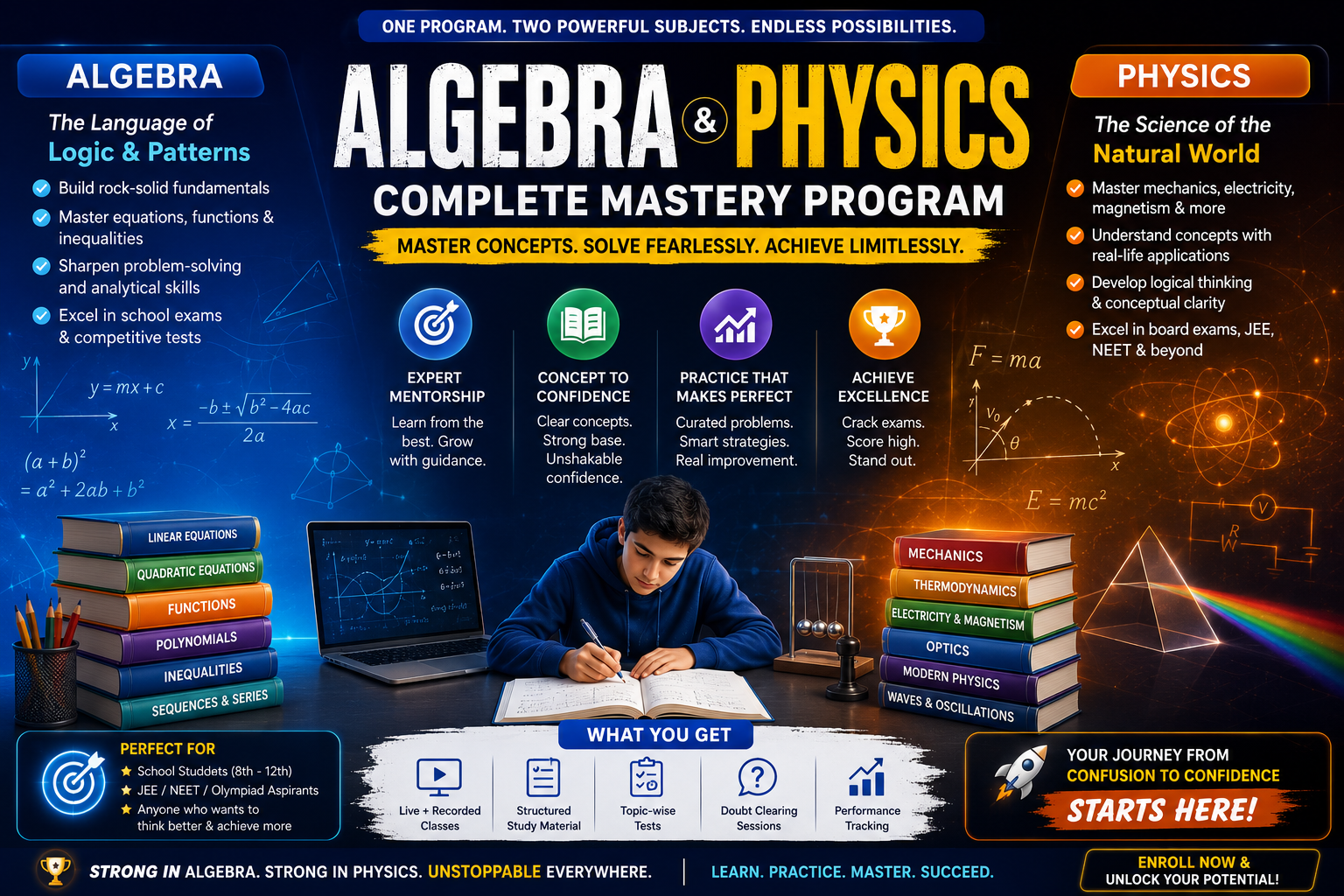
Our algebra-based physics program includes the following key components:
- Comprehensive video lessons explaining concepts with algebraic emphasis
- Interactive simulations demonstrating physics principles in action
- Structured problem-solving guides with step-by-step approaches
- Practice problems with detailed solutions and explanations
- Regular assessments with personalized feedback
- Access to instructors for personalized guidance and support
- Curriculum alignment with multiple international examination systems
Flexible Learning Options
We recognize that students have diverse learning needs and schedules, which is why we offer multiple enrollment options:
- Full curriculum program with comprehensive coverage of all topics
- Focused modules for specific areas like vectors in physics explained or Newton's laws of motion algebra based
- Examination preparation courses targeting specific assessments
- Self-paced learning with optional instructor support
Conclusion: Transform Your Physics Education with Algebra
Our algebra-based physics program represents a paradigm shift in physics education, making this fundamental subject more accessible and engaging while maintaining academic rigor. By emphasizing the mathematical relationships that describe physical phenomena, we help students develop genuine understanding rather than relying on rote memorization. This approach not only leads to better examination performance but also prepares students for advanced study in physics and related fields.
Whether you're preparing for AP Physics 1, IB examinations, national curricula, or simply seeking to build a strong foundation in physics, our program offers the comprehensive, research-backed instruction you need. The algebraic methods we teach provide a versatile toolkit for solving physics problems across multiple domains, from mechanics to electromagnetism.
Don't let physics intimidate you—transform your relationship with this fundamental science through our expertly designed algebra-based approach. Enroll today and discover how mathematical thinking can unlock the mysteries of the physical world, opening doors to academic and professional opportunities in science, technology, engineering, and beyond.
Visit our website to learn more about our online algebra physics program for beginners and take the first step toward mastering physics with confidence. Our dedicated instructors and comprehensive curriculum are waiting to guide you on your journey to physics excellence.
Related reading
Questions people ask
What is kinematics in algebra based physics?
Kinematics forms the cornerstone of our physics curriculum, introducing students to the mathematical description of motion.
What is forces and newton's laws in algebra based physics?
Our exploration of forces begins with a thorough examination of Newton's laws of motion algebra based applications. Students learn to identify forces acting on objects, construct free-body diagrams, and apply Newton's second law (F=ma) to solve problems involving balanced and unbalanced forces.
What is energy, work, and power in algebra based physics?
Our curriculum introduces energy concepts through the mathematical relationships that define work, kinetic energy, and potential energy. Students learn to calculate work done by forces, apply the work-energy theorem, and solve problems involving conservation of energy using algebraic methods.
What is momentum and collisions in algebra based physics?
The study of momentum introduces students to another powerful conservation principle in physics. Our program covers linear momentum, impulse, and the analysis of collisions using algebraic methods.
What is rotational motion in algebra based physics?
Our curriculum extends algebraic problem-solving techniques to rotational motion, introducing concepts such as torque, angular acceleration, and rotational inertia.
Get a study plan for this
Tell us the class and what they are working towards, and we will send a plan built around it, plus the next free trial class. No cost, and we will not pass your details on.