Physics Olympiad Intensive: Foundations to Mechanics
Program Overview: The 7-Month Physics Trajectory
Standard high school physics curriculums rely heavily on memorization and simple "plug-and-chug" algebra. However, elite physics competitions—such as the NSEJS, INPhO, and the F=ma exam—test a student's ability to logically deconstruct complex, multi-variable physical systems.
The EduGlobal Institute 7-Month Physics Intensive is a strictly structured, 1-on-1 intervention designed to upgrade a student's baseline scientific knowledge to an elite Olympiad level. Guided by the Syamabal Learning Software, this course forces students to move beyond basic definitions and fully grasp the real-world application of Newtonian mechanics and fluid dynamics.
Who This Course Is For
This program operates at a highly accelerated pace. It is specifically engineered for students who possess a strong mathematical foundation and are prepared for rigorous scientific reasoning.
- For Indian Students: Highly motivated students currently studying in Classes 10, 11, or 12 who are targeting national-level science examinations.
- For International Students: Students who have successfully attempted the AMC 8 (or possess equivalent logical problem-solving skills) and are looking to aggressively enter competitive physics.
Strict Academic Prerequisites
To ensure no time is wasted, students must enter the program with the following baseline knowledge:
- Mathematics: Fluency in basic calculations, solving linear equations in two variables, quadratic equations, and fundamental algebraic manipulation.
- Science: General, foundational science comprehension up to an 8th or 10th-grade standard.
Our Methodology: The Syamabal Protocol
We do not allow students to passively watch physics demonstrations. Physics requires active, algorithmic problem-solving.
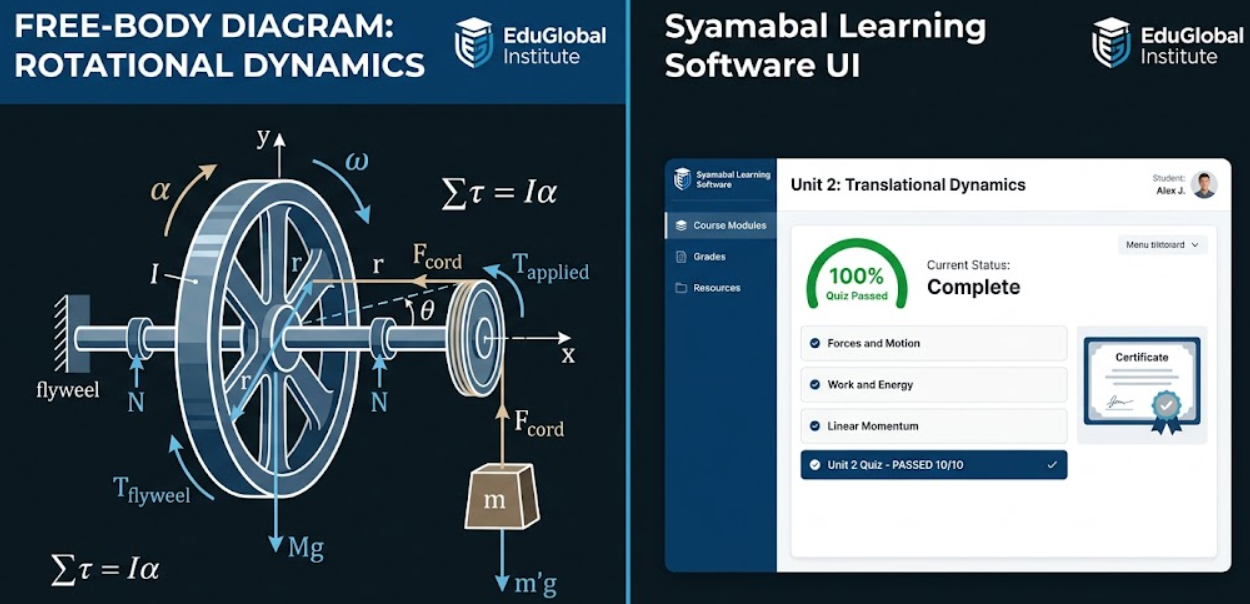
After each unit, students are subject to the Syamabal 6-Quiz Reinforcement Protocol. A student must pass six progressively difficult application quizzes before the software allows them to advance to the next unit. This ensures that foundational concepts (like vector addition) are absolutely solidified before attempting complex systems (like rotational kinematics).
The 7-Month Core Syllabus
The curriculum is broken down into 8 high-yield units, weighted precisely to mirror the demands of high-stakes, algebra-based physics exams (such as AP Physics 1 and F=ma).
Unit 1: Kinematics (10%–15% Exam Weight)
- Differentiation between scalars and vectors.
- 1D and 2D motion analysis.
- Calculating displacement, instantaneous/average velocity, and constant acceleration.
Unit 2: Force and Translational Dynamics (18%–23% Exam Weight)
- Deep application of Newton's Three Laws of Motion.
- Analyzing complex, multi-body systems.
- Uniform circular motion and the mathematical modeling of kinetic/static friction.
Unit 3: Work, Energy, and Power (18%–23% Exam Weight)
- The Law of Conservation of Energy in isolated and open systems.
- Application of the Work-Energy Theorem.
- Calculating mechanical power and energy transfer.
Unit 4: Linear Momentum (10%–15% Exam Weight)
- Defining impulse and calculating the area under Force-Time graphs.
- Conservation of linear momentum.
- Mathematical analysis of elastic vs. inelastic collisions and center of mass calculations.
Unit 5: Torque and Rotational Dynamics (10%–15% Exam Weight)
- Translating linear concepts to rotational kinematics.
- Calculating torque, rotational inertia, and net angular acceleration.
Unit 6: Energy and Momentum of Rotating Systems (10%–15% Exam Weight)
- Rotational kinetic energy calculations.
- Conservation of angular momentum in dynamic, changing systems.
Unit 7: Oscillations (2%–5% Exam Weight)
- The defining characteristics of Simple Harmonic Motion (SHM).
- Energy transformations in ideal spring-mass systems and simple pendulums.
Unit 8: Fluids (2%–5% Exam Weight)
- Calculating fluid density, absolute/gauge pressure, and buoyant forces (Archimedes' Principle).
- Introduction to fluid dynamics and ideal fluid flow rates.
The Verifiable Output
Upon completion of this 7-month timeline, the student will have effectively bypassed years of standard schooling. They will be fully capable of solving complex, algebra-based physics problems up to a 12th-grade standard. Most importantly, they will possess the structural logic required to competitively attempt the NSEJS, INPhO, F=ma, and other premier global science Olympiads.
Apply for Admission
Secure your spot for Physics Olympiad Intensive: Foundations to Mechanics.
Free Diagnostic Tests
Evaluate your readiness with our AI-analyzed mock assessments.
UT Austin 8th Grade Math CBE: Elite Comprehensive (Obj 2, 3 & 4)
Advanced 60-question interactive quiz for the UT Austin 8th Grade Math CBE. Rigorous distractors covering Objectives 2, 3, and 4. High-level prep.
UT Austin 8th Grade Math CBE: Obj 4 Numerical Computation
Master Objective 4 for the UT Austin 8th Grade Math CBE. 30 expert-level numerical practice questions covering equations, transversals, volume, and surface area.
Numerical Calculation Review - UT Austin CBE
Master Objectives 2 & 3 for the UT Austin 8th Grade Math CBE. 50 expert-level practice questions covering real numbers, slope, dilations, and linear functions.