
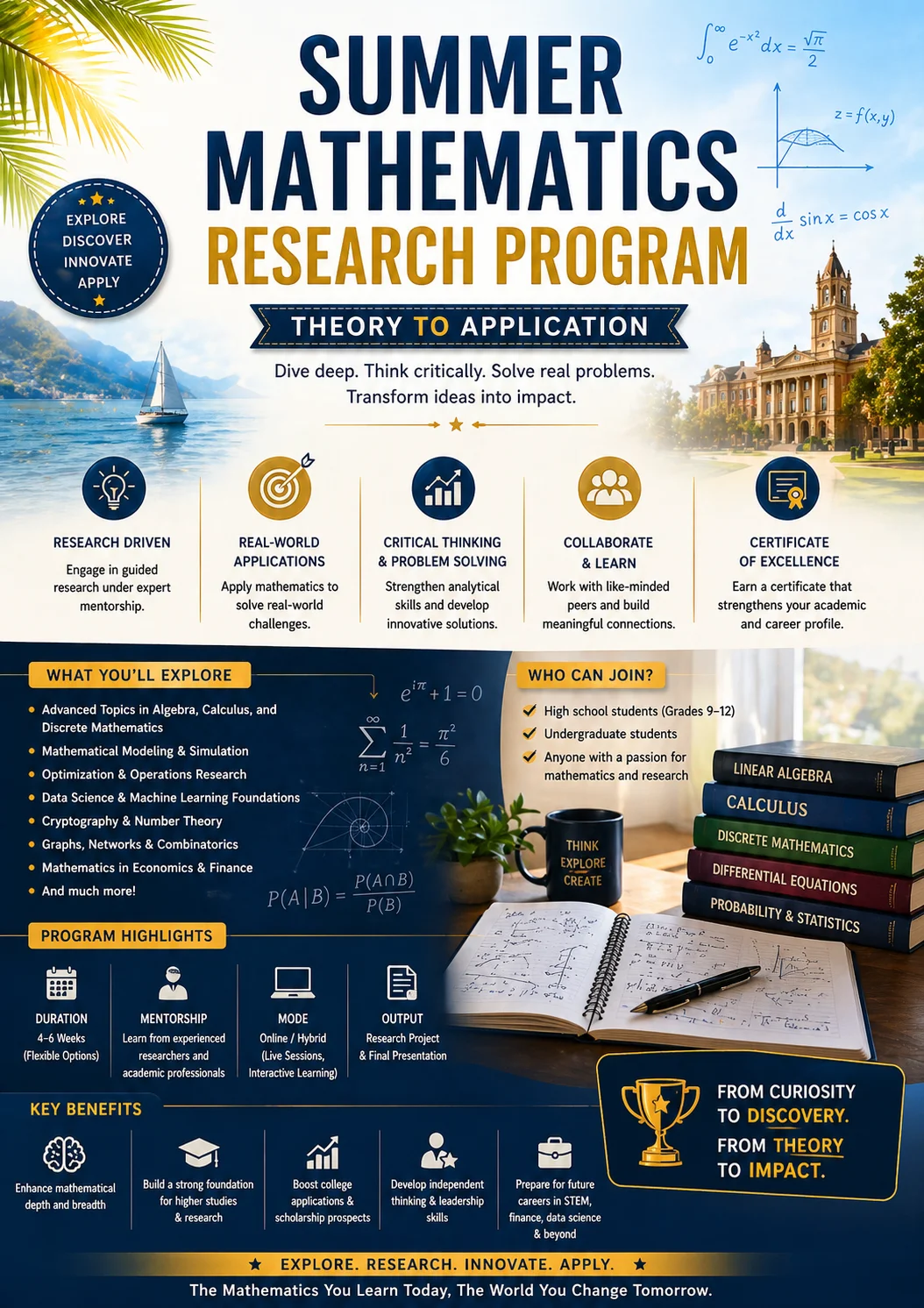
Summer Math Research Programs: A Parent's Guide to Unlocking Your High Schooler's Potential
Summer Math Research Programs: A Parent's Guide to Unlocking Your High Schooler's Potential
As the Head Academic Director at Syamabala Academy, I understand the profound impact that targeted academic experiences can have on a young mind. In today's competitive landscape, providing your high schooler with opportunities that extend beyond the traditional classroom is paramount. Summer math research programs offer an unparalleled avenue for intellectual growth, skill development, and future exploration. This guide is designed to equip you with the knowledge to navigate these transformative opportunities and empower your child's academic journey.
Why Summer Math Research Matters for Your High Schooler
The benefits of engaging in summer math research are multifaceted and extend far beyond the immediate academic year. These programs are not merely enrichment activities; they are strategic investments in your child's future.
Boosting College Applications and Admissions
Colleges and universities are increasingly seeking applicants who demonstrate initiative, intellectual curiosity, and a genuine passion for their chosen fields. Participation in a summer math research program provides concrete evidence of these qualities. It showcases a student's ability to engage with complex problems, contribute to a project, and work within a research environment – all highly valued attributes that differentiate applications.
Developing Essential 21st-Century Skills
Beyond theoretical knowledge, these programs cultivate critical 21st-century skills. Students learn to approach problems with a researcher's mindset, developing robust analytical abilities, critical thinking, and sophisticated problem-solving techniques. They learn to formulate hypotheses, design experiments (or computational models), analyze data, and communicate their findings effectively. Skills such as logical reasoning, abstract thinking, and the ability to work with mathematical concepts like calculus, linear algebra, and even introductory abstract algebra are honed.
Exploring Future STEM Careers and Passions
For many high school students, the world of STEM can seem abstract. Summer research provides a tangible glimpse into the day-to-day realities of scientific and mathematical inquiry. It allows them to explore specific areas of interest, such as cryptography, data science, theoretical physics, or computational biology, and discover where their true passions lie. This firsthand experience is invaluable in guiding future academic and career decisions.
Gaining Real-World Experience Beyond the Classroom
The structured environment of a research program mirrors professional academic and industry settings. Students learn to collaborate with mentors and peers, manage their time effectively, and present their work. This practical exposure builds confidence and a sense of accomplishment that cannot be replicated in a typical classroom setting.
Finding the Right Summer Math Research Program
The landscape of summer math research programs can seem vast. Understanding the different types and key selection criteria will help you identify the best fit for your child.
Understanding Different Program Types
Programs vary in structure and focus. Research Experiences for Undergraduates (REUs), while primarily for college students, sometimes have pathways or similar opportunities for exceptional high schoolers. Internships may be offered by research institutions or companies. Increasingly, online and remote research opportunities provide flexibility and accessibility.
Key Criteria for Selecting a Program
Consider the following when evaluating programs: Location (on-campus, remote), Duration (typically 6-10 weeks), Focus Area (specific branches of mathematics or interdisciplinary applications), and Cost (some are funded, others require tuition). Research the faculty mentors and their areas of expertise.
Identifying Programs for Different Skill Levels
Not all programs are designed for advanced prodigies. Many offer introductory research experiences for students with a strong foundation in high school mathematics. Look for programs that clearly outline their prerequisites and learning objectives.
Addressing Parent Anxiety: ""Is my child advanced enough?""
This is a common concern. A genuine interest in mathematics and a strong work ethic are often more crucial than being a math prodigy. Many programs are designed to nurture talent and provide a supportive learning environment. Focus on your child's enthusiasm and dedication; these are excellent indicators of potential success.
Global Summer Math Research Opportunities for High Schoolers
The pursuit of knowledge knows no borders. Excellent summer math research programs are available worldwide.
Top Programs in the US
Prestigious universities like MIT, Stanford, and Carnegie Mellon often host summer research programs. Many REUs, while targeting undergraduates, are open to exceptionally qualified high school students. Look for programs specifically advertised for pre-college students.
Opportunities in the UK
Institutions such as Cambridge and Oxford offer summer programs that may include research components. University departments often have summer outreach initiatives.
Programs in India
Leading Indian Institutes of Technology (IITs) and research organizations like the Indian Statistical Institute (ISI) offer summer research fellowships and internships. These are excellent options for students seeking rigorous mathematical training.
Options in Australia
Universities in Australia, including those in Sydney and Melbourne, provide summer research opportunities for high school students, often focusing on STEM fields.
Online and Remote Research Possibilities
Platforms like Polygence and various university-led online initiatives offer remote research experiences. These programs allow students to collaborate with mentors and peers globally, irrespective of their physical location.
International Student Participation
Many international programs welcome applications from students worldwide. It is crucial to check the specific admission requirements and visa regulations for each program.
The Application Process: Tips for Success
Navigating the application process requires foresight and careful preparation.
When to Start Looking and Applying
The application window for many summer programs opens in the fall of the preceding year, with deadlines typically in late fall or early winter. Begin your research early, ideally a year in advance.
Crafting a Strong Application
Your child's application is their opportunity to shine. Essays should articulate their passion for mathematics, their specific interests, and why they are a good fit for the program. Recommendations from teachers who know your child's academic strengths and character are vital.
Preparing for Interviews
Some programs include an interview component. Encourage your child to practice discussing their mathematical interests, their understanding of the program's research areas, and their goals. They should be prepared to discuss their academic background and any relevant projects.
Addressing Parent Anxiety: ""Will this be worth the investment?""
The return on investment for a summer math research program is significant and long-lasting. Beyond the immediate boost to college applications, the skills acquired—analytical thinking, problem-solving, and intellectual resilience—are foundational for success in higher education and future careers. The experience fosters independence, confidence, and a deeper understanding of their academic path. The connections made with mentors and peers can also open doors to future opportunities.
Success Stories and Testimonials
The impact of these programs is best illustrated through the experiences of those who have participated.
Hear from Students Who Participated
""Participating in the summer math research program at [Institution Name] allowed me to explore my fascination with number theory. I worked on a project"
Speak with an Expert
Get a personalized academic roadmap based on the strategies discussed in this report.
Application Sent!
Your details have been securely routed to our admissions team. An elite academic mentor will review your profile and contact you within 24 hours.