
How to Prevent the "Middle Years" Math Slump in Grades 3-5
Between the ages of 8 and 11, a silent crisis occurs in many classrooms. Children who previously loved counting and basic arithmetic suddenly decide they "hate math." Why does a smart, capable 9-year-old suddenly hit a wall?
The culprit is what we call the "Middle Years Trap." As math transitions into complex concepts like long division, LCM, and fractions, traditional education systems abandon visual learning. Instead, they force children to memorize blind algorithms without explaining why they work. The child stops visualizing, stops thinking logically, and is reduced to acting like a slow, frustrated calculator.
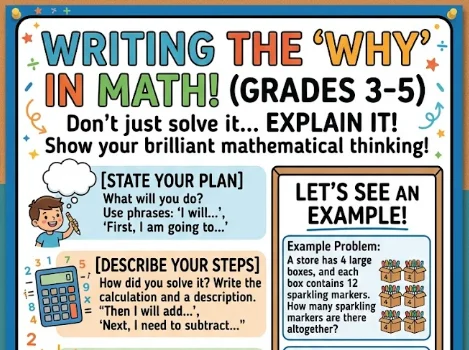
The Solution: "Writing the Why"
To save a child's mathematical confidence, we must align with their psychology. At this age, children crave intellectual power. They want to feel capable of decoding mysteries. This is the core philosophy behind Foundational Maths.
Instead of handing them a formula like (a+b)² = a² + 2ab + b² and demanding they memorize it, we teach them to prove it. By drawing squares and rectangles to physically calculate the area, the abstract equation suddenly becomes a tangible, undeniable truth. They write to reason, and they calculate to prove.
Translating Intuition into Power
The Foundational Maths program serves as the ultimate bridge between early childhood play and high-level Olympiad mastery. Our approach is built on three pedagogical pillars:
- Visual to Written Translation: We explicitly map the hands-on geometry learned in early years directly onto written algebraic equations.
- The 'Why' Before the 'How': No mathematical algorithm is ever taught without a logical proof. Even something as simple as x⁰ = 1 is proven logically before it is calculated.
- Algorithmic Speed: Once the logic is deeply understood, we transition students to structured, rapid mental math processes, giving them incredible processing speed.
Disguising University Concepts as Puzzles
We don't wait until High School to teach advanced discrete mathematics. We simply change the packaging.
Instead of boring algebra drills, we use Cryptarithmetic (like decoding SEND + MORE = MONEY) to teach algebraic substitution. We teach Kinematics and relative speed alongside basic fractions. We explore Geodesics by asking students to find the shortest 3D path for an ant walking across a folded cube.
The Ultimate Outcome
The journey from Grade 3 to 5 is critical. It is the exact moment a child decides whether they are a "math person" or not.
By teaching them to translate intuition into written logic, we are giving them the ultimate intellectual armor. A student who graduates from the Foundational Maths program doesn't just survive standard exams. Armed with the ability to write their own proofs and decode complex word problems, they step onto the Mathematics Olympiad stage feeling unstoppable.
Forging the next generation of elite logical thinkers.
Speak with an Expert
Get a personalized academic roadmap based on the strategies discussed in this report.
Application Sent!
Your details have been securely routed to our admissions team. An elite academic mentor will review your profile and contact you within 24 hours.