
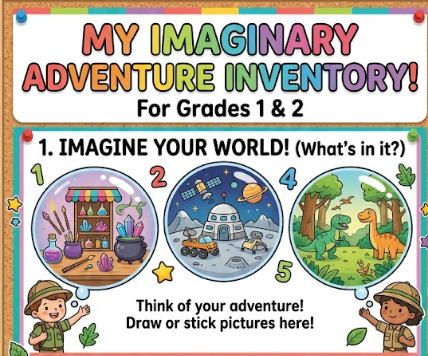
Inventory Maths: For Grades 1 & 2
What is this?
The "Touch-Think-Speak" Program
Inventory Maths is an elite foundational program for Grades 1 & 2 that replaces abstract equations and rote worksheets with tactile play, spatial reasoning, and visual logic. We do not teach formulas; we build mathematical intuition through physical and virtual experiences.
Why is this necessary?
Most traditional curricula make a critical psychological error with 6 to 8-year-olds: they force abstract symbols (like $3 \times 4 = 12$) onto children before they understand the physical quantity behind the numbers.
This premature abstraction causes math anxiety. Inventory Maths flips the script. By letting children "take inventory" of the world using manipulatives, GeoGebra, and logic puzzles, we align perfectly with their cognitive development. They learn the concept of multiplication as branching tree diagrams long before they are ever forced to write an equation.
The 4 Golden Rules
- Hybrid Reality: Virtual tools + physical home objects.
- 100% Response: No passive watching allowed.
- Discover, Don't Tell: Children formulate the laws themselves.
- Zero Worksheets: Pure interactive exploration.
The Conclusion & Outcome
After completing Inventory Maths, a child does not just pass standard tests; they possess a fully stocked "mental warehouse." They develop profound spatial reasoning, a complete absence of math anxiety, and an intuitive grasp of early combinatorics, parity, and geometry. They are perfectly primed and eagerly ready to transition into the rigorous written logic of Foundational Maths (Grades 3-5).
Detailed Curriculum Blueprint
The Pattern Detectives (Sequences & Logic)
Giant Number Lines (Parity), The Visual Sieve (Primes), Pascal's Pyramid (Combinatorics), and The Crowded House (Intro to Pigeonhole Principle).
The Bank Game (Place Value & Operations)
Tens & Ones Exchange, Geometry of Addition (Cuisenaire Rods), The Mystery Bag (Early Algebra), and Tower of Hanoi (Recursive Algorithms).
Branching Out (Multiplication & Division)
Tree Diagrams (Fundamental Counting Principle), Equal Sharing (Modulo Arithmetic), and Unitary Reasoning with Time/Distance.
Spatial Architecture (2D & 3D Geometry)
Polygons & Pegs, Paper Folding Nets (Platonic Solids), Dual Polyhedra, and The Magic Loop (Topology/Mobius Strip).
The Map Makers (Grids & Pathways)
Counting Paths in Grids, Obstacle Pathing (Optimization), and The Smart Ant (Geodesics/3D Shortest Paths).
Mirror & Motion (Transformations & Locus)
Mirror Symmetry (Reflection), Turning Shapes (Rotation), and Dog on a Leash (Axiom of a Circle).
Fractions & Fair Shares (Proportions)
Folding Halves & Quarters, Ratio Comparison, and Representing Fractions on a Number Line.
Secret Agents (Codes & Early Algebra)
Picture Math (Cryptarithmetic), Caesar Cipher (Substitution Codes), and Bifid/Polybius Grids (Coordinate Geometry Intro).
Our Vision
"We do not tell children the answers; we provide the inventory. By empowering children to discover mathematical laws themselves, we transform them from passive listeners into fearless logical thinkers. When they move to higher grades, they don't just survive the Olympiad engine—they drive it."
Secure Their Foundation TodayApply for Admission
Secure your spot for Inventory Maths: For Grades 1 & 2.
Free Diagnostic Tests
Evaluate your readiness with our AI-analyzed mock assessments.
UT Austin 8th Grade Math CBE: Elite Comprehensive (Obj 2, 3 & 4)
Advanced 60-question interactive quiz for the UT Austin 8th Grade Math CBE. Rigorous distractors covering Objectives 2, 3, and 4. High-level prep.
UT Austin 8th Grade Math CBE: Obj 4 Numerical Computation
Master Objective 4 for the UT Austin 8th Grade Math CBE. 30 expert-level numerical practice questions covering equations, transversals, volume, and surface area.
Numerical Calculation Review - UT Austin CBE
Master Objectives 2 & 3 for the UT Austin 8th Grade Math CBE. 50 expert-level practice questions covering real numbers, slope, dilations, and linear functions.