
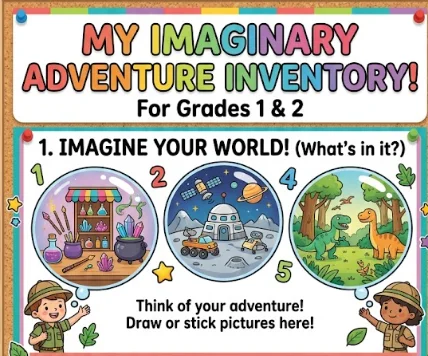
How 'Inventory Maths' Builds Elite Logic in Grades 1 & 2
It usually happens around the age of seven. A child who was once endlessly curious about the world suddenly decides, "I'm just not good at math." But the truth is, the problem rarely lies with the child. The problem lies in how we introduce numbers to young, developing minds.
Most conventional curricula make a critical psychological error: they force abstract symbols (like 5 + 7 = 12) onto children before they truly understand the physical quantity behind those numbers. This premature leap into abstraction is the root cause of early math anxiety.
The "Mental Warehouse" Approach
To build an elite mathematical thinker, we have to flip the script. This is the philosophy behind Inventory Maths, a revolutionary program designed specifically for Grades 1 and 2.
Instead of handing a 6-year-old a worksheet, we allow them to take "inventory" of the physical world. Before a child ever writes a multiplication equation, they draw branching tree diagrams to figure out how many outfit combinations they can make with 3 shirts and 2 pairs of pants. They are learning the Fundamental Counting Principle naturally, through visual logic.
The Touch-Think-Speak Methodology
In the Inventory Maths classroom—whether virtual or physical—passive learning is impossible. The program operates on four golden rules:
- Tactile Over Abstract: Addition isn't taught as a memorization drill; it is taught as the geometry of joining physical lengths together using blocks and rods.
- Zero Worksheets: We eliminate the anxiety of "right vs. wrong." Sessions are pure interactive exploration using tools like GeoGebra and physical manipulatives.
- Discover, Don't Tell: Teachers never give the rule outright. They set up visual puzzles and ask, "What happens if we do this?" The child formulates the mathematical law themselves.
- Verbal Proofs: Every session ends with the child speaking their "Aha!" moment out loud, solidifying their understanding.
Disguising University Math as Child's Play
Perhaps the most fascinating aspect of Inventory Maths is what happens behind the scenes. While parents see their children playing joyful games, the curriculum is secretly planting elite mathematical seeds.
When a child tries to put 3 toy birds into 2 toy houses without sharing and fails, they are mastering the Pigeonhole Principle. When they tie a string to a pencil to draw a perfect circle, they are learning the Locus of a Point. When they create a paper loop with a half-twist, they are exploring Topology (the Möbius Strip).
The Ultimate Outcome
By the end of Grade 2, a child who has experienced Inventory Maths doesn't just know how to count—they possess profound spatial reasoning and a complete absence of math anxiety.
They have successfully stocked their "mental warehouse." When they advance to higher grades, they won't just memorize formulas. They will rely on their deep physical intuition to write their own proofs, fundamentally primed to tackle the Mathematics Olympiad stage with fearless confidence.
Pioneering the future of early mathematical reasoning.
Speak with an Expert
Get a personalized academic roadmap based on the strategies discussed in this report.
Application Sent!
Your details have been securely routed to our admissions team. An elite academic mentor will review your profile and contact you within 24 hours.