
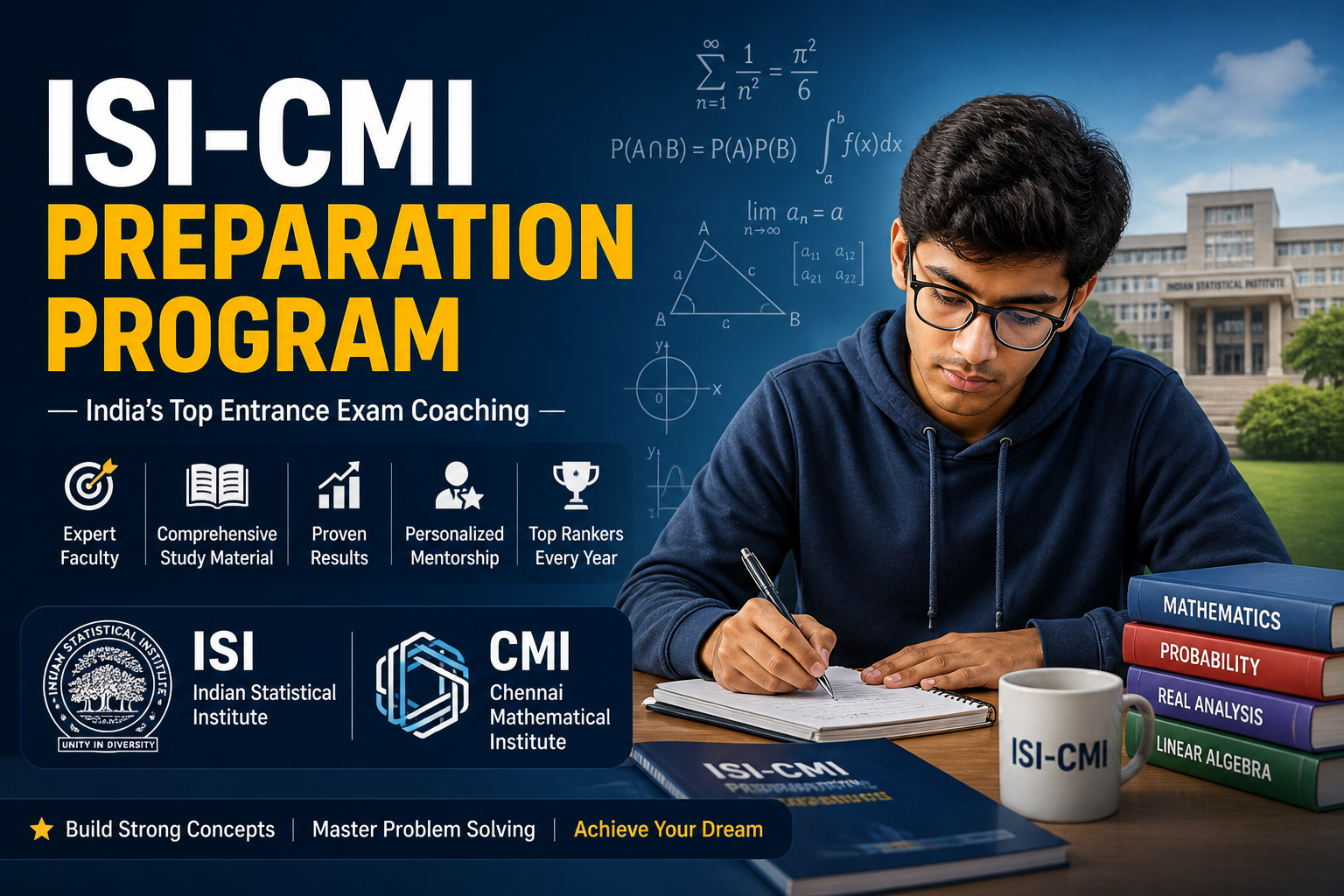
ISI-CMI Preparation Program: Your Comprehensive Guide to Cracking India's Premier Math Exams
The Indian Statistical Institute (ISI) and the Chennai Mathematical Institute (CMI) stand as prestigious institutions offering world-class education in mathematical sciences. Aspiring students nationwide recognize the ISI-CMI entrance exam as one of the most challenging mathematical competitions in India. Unlike conventional examinations, these tests evaluate not just rote learning but deep conceptual understanding, problem-solving abilities, and mathematical creativity. This comprehensive guide explores the ISI-CMI preparation program designed to help students navigate these prestigious examinations successfully while also considering their alignment with other competitive exams like the IIT JEE.
Understanding the ISI and CMI Entrance Examinations
The ISI-CMI entrance exam represents a unique challenge in India's competitive examination landscape. Both ISI and CMI conduct separate entrance examinations for their undergraduate programs, with ISI typically offering programs in Statistics, Mathematics, and Quantitative Economics, while CMI focuses on Mathematics and Computer Science. These examinations are renowned for their rigorous mathematical content that goes beyond the standard curriculum covered in schools, emphasizing problem-solving skills and theoretical understanding.
"The ISI and CMI entrance examinations have acceptance rates lower than some of the most competitive institutions globally, with approximately 2-3% of candidates qualifying for the final selection process."
Understanding the ISI CMI exam pattern is crucial for effective preparation. Both examinations typically consist of multiple-choice questions and descriptive problems that test candidates' abilities to apply mathematical concepts in novel situations. The ISI entrance exam usually has two stages: a written examination followed by an interview, while CMI primarily relies on a written examination. The ISI CMI eligibility criteria generally require candidates to have completed their 10+2 education with Mathematics as a compulsory subject, though specific requirements may vary for different programs.
ISI-CMI vs IIT JEE: Understanding the Differences
When comparing ISI CMI vs IIT JEE difficulty, several key differences emerge. While both examinations demand strong mathematical foundations, the ISI-CMI exams place greater emphasis on theoretical understanding and proof-based problem-solving. The IIT JEE, particularly the JEE Advanced, focuses more on application-based problem-solving within a broader syllabus that includes Physics, Chemistry, and Mathematics.
The ISI CMI vs JEE Advanced comparison reveals that ISI-CMI problems often require deeper conceptual understanding and more elegant solutions. Mathematics in JEE Advanced typically covers a wider range of topics but may not delve as deeply into theoretical aspects as ISI-CMI examinations. Additionally, while JEE Advanced has a negative marking system, ISI-CMI exams generally do not penalize incorrect answers, allowing candidates to attempt more questions strategically.
Key Differences Between ISI-CMI and IIT JEE
- Syllabus Focus: ISI-CMI emphasizes theoretical mathematics and proofs, while IIT JEE covers a broader range of applied mathematics topics
- Problem Style: ISI-CMI problems often require more creative and elegant solutions, whereas IIT JEE problems may be more calculation-intensive
- Exam Duration: ISI-CMI examinations are typically shorter but more intensive, while IIT JEE allows more time for problem-solving
- Selection Process: ISI-CMI often includes interviews focusing on mathematical thinking, while IIT JEE relies primarily on written examination scores
ISI-CMI Syllabus: Building Your Knowledge Foundation
A thorough understanding of the ISI CMI syllabus forms the cornerstone of effective preparation. The syllabus typically encompasses advanced topics in algebra, calculus, geometry, and number theory, often extending beyond the standard curriculum covered in schools. For instance, while school-level mathematics might cover basic calculus concepts, ISI-CMI preparation requires a deep understanding of mathematical analysis, including rigorous definitions of limits, continuity, and differentiability.
The ISI CMI syllabus also includes significant portions of linear algebra, abstract algebra, and real analysis that are not typically covered in depth in school curricula or even in IIT JEE preparation. Aspirants should focus on developing a strong foundation in these areas, as they form the core of mathematical thinking required for these examinations.
Core Topics in ISI-CMI Syllabus
- Algebra: Groups, rings, fields, polynomials, equations, inequalities, and number theory
- Calculus: Limits, continuity, differentiability, integration, sequences, and series
- Geometry: Euclidean geometry, coordinate geometry, and analytical geometry
- Linear Algebra: Matrices, determinants, vector spaces, linear transformations
- Real Analysis: Real numbers, sequences, continuity, differentiation, integration
ISI-CMI Preparation Strategy: A Step-by-Step Approach
Developing an effective ISI CMI preparation strategy requires careful planning and systematic execution. The ideal preparation timeline typically spans 12-18 months, allowing students to build foundational knowledge before progressing to advanced problem-solving. For students in Class 11, the ISI CMI preparation for class 11 should focus on strengthening core mathematical concepts and developing problem-solving skills. Those in Class 12 should concentrate on mastering advanced topics and practicing with ISI CMI previous year questions.
A crucial consideration for many students is ISI CMI preparation while preparing for JEE. While both examinations share some mathematical content, their approaches differ significantly. Students should allocate separate time slots for each preparation, ensuring they develop the specific thinking skills required for each examination. The ISI CMI preparation time should be dedicated to theoretical understanding and proof-based problem-solving, distinct from the application-focused approach needed for JEE.
Effective ISI-CMI Preparation Schedule
- Foundation Building (6-8 months): Master core mathematical concepts and develop problem-solving techniques
- Advanced Topics (4-6 months): Dive deeper into theoretical mathematics and complex problem-solving
- Practice and Revision (2-4 months): Work through ISI CMI previous year questions and refine problem-solving strategies
- Mock Tests and Interviews (1-2 months): Simulate examination conditions and prepare for interview rounds
Essential ISI-CMI Preparation Resources
Selecting the right ISI CMI preparation books is critical for success. Unlike standard textbooks, these resources should emphasize theoretical understanding and proof-based problem-solving. Some recommended books include "Problems in Calculus of One Variable" by I.A. Maron, "Algebra" by Michael Artin, and "Principles of Mathematical Analysis" by Walter Rudin. Additionally, ISI CMI preparation material should include collections of challenging problems that develop mathematical thinking beyond rote learning.
In today's digital age, ISI CMI online coaching platforms offer flexible learning options with expert guidance. These platforms often provide video lectures, problem-solving sessions, and personalized feedback. Many successful candidates also utilize ISI CMI preparation videos and ISI CMI preparation PDF resources to supplement their study materials. For those preferring structured learning, comprehensive ISI CMI preparation courses can provide a systematic approach to covering the entire syllabus.
ISI-CMI Preparation for Different Student Categories
Different student groups may require tailored approaches to ISI CMI preparation. For students in Class 11, the ISI CMI preparation for class 11 should focus on building a strong foundation in core mathematical concepts before advancing to more complex topics. Class 12 students should concentrate on mastering advanced topics and practicing with ISI CMI previous year questions under timed conditions.
ISI CMI preparation for repeaters allows students to leverage their previous experience while addressing specific weaknesses. Many repeaters benefit from a structured ISI CMI preparation schedule that identifies and targets their problem areas. For students participating in the Indian Olympiad Qualifier in Mathematics (IOQM), ISI CMI preparation for IOQM can provide a stepping stone, as both examinations share similar mathematical thinking requirements, though ISI-CMI problems are generally more advanced.
ISI-CMI Exam Pattern and Important Dates
Familiarity with the ISI CMI exam pattern is essential for effective preparation. The ISI entrance examination typically consists of a written test with multiple-choice questions and descriptive problems, followed by an interview for shortlisted candidates. CMI's examination primarily features a written test with both objective and subjective questions. Understanding this pattern helps students allocate their preparation time appropriately and develop strategies for different question types.
Staying updated with ISI CMI exam dates is crucial, as these examinations typically occur in May-June each year. The exact dates may vary slightly each year, so candidates should regularly check the official ISI and CMI websites for announcements. Additionally, being aware of the ISI CMI cutoff from previous years provides context regarding the expected performance levels needed for qualification, helping students set realistic targets for their preparation.
ISI-CMI Preparation Tips for Success
Several ISI CMI preparation tips can significantly enhance a student's chances of success. First, develop a habit of solving problems without immediately referring to solutions, as this builds independent thinking skills. Second, maintain a detailed notebook of important concepts, theorems, and problem-solving techniques for quick revision. Third, participate in study groups or online forums to discuss problems and learn from peers' approaches.
Regular practice with ISI CMI previous year questions is perhaps the most critical preparation tip. These problems provide insight into the examination's style, difficulty level, and frequently tested concepts. Additionally, seeking feedback from mentors or experienced educators on problem-solving approaches can help identify and address blind spots in mathematical understanding. Remember that success in ISI-CMI examinations hinges on developing deep conceptual understanding rather than memorization.
Conclusion: Your Path to ISI-CMI Success
Preparing for the ISI-CMI entrance exam represents a challenging yet rewarding journey that can open doors to premier mathematical education in India. By understanding the ISI CMI exam pattern, mastering the ISI CMI syllabus, and employing effective preparation strategies, students can develop the mathematical thinking skills required for success. Whether you're beginning your ISI CMI preparation for class 11 or refining your approach as a repeater, the key lies in consistent effort, deep conceptual understanding, and strategic problem-solving.
Edu Global Institute offers a comprehensive ISI-CMI preparation program designed to guide students through every stage of their preparation journey. Our expert faculty, proven methodologies, and extensive collection of ISI CMI preparation material provide the support needed to excel in these prestigious examinations. Join us to transform your mathematical abilities and achieve your dream of studying at ISI or CMI.