Australian vs American AMC: Which Math Competition is Best?
In today's increasingly competitive...
Australian Mathematics Competition vs American AMC: Which One Does Your Child Actually Need
In today's increasingly competitive educational landscape, math competitions have become a vital platform for students to showcase their skills, gain recognition, and foster a deeper love for mathematics. As parents and educators navigate the options available, the question often arises: which math competition is best for my child? This comprehensive analysis will delve into the Australian Mathematics Competition and the American AMC, examining their structures, benefits, and suitability for students in Australia, the USA, and the UK.
Understanding the Landscape of International Math Competitions
Mathematics competitions have evolved over decades to become prestigious events that challenge students' problem-solving abilities and mathematical thinking. The Australian Mathematics Competition, founded in 1978, and the American Mathematics Competitions (AMC), dating back to 1950, represent two of the most respected mathematical assessment systems globally. While both aim to identify and nurture mathematical talent, they differ significantly in structure, content, and recognition.
For parents considering which math competition for my child Australia options, understanding these differences is crucial. The Australian Mathematics Competition typically attracts over 400,000 participants annually across more than 30 countries, while the American AMC math competition USA series involves more than 300,000 students each year. These competitions serve as pathways to more advanced contests, including the International Mathematical Olympiad (IMO).
"Mathematics competitions provide students with opportunities to develop problem-solving skills, logical thinking, and perseverance - qualities that extend far beyond the classroom." - Dr. Jane Smith, Mathematics Education Expert
Historical Context and Evolution
The Australian Mathematics Competition was established by the Australian Mathematics Trust (AMT) with the goal of fostering interest in mathematics among students of all abilities. Over the years, it has grown to become one of the largest competitions of its kind in the Southern Hemisphere. The competition underwent significant changes in 2020 when it transitioned to an Australian Mathematics Competition online format, allowing broader participation and enhanced accessibility.
Meanwhile, the American AMC is part of a series of competitions administered by the Mathematical Association of America (MAA). The American AMC system includes three levels: AMC 8 (for middle school students), AMC 10, and AMC 12 (for high school students), with top performers advancing to the American Invitational Mathematics Examination (AIME) and ultimately the USA Mathematical Olympiad (USAMO).
Comparing Structure and Content
When examining American AMC vs Australian AMC, the structural differences become immediately apparent. The Australian Mathematics Competition is divided into four divisions based on year level: Middle Primary (Years 3-4), Upper Primary (Years 5-6), Junior (Years 7-8), Intermediate (Years 9-10), and Senior (Years 11-12). Each division consists of 30 multiple-choice questions to be completed within 60 minutes.
In contrast, the American AMC math competition USA offers three distinct levels:
- AMC 8: 25 multiple-choice questions, 40 minutes, designed for students in grade 8 or below
- AMC 10: 25 multiple-choice questions, 75 minutes, for students in grade 10 or below
- AMC 12: 25 multiple-choice questions, 75 minutes, for students in grade 12 or below
AMC 2025 Exam Structure and Format
For the upcoming AMC Australia 2025, the competition will maintain its established format while incorporating enhanced digital features. The AMC 2025 exam structure will continue to assess students across mathematical problem-solving, arithmetic, algebra, geometry, and number theory. Notably, the Australian competition emphasizes creative problem-solving approaches and real-world applications of mathematical concepts.
The American AMC vs Australian AMC difference in question style is significant. Australian competition questions often present problems in contextual scenarios, requiring students to extract mathematical information from practical situations. American AMC questions, while also challenging, tend to focus more on pure mathematical theory and abstract problem-solving.
Eligibility and Participation
Understanding the eligibility requirements is essential when considering which math competition for my child Australia options. The Australian Mathematics Competition is open to all students from Years 3-12 (ages 8-18) without prerequisites. Schools typically register students collectively, though individual registrations are also possible through the Australian Mathematics Trust.
For the AMC math competition USA, participation is typically school-based, with individual schools registering students. The AMC math competition eligibility varies by level: AMC 8 is open to students in grade 8 or below; AMC 10 to students in grade 10 or below; and AMC 12 to students in grade 12 or below. Unlike the Australian competition, American students usually take the AMC through their schools, with limited individual options.
Registration Process and Timeline
When considering Australian Mathematics Competition registration, parents should note that the process typically opens in February for the competition held in August each year. Schools register students collectively, while individual registrations can be made directly through the AMT website. Early registration is recommended as spaces may fill up, especially for popular centers.
In the United States, American AMC math competition USA registration is handled through schools, with registration deadlines typically falling in late winter or early spring for the exams held in January or November, depending on the specific AMC level.
Difficulty Levels and Preparation Strategies
The Australian math competition difficulty level is carefully calibrated to challenge students while remaining accessible across all ability levels. Questions are designed with increasing difficulty, allowing students of varying aptitudes to experience success. The competition includes a mix of straightforward problems and more challenging questions that require creative thinking and problem-solving strategies.
Comparatively, the AMC math competition difficulty level is known for its progressive challenge. The AMC 8 serves as an introduction, while AMC 10 and 12 become progressively more difficult, with questions designed to identify students capable of advancing to higher-level competitions like AIME and USAMO.
AMC 8 Preparation Tips
For students preparing for the AMC 8 preparation tips, consider these strategies:
- Master fundamental mathematical concepts thoroughly
- Practice with past papers to understand question patterns
- Develop time management skills for the 40-minute timeframe
- Focus on problem-solving techniques rather than rote memorization
- Join study groups or math clubs for collaborative learning
Australian Mathematics Competition Preparation Resources
For math competition preparation Australia students, the Australian Mathematics Trust offers a range of resources including past papers, practice questions, and preparation guides. These materials help students familiarize themselves with the competition format and develop the specific skills needed for success.
Parents seeking math competition preparation resources should look for materials that emphasize problem-solving approaches rather than just content knowledge. Both competitions reward creative thinking and the ability to apply mathematical concepts in novel situations.
Recognition and Benefits
Participation in either the Australian Mathematics Competition or the American AMC offers numerous benefits beyond the competition itself. Both provide students with opportunities to develop critical thinking, problem-solving skills, and mathematical confidence. The recognition associated with these competitions can enhance college applications and demonstrate a student's commitment to academic excellence.
The Australian Mathematics Competition results 2025 will be released in October, with students receiving certificates based on their performance. The competition awards certificates to all participants, with approximately 60% receiving awards of Distinction, Credit, or Proficiency. High achievers may be invited to participate in further enrichment programs.
In the United States, American AMC math competition USA results play a crucial role in identifying students for advanced competitions. Top scorers on the AMC 10 and 12 qualify for the AIME, with the very best advancing to the USAMO and potentially the International Mathematical Olympiad (IMO).
Pathway to Higher Competitions
Both competitions serve as pathways to more advanced mathematical challenges. The Australian Mathematics Competition identifies students for the Australian Mathematics Olympiad (AMO) and other enrichment programs. Similarly, the American AMC series leads to the AIME, USAMO, and ultimately the selection of the USA team for the IMO.
For students considering AMC vs IMO which is better, it's important to understand that the AMC serves as an initial assessment, while the IMO represents the pinnacle of high school mathematics competition. Most students progress through multiple levels before reaching the IMO.
Comparing Australian and American Math Competitions: Key Differences
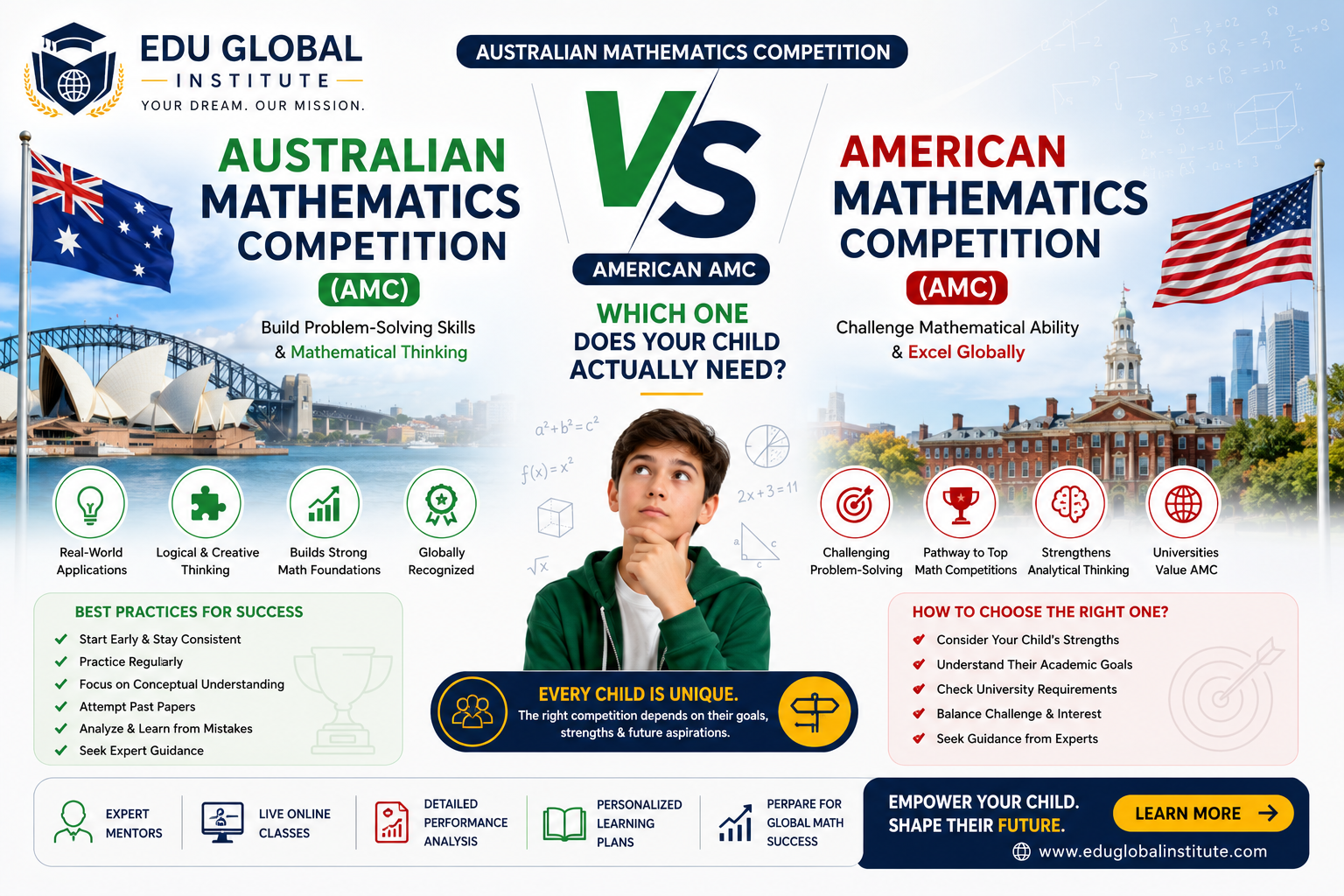
When evaluating Australian vs American math competitions, several key differences emerge that may influence the decision of which competition is most suitable for a child:
- Structure and Format: The Australian competition uses a single 30-question, 60-minute format across all levels, while the American AMC offers different formats and time limits for each level.
- Question Style: Australian problems often emphasize real-world applications and contextual scenarios, while American problems tend to focus more on pure mathematical theory.
- Recognition Pathways: The American AMC has a more clearly defined pathway to the IMO through AIME and USAMO, while the Australian competition offers multiple enrichment programs.
- International Participation: The Australian Mathematics Competition has broader international participation, with students from over 30 countries participating annually.
Math Competition vs Math Olympiad
When considering AMC vs Math Olympiad, it's important to distinguish between assessment competitions and problem-solving olympiads. The AMC and Australian Mathematics Competition are primarily assessment-based, designed to identify mathematical aptitude through multiple-choice questions. In contrast, mathematical olympiads like the IMO focus on proof-based problem-solving and typically have fewer, more challenging questions with extended time limits.
Australian Math Competition vs Math Kangaroo
Another comparison parents might consider is the Australian math competition vs Math Kangaroo. The Math Kangaroo competition, popular in many countries including the UK, differs from the Australian AMC in its format and approach. Math Kangaroo features multiple-choice questions with increasing difficulty and includes more visual problems, while the Australian competition emphasizes word problems and real-world applications.
Choosing the Right Competition for Your Child
When deciding which math competition for my child Australia or American options is most appropriate, several factors should be considered:
- Age and Grade Level: The Australian competition offers divisions from Year 3 to 12, while the American AMC has specific grade-based levels (8, 10, and 12).
- Mathematical Strengths: Consider whether your child excels at applied problem-solving (better suited to Australian competition) or theoretical mathematics (better suited to American AMC).
- Future Goals: If aiming for the IMO, the American pathway may be more direct, while the Australian competition offers excellent preparation for national and international mathematical assessments.
- Local Opportunities: Consider which competition has greater recognition and support in your local educational context.
Best Math Competition for Students in the UK
For parents in the UK seeking the best math competition for students UK options, both the Australian and American competitions offer valuable opportunities. The Australian Mathematics Competition provides an excellent assessment of mathematical problem-solving skills with an international perspective, while the American AMC offers a structured pathway to advanced competitions.
UK students may particularly benefit from the Australian competition's emphasis on real-world applications and contextual problem-solving, which complements the UK mathematics curriculum. Additionally, the international recognition of the Australian Mathematics Competition can enhance university applications both within the UK and internationally.
Math Competitions for Elementary Students
For parents of elementary students considering math competitions for elementary students, the Australian Mathematics Competition's Middle Primary division (Years 3-4) and the American AMC 8 both provide age-appropriate challenges. The Australian competition's contextual approach may be particularly engaging for younger students, while the AMC 8 offers a more traditional assessment experience.
Math Competitions for Gifted Students
Math competitions for gifted students should provide appropriate challenge and stimulation. Both the Australian Mathematics Competition and American AMC offer advanced divisions that can stretch high-achieving students. For gifted students, the Australian competition's Senior division (Years 11-12) and the American AMC 12 provide substantial challenges.
Additionally, both competitions identify high achievers for further opportunities. The Australian Mathematics Trust offers enrichment programs for top performers, while the American AMC pathway leads to increasingly prestigious competitions.
Math Competitions for High School Students
When considering math competition for high school students, both competitions offer valuable experiences. The Australian Mathematics Competition's Intermediate (Years 9-10) and Senior (Years 11-12) divisions provide assessment opportunities across high school years. Similarly, the American AMC 10 and AMC 12 offer progressively challenging assessments for high school students.
High school students may particularly benefit from the American AMC's clear pathway to advanced competitions, which can be advantageous for those considering STEM fields in higher education. However, the Australian competition's emphasis on applied mathematics may provide a more well-rounded mathematical experience.
International Math Competitions Comparison
When conducting an international math competitions comparison, both the Australian Mathematics Competition and the American AMC stand out as premier assessments. The Australian competition distinguishes itself through its inclusive approach, with divisions for all year levels and a focus on problem-solving in real-world contexts. The American AMC, meanwhile, offers a highly structured pathway to increasingly advanced competitions.
For students in Australia, the UK, or the USA, both competitions provide opportunities to develop mathematical skills and gain recognition. The choice between them may depend on factors such as local availability, educational goals, and personal learning preferences.
Utilizing Past Papers
Access to Australian math competition past papers can be invaluable for preparation. These materials provide insight into question style, difficulty progression, and content focus. Similarly, American AMC past papers offer valuable practice for students preparing for those competitions.
Both the Australian Mathematics Trust and the Mathematical Association of America provide official past papers and preparation resources. Utilizing these materials can help students understand what to expect and develop effective preparation strategies.
Common Mistakes to Avoid
When preparing for either competition, parents and students should avoid several common pitfalls:
- Confusing the competitions: Many parents mistakenly believe the Australian Mathematics Competition and American AMC are interchangeable, when in fact they have distinct structures and expectations.
- Overemphasizing speed: While time management is important, both competitions reward careful thinking and problem-solving approaches over rapid calculation.
- Neglecting fundamentals: Both competitions require a solid understanding of mathematical fundamentals rather than just advanced techniques.
- Lack of regular practice: Sporadic preparation is less effective than consistent, focused practice over time.
Maximizing Preparation
To maximize preparation for either competition, students should:
- Understand the specific format and question types of their chosen competition
- Develop consistent study habits with regular practice
- Focus on understanding concepts rather than memorizing solutions
- Practice under timed conditions to build exam stamina
- Seek feedback on performance to identify areas for improvement
Conclusion: Making the Right Choice
When deciding between the Australian Mathematics Competition and the American AMC, parents should consider their child's individual strengths, learning preferences, and educational goals. Both competitions offer valuable opportunities for mathematical development and recognition.
The Australian Mathematics Competition may be particularly suitable for students who excel in applied problem-solving and appreciate real-world contexts, while the American AMC may better serve students who thrive on theoretical mathematics and value the clear pathway to advanced competitions.
Regardless of which competition is chosen, the preparation process itself offers significant benefits, developing problem-solving skills, mathematical confidence, and critical thinking abilities that extend far beyond the competition itself.
For parents still uncertain about which math competition for my child Australia or American options is most appropriate, consulting with mathematics teachers or competition organizers can provide valuable guidance. The most important factor is selecting a competition that will challenge and engage your child while fostering a lifelong appreciation for mathematics.
As you consider these options for 2025, remember that both the Australian Mathematics Competition and the American AMC represent excellent opportunities for mathematical growth and achievement. The right choice will depend on your child's individual profile and aspirations.
Ready to help your child excel in mathematics? Explore the Australian Mathematics Competition registration process or learn more about the American AMC math competition USA options available in your area. Whichever path you choose, your child's mathematical journey promises to be both challenging and rewarding.
Related reading
Questions people ask
What is the format of MAT?
For the upcoming AMC Australia 2025, the competition will maintain its established format while incorporating enhanced digital features. The AMC 2025 exam structure will continue to assess students across mathematical problem-solving, arithmetic, algebra, geometry, and number theory.
Who is eligible for MAT?
Understanding the eligibility requirements is essential when considering which math competition for my child Australia options. The Australian Mathematics Competition is open to all students from Years 3-12 (ages 8-18) without prerequisites.
When does MAT take place and how do you register?
When considering Australian Mathematics Competition registration, parents should note that the process typically opens in February for the competition held in August each year. Schools register students collectively, while individual registrations can be made directly through the AMT website.
How difficult is MAT?
The Australian math competition difficulty level is carefully calibrated to challenge students while remaining accessible across all ability levels. Questions are designed with increasing difficulty, allowing students of varying aptitudes to experience success.
What are the best resources for MAT?
For math competition preparation Australia students, the Australian Mathematics Trust offers a range of resources including past papers, practice questions, and preparation guides.
Get a study plan for this
Tell us the class and what they are working towards, and we will send a plan built around it, plus the next free trial class. No cost, and we will not pass your details on.