AP Physics C Exam: Mechanics and E&M, Explained
Two separate papers, a new 2027 format, and the unit-weighting detail almost everyone reads wrongly.
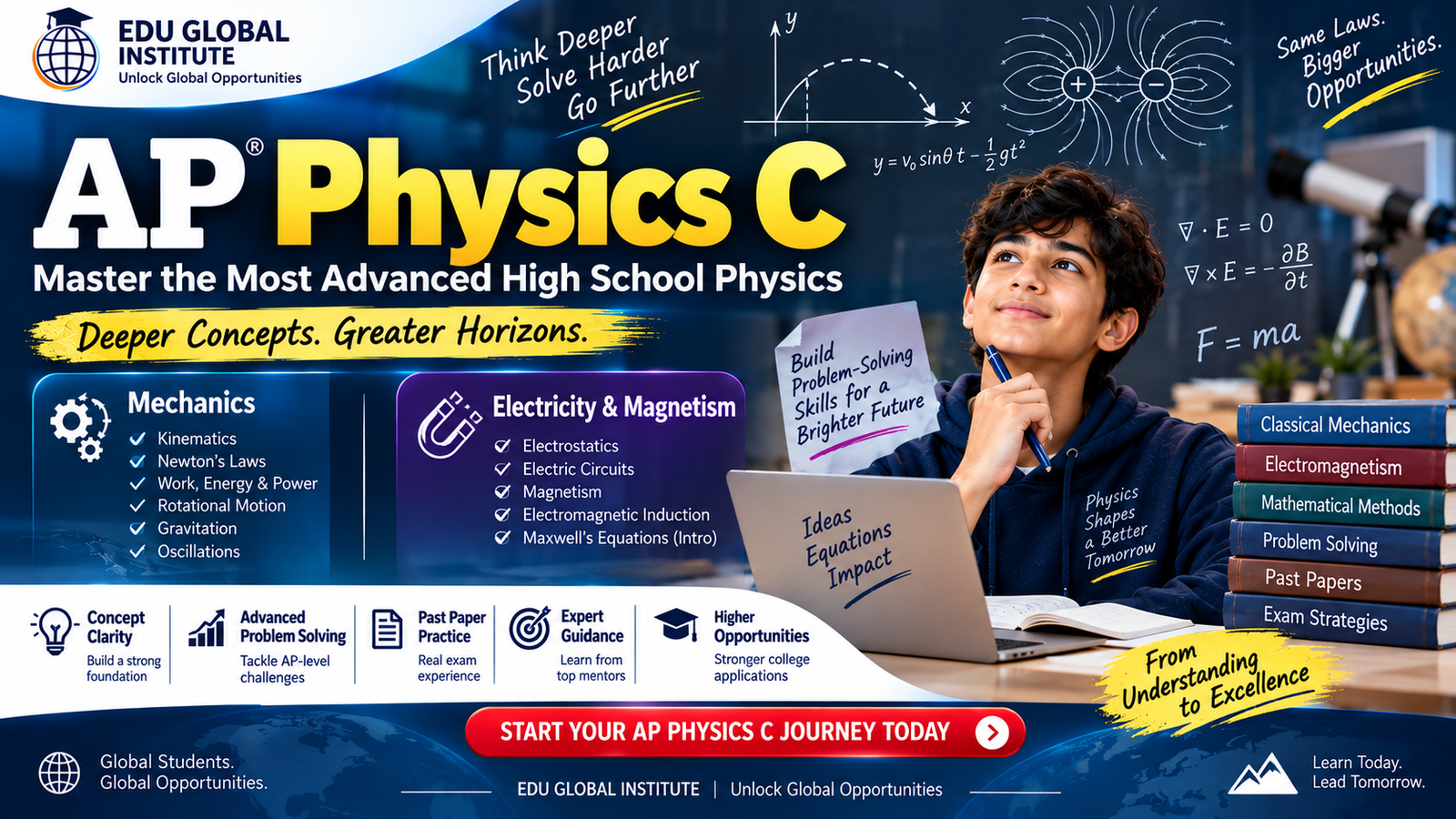
The AP Physics C exam is not one exam. It is two: Mechanics, and Electricity and Magnetism. They are separate registrations, separate papers, separate scores, and in 2027 they are sat on different days. Students who plan for "the Physics C exam" as a single event routinely under-prepare for the second one.
Both papers have also just been restructured for May 2027. This guide sets out the new format, the unit weightings for each paper, the calculus you actually need, and the one detail about those weightings that almost everyone reads wrongly.
The 2027 format, verified
The College Board's clarifications documents confirm that both halves of the AP Physics C exam change with the May 2027 administration, identically to each other and to the algebra-based papers:
| Section | Before | From May 2027 |
|---|---|---|
| I - Multiple choice | 40 questions, 80 minutes | 42 questions, 85 minutes |
| II - Free response | 4 questions, 100 minutes | 4 questions, 95 minutes |
Each paper is now 50 per cent multiple choice and 50 per cent free response, running three hours in total. Calculators are permitted, and reference material is provided in Bluebook during the test preview and on exam day.
This is a substantial convergence: Mechanics and Electricity and Magnetism now share an identical structure with each other and with AP Physics 1 and 2. Older preparation material describing a 45-minute, 35-question multiple-choice section is describing a paper that no longer exists.
The weighting detail almost everyone misreads
The College Board publishes the AP Physics C exam unit weightings as a percentage of the multiple-choice score, not of the whole exam. That is stated on the course pages and it changes how you should plan.
Multiple choice is half the paper. So a unit listed at 20 to 25 per cent contributes roughly 10 to 12 per cent of your final score through that section. The free-response half is not distributed by unit at all - four questions cannot cover seven units - which means a student who allocates revision strictly by unit weighting is planning against only half the exam.
The practical consequence: cover every unit competently rather than perfecting the heaviest ones, because the free-response section can land anywhere, and it is worth as much as the entire multiple-choice section.
Mechanics: seven units
| Unit | % of multiple-choice score |
|---|---|
| 1. Kinematics | 10-15% |
| 2. Force and Translational Dynamics | 20-25% |
| 3. Work, Energy, and Power | 15-25% |
| 4. Linear Momentum | 10-20% |
| 5. Torque and Rotational Dynamics | 10-15% |
| 6. Energy and Momentum of Rotating Systems | 10-15% |
| 7. Oscillations | 10-15% |
Dynamics is the single heaviest unit at 20 to 25 per cent, with work and energy close behind. Note how flat the rest is: no unit falls below 10 per cent, so there is nothing safe to skip.
Electricity and Magnetism: six units, numbered 8 to 13
The numbering continues from Mechanics rather than restarting, which is why you will see E and M units labelled 8 through 13. The two courses form one sequence of thirteen units.
| Unit | % of multiple-choice score |
|---|---|
| 8. Electric Charges, Fields, and Gauss's Law | 15-25% |
| 9. Electric Potential | 10-20% |
| 10. Conductors and Capacitors | 10-15% |
| 11. Electric Circuits | 15-25% |
| 12. Magnetic Fields and Electromagnetism | 10-20% |
| 13. Electromagnetic Induction | 10-20% |
Gauss's law and circuits are the two heaviest, each up to 25 per cent. The ranges here are wider than on Mechanics, which means year-to-year variation is larger and planning around a single year's distribution is riskier.
How much calculus you actually need
The College Board is explicit. For Mechanics: you should have taken calculus or be taking it at the same time as the course. For Electricity and Magnetism: you should have taken a calculus-based Newtonian physics course, such as Physics C Mechanics or equivalent, and should also have taken or be concurrently taking calculus.
In practice the demand is narrower than "all of calculus". You need to differentiate and integrate confidently, recognise which a situation calls for, and be comfortable with the idea that a physical law is often a statement about a rate or an accumulation. Taking AP Calculus concurrently works well, provided the physics does not run ahead of techniques you have not yet met - worth checking against your school's sequence before the year starts.
What separates a 5 from a 3
The honest answer is derivation rather than recall, and it is the reason the calculus-based papers reward a different kind of study.
A student who has memorised that the moment of inertia of a uniform disc is one half M R squared can answer questions about uniform discs. A student who can set up and evaluate the integral can answer questions about any object the examiner chooses - including one that has never appeared in a past paper. The same is true of Gauss's law: memorising the field of a sphere is worth one question, while understanding why the symmetry lets you pull the field out of the integral is worth every question of that family.
This is why the free-response section discriminates so sharply. Four questions cannot test recall of thirteen units, so they test whether you can construct a result. Practise by deriving standard results from scratch, without notes, until the setup is automatic.
Exam day, 2027: two different days
Mechanics is on Monday 3 May 2027 (Session 1). Electricity and Magnetism is on Wednesday 5 May 2027 (Session 2). Both are hybrid digital administrations: multiple choice in the Bluebook application, free-response answers handwritten in a paper booklet that is collected for scoring.
The two-day gap is a planning opportunity rather than an inconvenience. A student sitting both should treat the Monday evening and Tuesday as a dedicated E and M review window, planned in advance rather than improvised in a state of post-exam fatigue.
Physics C against Physics 1 and 2
The two tracks look similar on paper and are not. Physics 1 and 2 are algebra-based and cover fifteen units between them. Physics C is calculus-based and covers thirteen, but goes far deeper into each: it expects derivation where the algebra-based papers accept application of a given relationship.
For engineering and physical-science applicants, Physics C is generally the stronger signal, and many universities award credit differently for the two. If you are choosing, the question is not which is easier but whether your calculus is ready - a student taking Physics C without the calculus underneath it will struggle regardless of how good their physics is. Our guide to the algebra-based papers covers that track in the same detail.
Where to go next
The mathematics that underpins these papers is covered in our AP Calculus 2027 exam guide, and the algebra-based alternative in our AP Physics 1 and 2 guide. Our course listing shows the programmes we currently teach.
The mathematics underneath these papers is covered in our AP Calculus 2027 exam guide, which explains the format change to AB and BC for the same administration.
The short version
Two separate exams, sat two days apart in 2027, now sharing an identical format of 42 multiple-choice questions in 85 minutes and four free-response questions in 95. The published unit weightings apply to the multiple-choice score only, so they describe half the paper. Mechanics is dominated by dynamics and energy; E and M by Gauss's law and circuits. And on both papers, the students who score 5s are the ones who derive rather than recall.
Questions people ask
Is AP Physics C one exam or two?
Two. Mechanics and Electricity and Magnetism are separate exams with separate registrations and separate scores. In 2027 they are sat on different days - Mechanics on Monday 3 May (Session 1) and Electricity and Magnetism on Wednesday 5 May (Session 2). Many students take only Mechanics; taking both is common for engineering applicants.
How many questions are on the AP Physics C exam?
From May 2027 each paper has 42 multiple-choice questions in 85 minutes and four free-response questions in 95 minutes, each section worth 50 per cent. This replaces the previous 40 multiple-choice questions in 80 minutes and 100 minutes of free response. Both Physics C papers now share this structure with AP Physics 1 and 2.
Do the published unit weightings cover the whole exam?
No, and this is the most common misreading. The College Board publishes Physics C unit weightings as a percentage of the multiple-choice score, not of the total. Since multiple choice is half the paper, a unit listed at 20-25% contributes roughly 10-12% of your final score through that section. The free-response half is not distributed by unit, so planning revision purely by weighting ignores half the exam.
How much calculus do I need for AP Physics C?
The College Board states you should have taken calculus or be taking it concurrently with Mechanics. For Electricity and Magnetism it additionally recommends a prior calculus-based Newtonian physics course such as Physics C Mechanics. In practice you need confident differentiation and integration and the judgement to know which a situation calls for; taking AP Calculus in the same year works well if the sequencing is checked.
Should I take AP Physics C or AP Physics 1 and 2?
Physics C is calculus-based and goes considerably deeper across thirteen units; Physics 1 and 2 are algebra-based and cover fifteen units more broadly. For engineering and physical-science applicants Physics C is generally the stronger signal and often attracts different university credit. The deciding question is whether your calculus is ready, since strong physics cannot compensate for absent calculus on these papers.
Get a study plan for this
Tell us the class and what they are working towards, and we will send a plan built around it, plus the next free trial class. No cost, and we will not pass your details on.