AP Physics 1 Exam Guide: Format, Units and Scoring
The 2027 format change, the unit weightings for Physics 1 and 2, and why three of the four free-response questions need sentences rather than algebra.
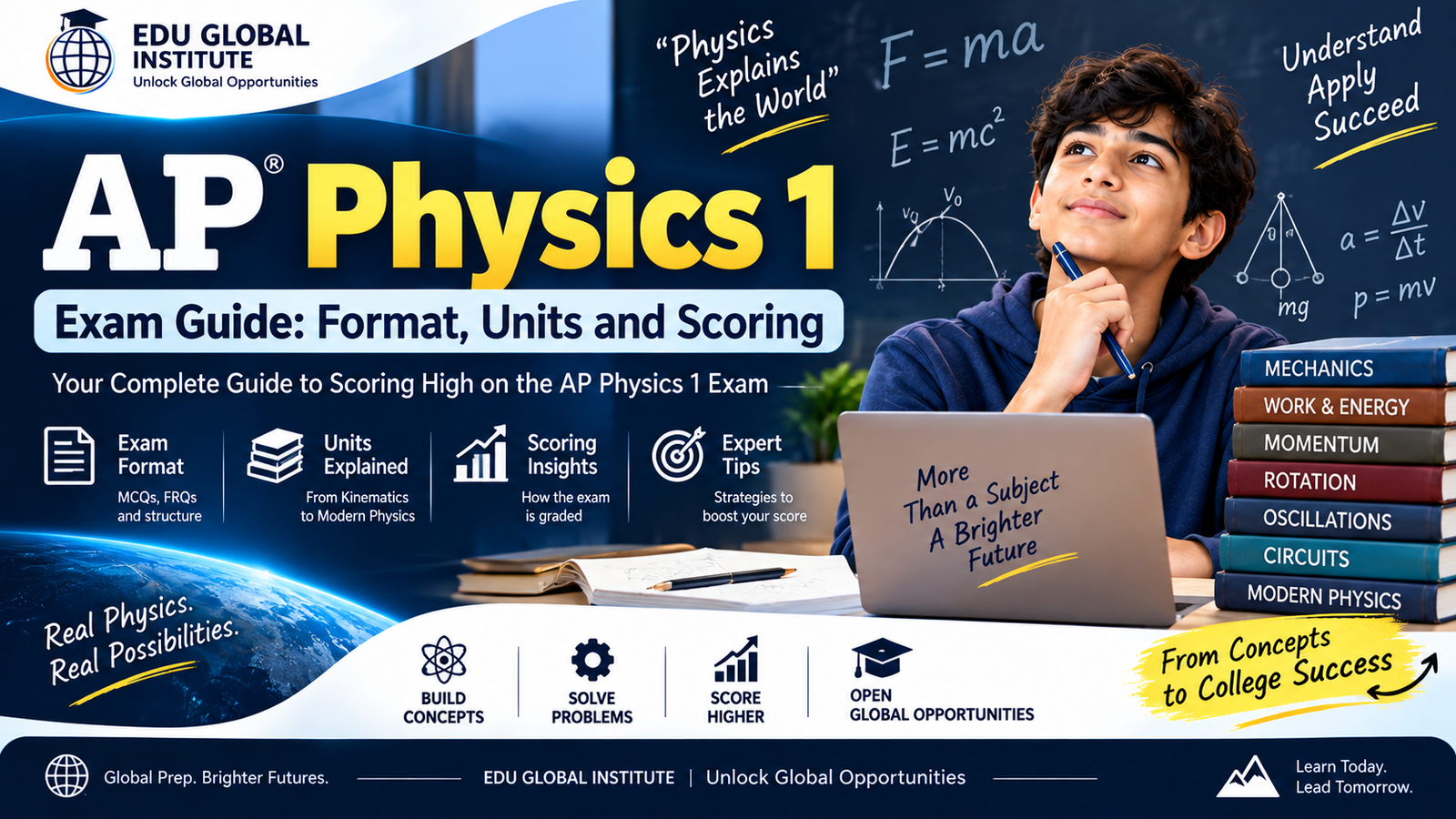
The AP Physics 1 exam has a reputation as one of the hardest scoring papers the College Board sets, and students usually blame the physics. That is rarely the real problem. The paper is algebra-based and assumes no calculus at all; what it assumes instead is that you can explain your reasoning in writing, move between four different representations of the same situation, and design an experiment under time pressure. Most students have never practised any of those three.
The format has also just changed. This guide covers the new structure, the unit weightings for both Physics 1 and Physics 2, and where the marks actually go.
The format changed for May 2027
The College Board's clarifications documents confirm that the AP Physics 1 exam and its Physics 2 counterpart both change with the May 2027 administration, and both change identically:
| Section | Before | From May 2027 |
|---|---|---|
| I - Multiple choice | 40 questions, 80 minutes | 42 questions, 85 minutes |
| II - Free response | 4 questions, 100 minutes | 4 questions, 95 minutes |
The weighting stays at 50 per cent for each section, and the total remains three hours. Two more multiple-choice questions with five more minutes leaves the per-question pace essentially unchanged at just over two minutes. The free-response section, however, loses five minutes with no reduction in questions - which matters more than it sounds, because those are the questions that require writing.
The four free-response types, and why they catch people out
Both papers set exactly four free-response questions, one of each type. Only the first is a conventional physics problem:
- Mathematical routines - the familiar kind: set up the physics, do the algebra, get a number.
- Translation between representations - move between a graph, a table, an equation and a verbal description of the same situation.
- Experimental design and analysis - propose a procedure, say what you would measure, and justify why it answers the question.
- Qualitative and quantitative translation - explain in prose why the algebra says what it says.
Three of the four require sentences. A student who has prepared by grinding numerical problems has prepared for one question out of four, and will meet the other three for the first time in the hall. This is the single biggest structural reason capable students underperform on the algebra-based papers.
The fix is not more physics. It is writing physics: every week, answer at least one question in words alone, and have it marked against the published rubric rather than against whether it sounds right.
Physics 1 units and weighting
The AP Physics 1 exam covers eight units. The College Board publishes these weightings as a percentage of the multiple-choice score specifically, not of the whole exam - a distinction worth holding onto when you plan revision.
| Unit | Weighting |
|---|---|
| 1. Kinematics | 10-15% |
| 2. Force and Translational Dynamics | 18-23% |
| 3. Work, Energy, and Power | 18-23% |
| 4. Linear Momentum | 10-15% |
| 5. Torque and Rotational Dynamics | 10-15% |
| 6. Energy and Momentum of Rotating Systems | 5-8% |
| 7. Oscillations | 5-8% |
| 8. Fluids | 10-15% |
Two units - dynamics and energy - carry up to 46 per cent of the multiple-choice score between them. If your revision time is limited, that is where it belongs. Oscillations and rotational energy sit at 5 to 8 per cent each and are routinely over-revised because they feel difficult.
Physics 2 units and weighting
Physics 2 continues the numbering from Physics 1, running units 9 through 15. Note that the College Board expresses these weightings as a percentage of the exam score, phrased differently from the Physics 1 page - so do not treat the two sets of percentages as directly comparable.
| Unit | Weighting |
|---|---|
| 9. Thermodynamics | 15-18% |
| 10. Electric Force, Field, and Potential | 15-18% |
| 11. Electric Circuits | 15-18% |
| 12. Magnetism and Electromagnetism | 12-15% |
| 13. Geometric Optics | 12-15% |
| 14. Waves, Sound, and Physical Optics | 12-15% |
| 15. Modern Physics | 12-15% |
Physics 2 is noticeably flatter than Physics 1: no unit dominates, and the spread from heaviest to lightest is only a few percentage points. That argues for even coverage rather than a targeted attack, which is the opposite of the right strategy on Physics 1.
What you need before you start
The College Board's recommendations are modest, and worth quoting accurately because students often assume more is required. For Physics 1: geometry completed, and Algebra II taken or being taken at the same time. For Physics 2: Physics 1 or a comparable introductory course, with precalculus taken or concurrent.
No calculus is required for either. If you want the calculus-based treatment, that is AP Physics C, which is a separate pair of exams with a different structure and a genuine calculus prerequisite.
Exam day, 2027
Both are hybrid digital administrations. Multiple-choice questions are answered in the College Board's Bluebook application; free-response questions appear on screen but are answered by hand in a paper booklet that is collected and scored. Calculators are permitted throughout, and reference material is provided and visible in Bluebook during the test preview and on exam day.
In 2027 the two papers fall on consecutive days: AP Physics 1 on Wednesday 5 May (Session 2) and AP Physics 2 on Thursday 6 May (Session 1). A student sitting both should plan the final fortnight around that adjacency rather than treating them as independent events.
A preparation approach that matches the paper
Learn the physics through representations, not formulae. For every situation you study, be able to draw it, graph it, tabulate it and describe it in a sentence. The exam explicitly tests moving between those views, so learning one view is learning a quarter of what is asked.
Write one explanation a week from the start. Not at the end, when mocks begin. Written justification is a skill that improves slowly and it carries a quarter of the free-response section.
Design experiments on paper. Take any relationship in the syllabus and write how you would measure it: what you would vary, what you would hold constant, what you would plot, and how the graph's gradient answers the question. Twenty minutes a week makes the experimental-design question routine rather than alarming.
Then sit full timed papers at the new lengths - 42 questions in 85 minutes, four free-response in 95 - rather than at the timings older books print.
Where to go next
Students taking calculus alongside physics will also want our guide to the calculus-based AP Physics C exams, and the AP Calculus 2027 guide covers the mathematics that underpins it. Our course listing shows the programmes we currently teach.
If you are taking calculus in the same year, our AP Calculus 2027 exam guide covers the parallel format change, and the AP Physics C guide sets out the calculus-based alternative to this track.
The short version
From May 2027 both algebra-based papers run 42 multiple-choice questions in 85 minutes and four free-response questions in 95. Three of those four require written reasoning, which is where most marks are lost. On Physics 1, dynamics and energy carry nearly half the multiple-choice score; Physics 2 is far flatter and rewards even coverage. No calculus is needed for either.
Questions people ask
How many questions are on the AP Physics 1 exam?
From the May 2027 administration, 42 multiple-choice questions in 85 minutes and four free-response questions in 95 minutes, with each section worth 50 per cent of the score. This is a change from the previous 40 multiple-choice questions in 80 minutes and 100 minutes for free response. AP Physics 2 uses the identical structure.
Do I need calculus for AP Physics 1?
No. AP Physics 1 is algebra-based. The College Board recommends you have completed geometry and are taking Algebra II concurrently. AP Physics 2 recommends Physics 1 or a comparable course plus precalculus taken or concurrent. The calculus-based option is AP Physics C, a separate pair of exams.
Why is AP Physics 1 considered so difficult?
Chiefly because of the free-response section. Only one of the four questions is a conventional calculation; the other three ask you to translate between representations, design and analyse an experiment, and explain in prose why your algebra behaves as it does. Students who prepare only by solving numerical problems are prepared for a quarter of that section.
Which AP Physics 1 units carry the most marks?
Force and Translational Dynamics and Work, Energy and Power, each at 18-23% of the multiple-choice score - up to 46% between them. Kinematics, Linear Momentum, Torque and Rotational Dynamics, and Fluids each sit at 10-15%, while Energy and Momentum of Rotating Systems and Oscillations are the lightest at 5-8% each.
When are the 2027 AP Physics exams?
AP Physics 1 is on Wednesday 5 May 2027 (Session 2) and AP Physics 2 on Thursday 6 May 2027 (Session 1) - consecutive days. Both are hybrid digital exams with multiple choice in the Bluebook application and handwritten free-response booklets returned for scoring. Calculators are permitted and reference material is provided.
Get a study plan for this
Tell us the class and what they are working towards, and we will send a plan built around it, plus the next free trial class. No cost, and we will not pass your details on.