Probability Course Guide: Basic to Advanced
Most probability errors happen at setup rather than in the arithmetic, which is why a good course spends its time on the part students rush.

A good probability course spends most of its time on the part students rush, because in this subject the arithmetic is rarely the difficulty. Writing down the wrong sample space, or conditioning on the wrong event, produces flawless calculation and a confident wrong answer.
Setup is almost everything
Probability is unusual among mathematical subjects in that most errors are not computational.
A student decides what the experiment is, what counts as an outcome, and what is being conditioned on. Get any of those wrong and the rest of the work is irrelevant, however neatly executed. Get them right and the calculation is often trivial.
So the early stages should be spent stating problems precisely: what is the sample space, are the outcomes equally likely, and what exactly is the event we are asked about. Students find this slow and it is the only part that reliably prevents wrong answers.
Intuition is unreliable, and that is the content
Human intuition about chance is genuinely poor, and a probability course that does not confront that leaves students able to pass examinations and still reason badly about real situations.
The clearest case is the base-rate error. Given a test that is 99 per cent accurate for a disease affecting one person in ten thousand, most people — including many professionals — read a positive result as near-certainty.
It is not. Almost all positives come from the vast healthy population, because there are so many more of them. Bayes theorem makes this precise in two lines, and the fact that the error persists among educated people is exactly why it deserves teaching time rather than a footnote.
Linearity of expectation
If a student takes one thing from a probability course, it should be this.
Expectation is linear whether or not the variables are independent. That is a remarkable statement and students routinely fail to appreciate what it licenses: a problem that appears to demand tracking complicated dependencies between events can collapse into a sum of individually trivial expectations.
Competition problems are built on this repeatedly, from AMC level upward. Students who have internalised it start problems that others cannot begin, and the gap looks like talent when it is technique.
The three stages
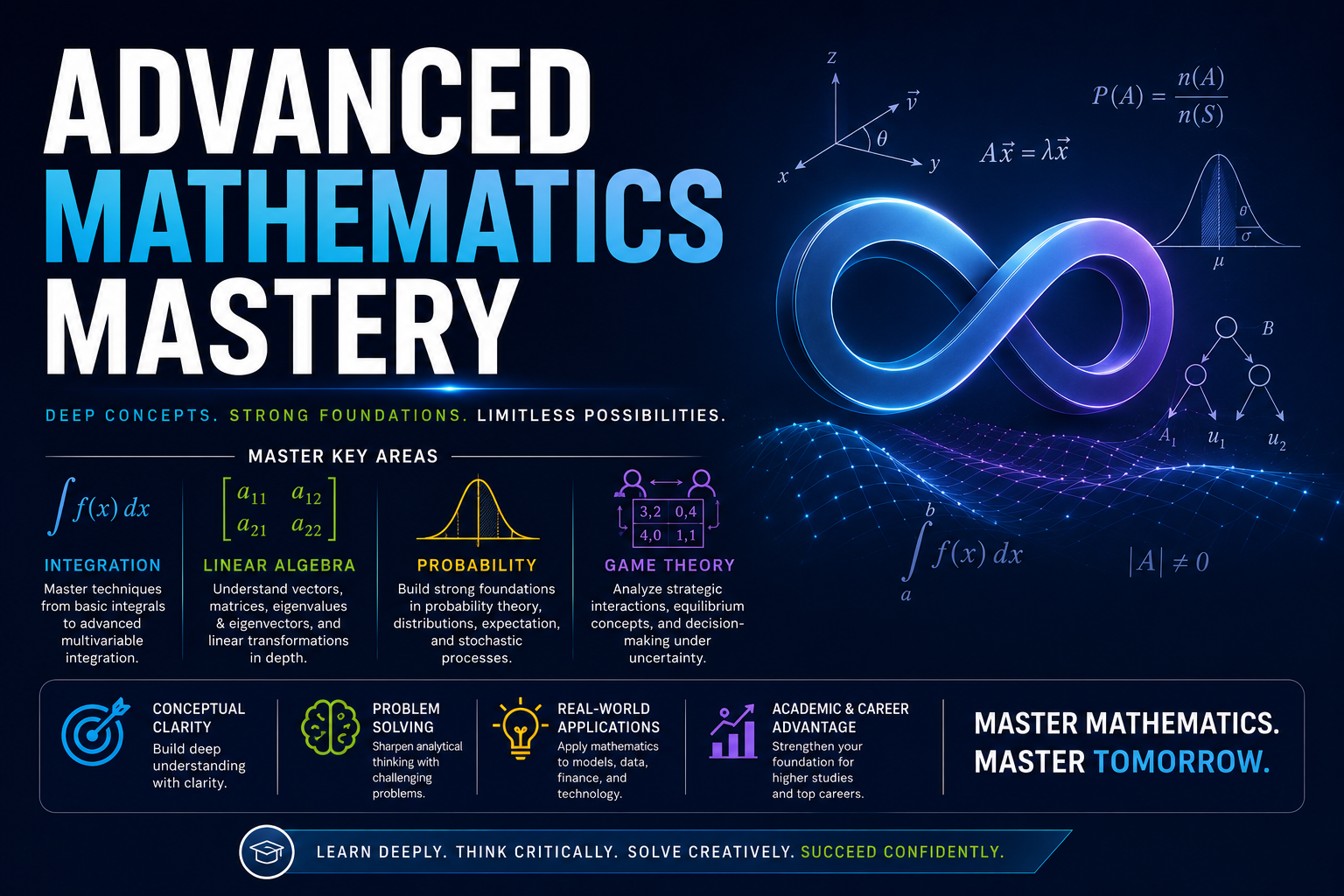
Basic covers the counting probability needs, sample spaces and events as sets, the axioms, inclusion-exclusion, then conditional probability, independence, the law of total probability and Bayes.
Intermediate covers random variables and expectation, the standard discrete distributions — Bernoulli, binomial, geometric, negative binomial, Poisson, hypergeometric — continuous variables with density and distribution functions, the uniform, exponential and normal distributions, and joint distributions with covariance and convolution.
Advanced covers the laws of large numbers and the central limit theorem, Markov chains including absorbing states and the fundamental matrix, and an introduction to measure-theoretic foundations.
What the limit theorems do not say
The central limit theorem is probably the most misquoted result in mathematics.
It does not say that everything is normally distributed. It does not apply regardless of conditions. And it says nothing useful about the tails at the sample sizes people habitually invoke it for — which matters enormously in finance, where the tails are the entire risk.
A probability course should teach the conditions alongside the statement, and spend time on what these theorems do not claim. A student who knows the limits of a theorem understands it better than one who knows only its conclusion.
Markov chains and where they lead
Transition matrices, classification of states as recurrent, transient or absorbing, stationary distributions, and absorbing chains with the fundamental matrix and expected time to absorption.
This unit pays off well beyond probability itself. It is the standard model for retention and churn problems, it appears directly in the Integral Cup probability track, and it is the foundation for the MCMC methods that modern statistics runs on.
Independence is not the same as unrelated
A recurring confusion worth naming, because it causes errors that look like carelessness and are actually conceptual.
Two events are independent when knowing one occurred does not change the probability of the other. That is a precise numerical condition, and it does not match the everyday sense of "unconnected". Events can be causally unrelated and statistically dependent, and events that sound related can be independent.
Students who treat independence as a description rather than a condition to check will multiply probabilities that should not be multiplied, which is one of the most common sources of wrong answers in the whole subject.
Where elementary probability stops working
The final unit is an honest signpost rather than a full treatment. Elementary probability assumes you can assign a number to every event, and once the sample space is uncountable that assumption quietly fails.
Sigma-algebras, measurable functions, probability as a measure, expectation as an integral, conditional expectation as a projection — an introduction, placed last, and optional for students who want the competition material only.
Students continuing to graduate study or into quantitative finance will meet the rigorous version regardless, and meeting it once here makes that transition far less abrupt.
How the subject is usually taught badly
Two failure modes are worth naming, because students arrive with both.
The first is treating probability as a branch of counting. Counting matters, but a student who believes every problem reduces to a ratio of favourable to total outcomes will be defeated the first time outcomes are not equally likely, which is most of the time in practice.
The second is learning distributions as a list of formulas to match against problems. The useful question is never which distribution to use but what the underlying experiment is. Once the experiment is clear the distribution follows, and a student who works that way can handle a situation that fits no standard family.
Who this suits
Students from Class 9 upward through undergraduate study, with school algebra. The counting this course needs
Who this suits
Students from Class 9 upward through undergraduate study, with school algebra. The counting this course needs is taught within it; our combinatorics course goes considerably further for students who find counting is their real obstacle.
It pairs naturally with statistics, which is the inverse problem: probability reasons from a known model to outcomes, while statistics infers the model from the outcomes.
Questions people ask
Why is probability so counter-intuitive?
Because human intuition about chance is genuinely unreliable, and because most errors happen at setup rather than in the arithmetic. A student who writes down the wrong sample space, or conditions on the wrong event, computes flawlessly and gets a wrong answer.
What is the base-rate error?
The commonest mistake in applied probability. Given a test that is 99 per cent accurate for a disease affecting one person in ten thousand, most people conclude a positive result means near-certainty. It does not, because the vast majority of positives come from the enormous healthy population. Bayes theorem makes this precise in two lines.
What is the single most useful technique?
Linearity of expectation, without much competition. It holds whether or not the variables are independent, which is what makes it extraordinary: problems that look as though they require tracking complicated dependencies collapse into a sum of simple expectations.
Do I need combinatorics as well?
Not to begin, since a probability course teaches the counting it needs. If counting turns out to be the consistently hard part of your probability problems rather than the probability itself, a dedicated combinatorics course addresses that directly.
Why include measure theory?
Because the elementary treatment quietly breaks once the sample space is uncountable, and students going on to graduate study or quantitative finance will meet the rigorous version anyway. It is an introduction rather than a full course, placed last and optional.
Get a study plan for this
Tell us the class and what they are working towards, and we will send a plan built around it, plus the next free trial class. No cost, and we will not pass your details on.