IOQM RMO INMO Preparation: The Complete Pathway
IOQM asks for an integer, RMO and INMO ask for a proof. That single change defeats more students than the mathematics does.

Serious IOQM RMO INMO preparation has to confront one fact early: the pathway changes what it asks for halfway through, and most students are not prepared for the change.
The four stages
The Indian olympiad pathway runs in sequence. IOQM, the Indian Olympiad Qualifier in Mathematics, is conducted by the Mathematics Teachers Association. From there students progress to RMO, the Regional Mathematical Olympiad, then INMO, the Indian National Mathematical Olympiad.
Strong INMO performers are invited to a training camp, and from that camp the teams for the International Mathematical Olympiad and the European Girls' Mathematical Olympiad are selected. The stages from RMO onward are organised by HBCSE under the aegis of the National Board for Higher Mathematics.
It is worth noting that HBCSE is an institution rather than an examination — it hosts the programme. Students sometimes see it listed as though it were a contest in its own right.
The change that defeats most students
IOQM asks for integer answers. There is no multiple choice, so nothing to guess between, but what is wanted is still a number.
RMO is six problems in three hours, with full written proof required. INMO is six problems in four and a half hours, likewise. A correct final answer with no argument earns very little. A clearly written partial attempt that never reaches an answer can earn a good deal.
That is a different examination in everything but topic. A student who has spent six years producing answers meets it for the first time with a place at stake, and the result is predictable: they solve problems in their head, write three lines, and score poorly on work they genuinely did.
What a proof actually has to contain
Most of what separates a good RMO script from a weak one is not additional mathematics. It is the discipline of producing an argument a marker can follow.
That means stating what is assumed. Justifying the steps that are not self-evident. Handling the cases the problem actually contains rather than the convenient one. Finishing with the conclusion explicitly reached rather than implied.
Students almost never write this way naturally, because school examinations rarely require it. The remedy is marking written work to olympiad standard from early on, which is uncomfortable for the first month and transformative by the third.
The four areas
Number theory: divisibility, modular arithmetic used as a tool, orders and primitive roots, quadratic residues at the higher stages. Our number theory course follows this progression in the order it builds.
Algebra: polynomials and Vieta, functional equations, the inequality toolkit of AM-GM, Cauchy-Schwarz and Jensen, and sequences. Technique here has to be automatic, because it is the machinery every other area borrows.
Combinatorics: systematic counting, bijections, pigeonhole, double counting, invariants and extremal arguments. This is the area where Indian olympiad problems are frequently hardest and where our combinatorics course does the most work.
Geometry: circle theorems, cyclic quadrilaterals, power of a point, Ceva and Menelaus, and at the higher stages homothety and inversion. The geometry course runs from angle chasing through to inversion for exactly this reason.
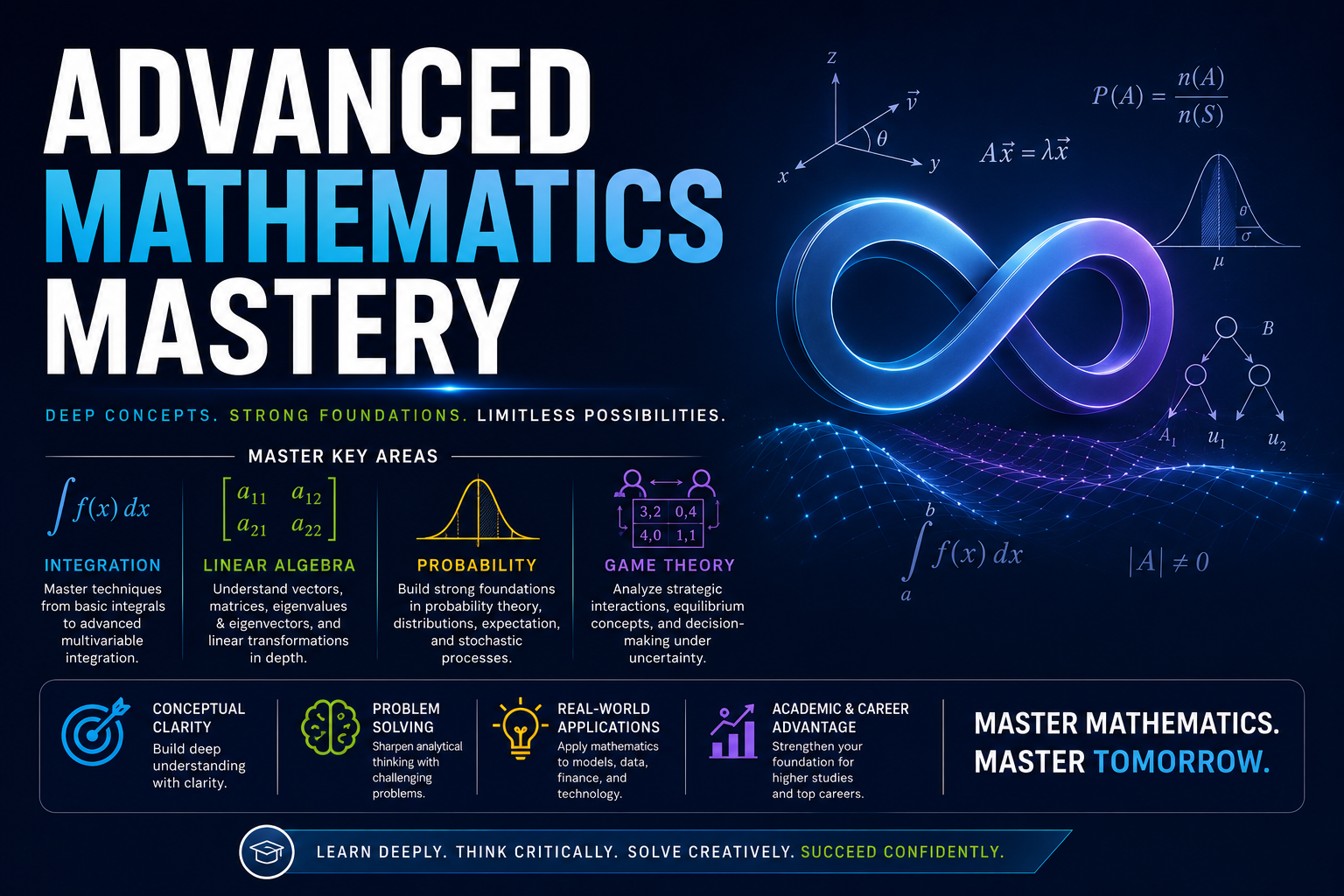
There is no calculus anywhere in the pathway, which surprises families who assume harder means more advanced. It means deeper.
Preparing for two different examinations at once
Good IOQM RMO INMO preparation trains both modes deliberately rather than hoping proof writing appears when needed.
For IOQM: accuracy under time, with integer answers checked. Nearly right is worth nothing, so a trained checking habit — re-reading the question, confirming the answer is the right kind of object, sanity-checking its size — is a genuine source of marks.
For RMO and INMO: sustained work on single problems, written out in full and marked on presentation as strictly as on correctness. Three hours for six problems means thirty minutes each, which is long enough that stamina and the willingness to stay with one problem matter as much as technique.
These are different practice sessions and cannot substitute for one another. A student who only ever does timed short-answer sets will clear IOQM and stall at RMO.
A realistic timeline
Students who reach INMO have usually been working for three to five years, and that is worth saying plainly rather than implying a shortcut exists.
The sensible build starts in middle school with our IOQM foundation course, moves through NMTC and IOQM attempts in Class 8 and 9, and treats the first RMO as experience rather than as a verdict.
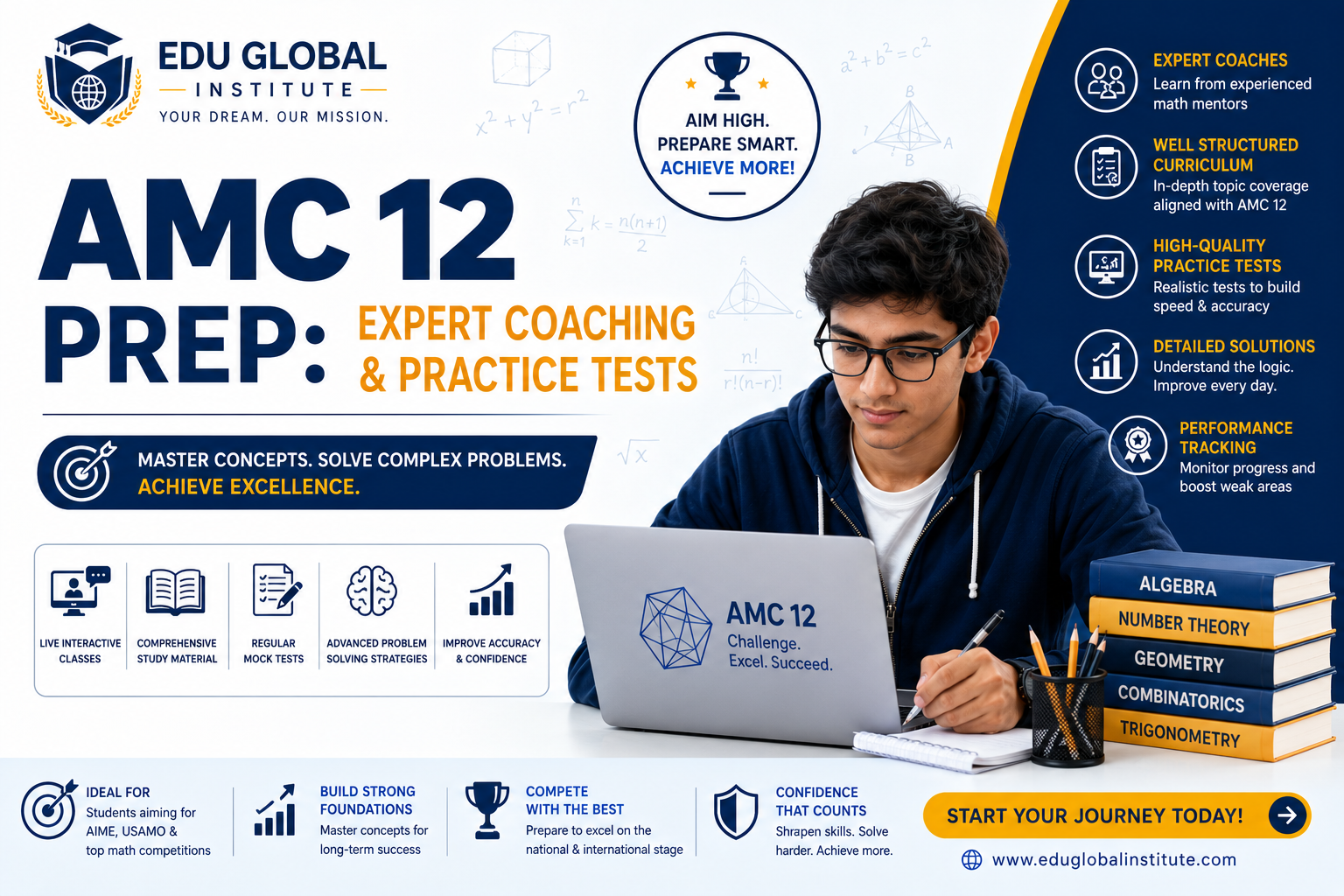
Along the way, the international contests are useful rather than a distraction. The AMC 10 and AMC 12 cover overlapping topics in a faster format, and the written-solution contests in the CEMC series give proof practice at lower stakes than RMO.
Why geometry is the most neglected area
Among the four areas, geometry is the one students most often postpone, and the reason is understandable: it has no procedure.
In algebra a student who knows the method can execute it. In geometry a student can know every theorem in the syllabus and still not see which applies to the figure in front of them. That gap does not close by learning more theorems; it closes by working a large number of configurations until the common ones become recognisable.
Because that takes time rather than instruction, it rewards starting early and punishes leaving it to the final year. Students who postpone geometry until after RMO find they have one of the four areas missing at exactly the stage where problems get harder.
What the pathway is worth even if a student stops early
Most students who begin this pathway do not reach INMO, and that has to be the starting assumption rather than a disappointment at the end.
What they take away is substantial regardless: real fluency in number theory and combinatorics, the habit of writing an argument rather than asserting a conclusion, and tolerance for problems that do not yield in five minutes. Those serve a future engineer, economist or researcher as directly as they serve a medallist.
Stage dates, eligibility and the structure of the programme are set by MTA and HBCSE and change between cycles. Check their current announcements before planning around them.
Questions people ask
What are the stages of the Indian olympiad pathway?
IOQM first, conducted by the Mathematics Teachers Association. Then RMO, the Regional Mathematical Olympiad. Then INMO, the Indian National Mathematical Olympiad. Strong INMO performers are invited to the training camp, from which the IMO and EGMO teams are selected. The later stages are organised by HBCSE under the National Board for Higher Mathematics.
How do RMO and INMO differ from IOQM?
Entirely in what they ask for. IOQM wants integer answers. RMO is six problems in three hours and INMO is six problems in four and a half hours, both requiring detailed written proof. A correct answer with no argument earns very little, and a well-presented partial attempt that never reaches the answer can earn a good deal.
What topics does the pathway cover?
The four standard olympiad areas: number theory, algebra, combinatorics and geometry. No calculus. The depth increases at each stage but the areas never change, which is why early foundations pay for years.
When should proof writing start?
Years before RMO. Most students arrive at RMO having spent five or six years producing answers and never once producing a justification, and the transition catches them at the worst possible moment. Writing out why something is true, even informally, costs nothing in Class 8 and pays enormously in Class 10.
What are the dates for the current cycle?
IOQM, RMO and INMO run at set points across the academic year, with IOQM typically in the autumn, RMO later in the year and INMO early in the following one. Dates and eligibility are set by MTA and HBCSE each cycle, so check their announcements rather than relying on last year.
Get a study plan for this
Tell us the class and what they are working towards, and we will send a plan built around it, plus the next free trial class. No cost, and we will not pass your details on.