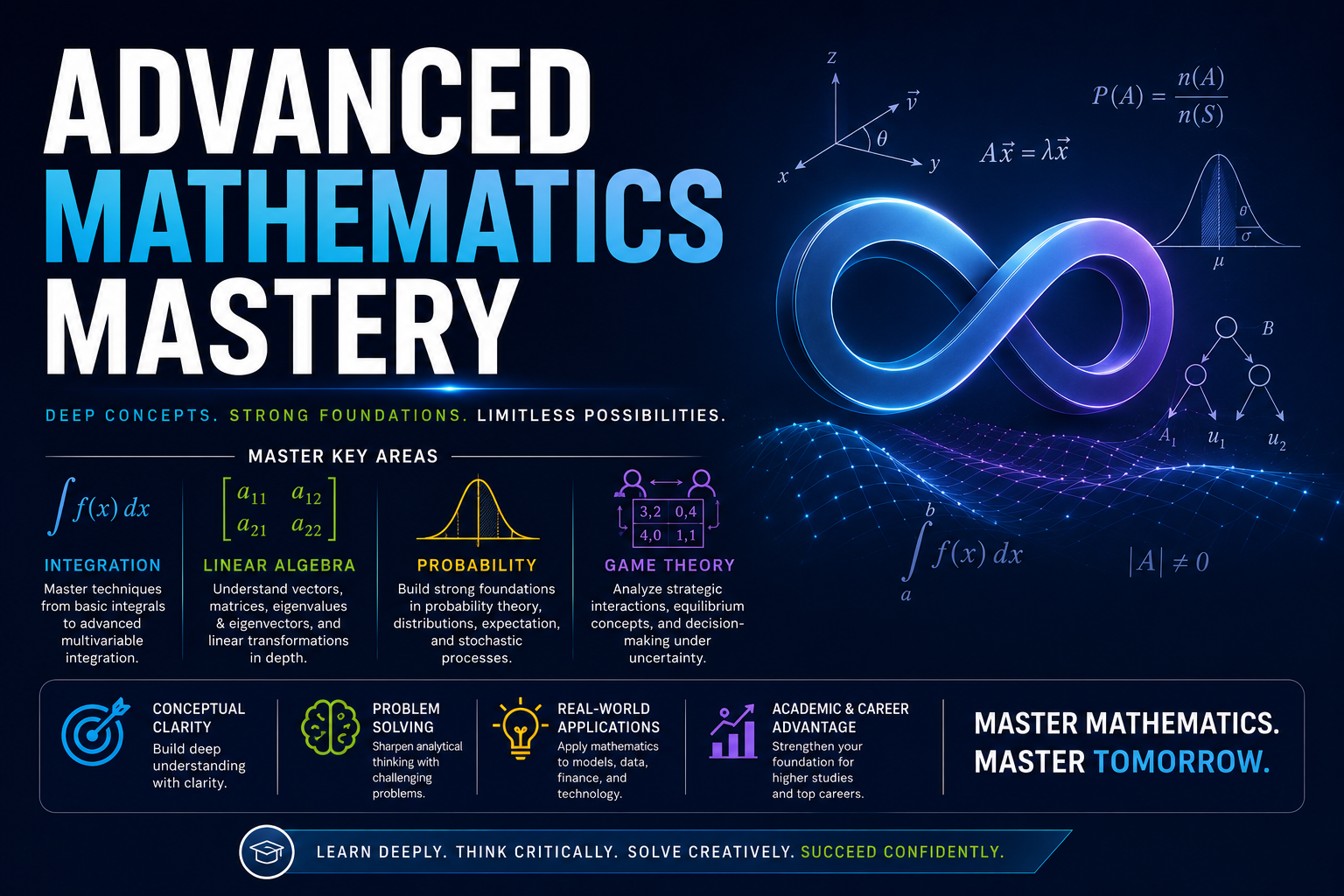
IOQM Foundation Preparation: Class 6 to 8 Guide
IOQM is sat from Class 8 onwards, but the students who do well there usually started building the four core areas two or three years earlier.

IOQM foundation preparation answers a question families ask constantly: if the examination is sat in Class 8 or later, why would a Class 6 student start now? The honest answer is that the students who do well at IOQM are almost never the ones who started the year before.
What IOQM is and where it leads
The Indian Olympiad Qualifier in Mathematics is the first stage of the national olympiad pathway, conducted by the Mathematics Teachers Association. From IOQM the route continues to RMO, then INMO, then the training camp and international selection.
Eligibility covers a band of school years beginning in middle school, so Class 8 students commonly sit it. The exact band is set each cycle, so confirm it with the organisers rather than assuming.
What matters for a younger student is the shape of the pathway: each stage asks for more depth in the same four areas, and the later stages ask for written proof. Nothing about it rewards starting late.
The four areas, and why school does not cover them
Number theory — divisibility, modular arithmetic, primes, digit problems. School teaches divisibility rules and stops. Competition number theory treats remainders as objects you calculate with, and that shift takes time.
Combinatorics — systematic counting, complementary counting, pigeonhole, bijections, invariants. School teaches two formulas. Competition counting is an argument, and building the repertoire is the work of years rather than weeks.
Algebra — factorisation, equations, sequences, inequalities. School covers the content but not the fluency; IOQM assumes manipulation costs no thought at all.
Geometry — angles, triangles, circles, areas and configurations. The school syllabus is closer here than elsewhere, which is why geometry can be built slightly later without penalty.
Two of those four are barely touched in school, and both reward accumulation. That is the entire argument for IOQM foundation preparation starting in Class 6.
Integer answers change the game
IOQM asks for integer answers rather than offering multiple choice. There is nothing to guess between and no options to substitute back into the problem.
The practical consequence is that nearly right is worth nothing. A student who solves a problem correctly and slips in the final arithmetic scores the same as one who had no idea.
So checking becomes a trained skill rather than an afterthought: re-reading what was asked, confirming the answer is the right kind of object, and sanity-checking its size. Students who come from multiple-choice competitions find this adjustment harder than the mathematics.
A three-year build
Class 6 should be exposure. Work problems, get plenty wrong, talk about them. Number sense and systematic counting, with no timing and no score targets. The aim is that a hard problem feels interesting rather than threatening.
Class 7 builds technique. Modular arithmetic as a tool, counting in stages and by complement, algebraic fluency, and the geometry configurations that recur. This is the year that decides whether Class 9 feels hard.
Class 8 adds contest conditions and, for students who are ready, a first IOQM attempt treated as experience rather than as a verdict.
Across all three years the most valuable single habit is attempting problems that do not yield immediately, because that is what the pathway consists of.
Start proof habits early, even though IOQM does not ask
This is the piece most preparation leaves out, and it costs students later.
IOQM wants a number. RMO and INMO want an argument, written so a marker can follow it. Most students arrive at RMO having spent five years producing answers and never once producing a justification, and the transition catches them at the worst possible moment.
Writing out why something is true, even informally, costs nothing in Class 7 and pays enormously in Class 10. It also makes a student a better problem solver immediately, because an argument you have to write down is an argument you have to actually have.
What to sit along the way
A younger student should be competing, not only training. The NMTC is the closest Indian parallel and draws on exactly the same four areas. The AMC 8 adds speed and a different problem voice.
For variety, Math Kangaroo and SASMO both suit this age and reward the same underlying habits in different formats.
None of these competes with IOQM foundation preparation. They are where the preparation gets tested, which is the only way a student finds out what they have actually built.
What a weekly routine should look like
Consistency beats intensity at this age, and the schedule matters less than the fact that it does not stop.
Three sessions a week of forty minutes is a realistic target for a Class 6 or 7 student alongside school. Two of those should be new problems; the third should revisit problems from earlier weeks that were not solved. That third session is the one families skip and the one that builds the most.
Across a term, add one longer session where a student works a single hard problem for half an hour with no expectation of finishing. Nothing else builds tolerance for difficulty as directly, and tolerance for difficulty is what the whole pathway runs on.
Signs the foundation is working
Scores are a poor measure this early, so it helps to know what else to watch.
The clearest signal is what a student does on meeting an unfamiliar problem. At the start they stop and ask for help within a minute. Later, they try something — a small case, a diagram, a guess tested against the conditions — before asking. That change usually appears somewhere in the second year and it is worth more than any contest result.
A second signal is whether they can explain a solution a week later. Mathematics genuinely understood survives the week; mathematics memorised does not, and the difference matters enormously by the time RMO arrives.
A caution worth stating
A caution worth stating
The pathway is long and selective, and a student who treats IOQM as a verdict on themselves at thirteen will have a bad time regardless of their score.
The right framing is that these years build mathematical maturity which pays whether or not the student reaches INMO. Number theory, counting and the habit of attacking an unfamiliar problem serve a future engineer, economist or researcher just as well as a future olympiad medallist.
Eligibility, dates and the stage structure are set by MTA and HBCSE and change between cycles. Check the current announcements before planning around them.
Questions people ask
What is IOQM and when can a student sit it?
The Indian Olympiad Qualifier in Mathematics is the first stage of the national olympiad pathway, conducted by the Mathematics Teachers Association. Eligibility covers a band of school years starting in middle school, so students in Class 8 commonly sit it. Confirm the exact eligibility for the current cycle with the organisers, since the band is set each year.
Why start in Class 6 if the exam comes later?
Because the four areas IOQM tests are not covered in school at the depth required, and they take years rather than months to build. Students who begin in Class 6 arrive at their first IOQM with the groundwork in place and spend that year on problems rather than on catching up.
What does the answer format mean for preparation?
IOQM answers are integers rather than multiple choice, so there is nothing to guess between and no options to substitute back. Accuracy matters more than on an AMC-style paper, and a student who is nearly right earns nothing. That makes checking a trained skill rather than an afterthought.
Which topics matter most early?
Number theory and combinatorics, by a distance. Both are barely touched in school, both recur throughout the pathway, and both reward years of accumulation. Algebra fluency underpins everything, and geometry can be built slightly later without penalty.
Where does IOQM lead?
To RMO, then INMO, then the training camp and international selection. Each stage demands written proof rather than a numeric answer, which is why proof habits are worth starting early even though IOQM itself does not require them.
Get a study plan for this
Tell us the class and what they are working towards, and we will send a plan built around it, plus the next free trial class. No cost, and we will not pass your details on.