Game Theory Course Guide: Basic to Advanced
Game theory is usually taught as anecdote. Taught as mathematics it is the most self-contained subject in the series and a good first proof course.

A game theory course taught properly looks almost nothing like the version most people meet. The popular treatment is a set of stories — the prisoner's dilemma recounted, Nash equilibrium invoked loosely, a conclusion drawn about human nature. It is entertaining and teaches very little.
The formal subject
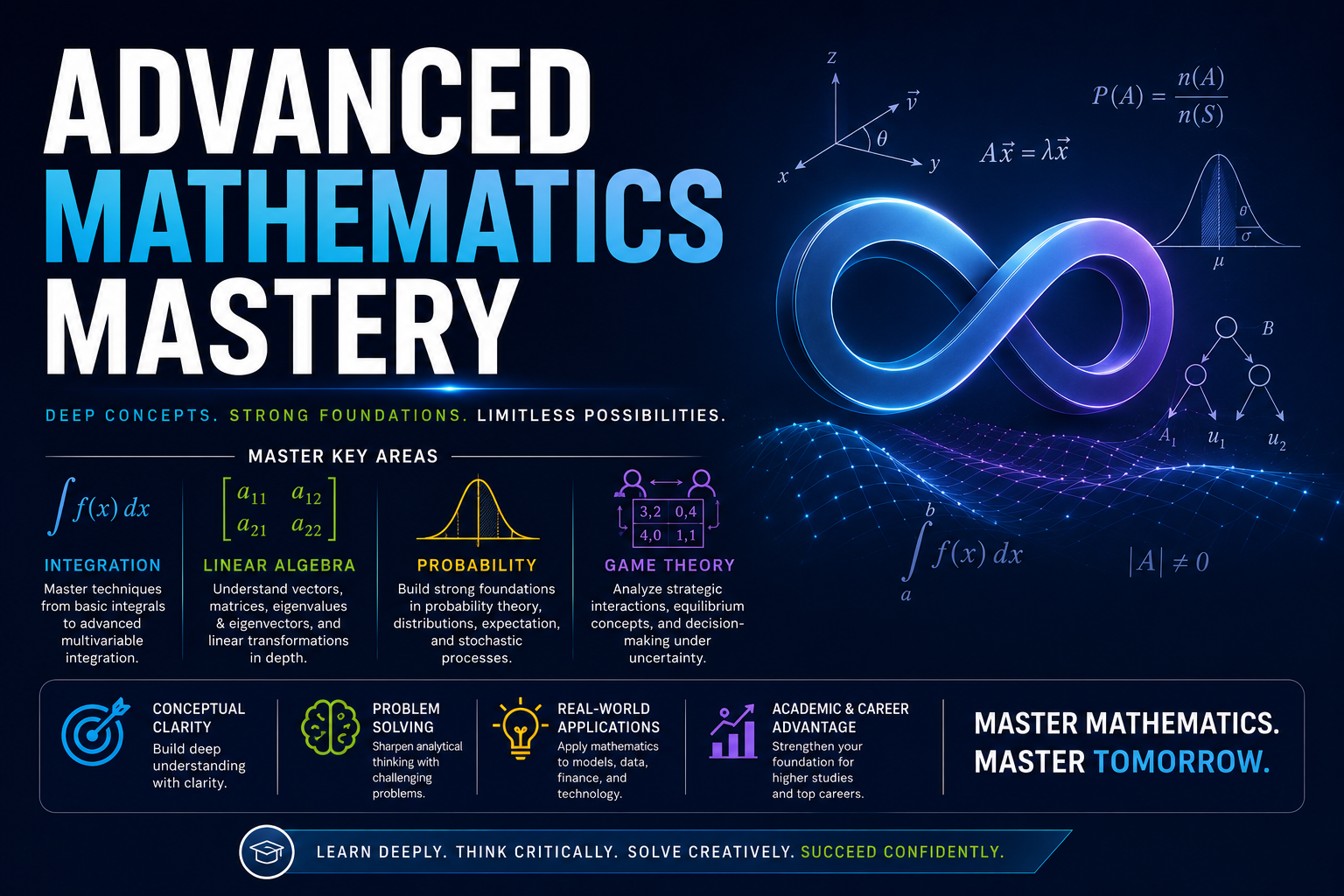
Taught as mathematics, a game theory course is strategies, payoffs, equilibrium concepts, theorems and proofs. It runs from payoff matrices and dominance through Nash equilibria and backward induction to Sprague-Grundy, repeated games and auction design.
It is also the most self-contained subject in our series. It needs probability for mixed strategies and very little else, where analysis and optimisation assume substantial calculus and linear algebra. That makes it an unusually good entry point.
What Nash equilibrium does not promise
A Nash equilibrium is a strategy profile in which no single player can improve their own payoff by unilaterally deviating. That is the entire content, and four things follow that popular accounts routinely obscure.
It does not mean the outcome is good — the prisoner's dilemma equilibrium is worse for both players than the cooperative outcome, which is precisely why the example is famous. It does not mean the equilibrium is unique. It does not mean players will find it. And it says nothing about fairness.
A student who holds those caveats understands the concept better than most people who cite it in conversation.
Representation decides what you can say
How a game is written down determines what questions you can answer about it.
Normal form — the payoff matrix — suits simultaneous play. Extensive form — the game tree with information sets — is required when moves are sequential or when a player does not know what has already happened.
Converting between the two is routine and instructive. Getting the representation wrong makes the rest of the analysis answer a different question than the one asked, which is a failure mode students rarely notice on their own.
Backward induction and non-credible threats
Finite games of perfect information are solved from the terminal nodes upward, and the resulting subgame perfect equilibrium is sharper than Nash equilibrium alone.
The reason is worth stating. Nash equilibrium permits threats a player would never actually carry out — a strategy saying "if you do that, I will do something that hurts us both" can support an equilibrium even though nobody believes it.
Subgame perfection rules those out by requiring the threat to be optimal at the point it would have to be executed. That distinction is one of the genuinely useful ideas in the subject and has obvious analogues outside mathematics.
Impartial games and the theorem that unifies them
A separate strand deals with combinatorial games: two players alternate, the moves available depend only on the position rather than whose turn it is, and the last player to move wins.
Nim has a complete solution. The Sprague-Grundy theorem then does something remarkable: it shows that every impartial game is equivalent to a single Nim heap of some size.
So once a student can compute nim-values, a whole class of competition problems — chips in boxes, stones in piles, tokens moved on a board — collapses into one technique. This is the material students most often report enjoying, and it appears directly in the Integral Cup game theory track.
Why cooperation can be rational
The prisoner's dilemma played once has a bleak and unambiguous answer. Played repeatedly, with the end date unknown, it does not.
Repeated games, the folk theorem, trigger strategies and tit-for-tat show that cooperation can be sustained as an equilibrium when the shadow of future interaction is long enough. Discounting makes "long enough" precise.
Evolutionary game theory then removes the rationality assumption entirely and asks which strategies survive in a population — a different question with a strikingly similar answer, which is one of the more interesting results in the subject.
Designing the game instead of playing it
The final unit inverts everything. Instead of analysing a game, you design the rules so the behaviour you want is optimal for the participants.
The second-price sealed-bid auction is the clean example: bidding your true valuation is a dominant strategy, which is an engineered property rather than a happy accident. Revenue equivalence, incentive compatibility and the basics of mechanism design follow.
This is the branch with the clearest commercial footprint — advertising auctions and spectrum sales are built on it — and it is where a student sees mathematics used to construct a situation rather than to describe one.
Why it suits a student new to rigorous proof
Game theory needs very little machinery before the arguments start, which makes it a gentler introduction to proof than number theory or analysis.
The objects are concrete: a matrix of payoffs, a tree of moves, a pile of stones. A complete proof is often five lines and can be followed in a first week. A student who has never written an argument can begin here and carry the habit into our number theory and combinatorics courses, where the proofs are longer but the discipline is identical.
Mixed strategies and why randomising is rational
One result in any game theory course reliably surprises students: sometimes the optimal play is to randomise deliberately.
In a game with no pure-strategy equilibrium, committing to any fixed choice lets an opponent exploit you. The stable play is a probability distribution over your options, chosen precisely so that the opponent is indifferent between theirs.
That indifference condition is also how mixed equilibria are computed, which students find satisfying: the rule that makes the strategy work is the same rule that lets you find it. Nash's theorem then guarantees such an equilibrium always exists in a finite game, which is a genuinely deep result stated in one line.
Who this suits
Students from Class 9 upward through undergraduate study, needing school algebra and basic probability for the mixed-strategy material.
A game theory course is often the right third track for an Integral Cup entrant, and a good first course for a student who wants to see what mathematical reasoning looks like before committing to a heavier syllabus.
Questions people ask
Is this a mathematics course or an economics course?
Mathematics. Game theory is popular as anecdote, and that version teaches almost nothing. Here it is a formal subject: strategies, payoffs, equilibrium concepts and theorems with proofs. The applications to economics, biology and politics are real and we draw on them, but the content is mathematical.
What does a Nash equilibrium actually guarantee?
That no single player can improve their own payoff by unilaterally changing strategy. That is all. It does not promise a good outcome for anyone, does not promise uniqueness, and does not promise players will find it. Those caveats are the most commonly oversold points in popular treatments.
What is the Sprague-Grundy theorem?
The central result for impartial combinatorial games. It says every such game is equivalent to a single Nim heap of some size, so once you can compute nim-values you can solve games that look nothing like Nim. It turns a whole class of competition problems into one technique.
Why is this a good first proof course?
Because it needs very little prior machinery. Most of the arguments are short, the objects are concrete, and a student can follow a complete proof in their first week. That makes it a gentler introduction to rigorous reasoning than number theory or analysis.
Is auction theory really game theory?
It is one of its most successful applications. A second-price sealed-bid auction has the striking property that bidding your true valuation is a dominant strategy, which is a designed result rather than an accident. That shift from analysing a game to designing one is mechanism design.
Get a study plan for this
Tell us the class and what they are working towards, and we will send a plan built around it, plus the next free trial class. No cost, and we will not pass your details on.