Advanced Maths for Research: Integral Cup Guide
The Integral Cup asks each entrant to choose three of four tracks. Choosing well, and studying in dependency order, matters more than extra hours.

Advanced maths for research means something specific here: the mathematics a quantitative degree assumes in its first year and that modern machine learning research is written in. The Integral Cup Grand Prix gives that material a structure and a deadline.
Four tracks, and you choose three
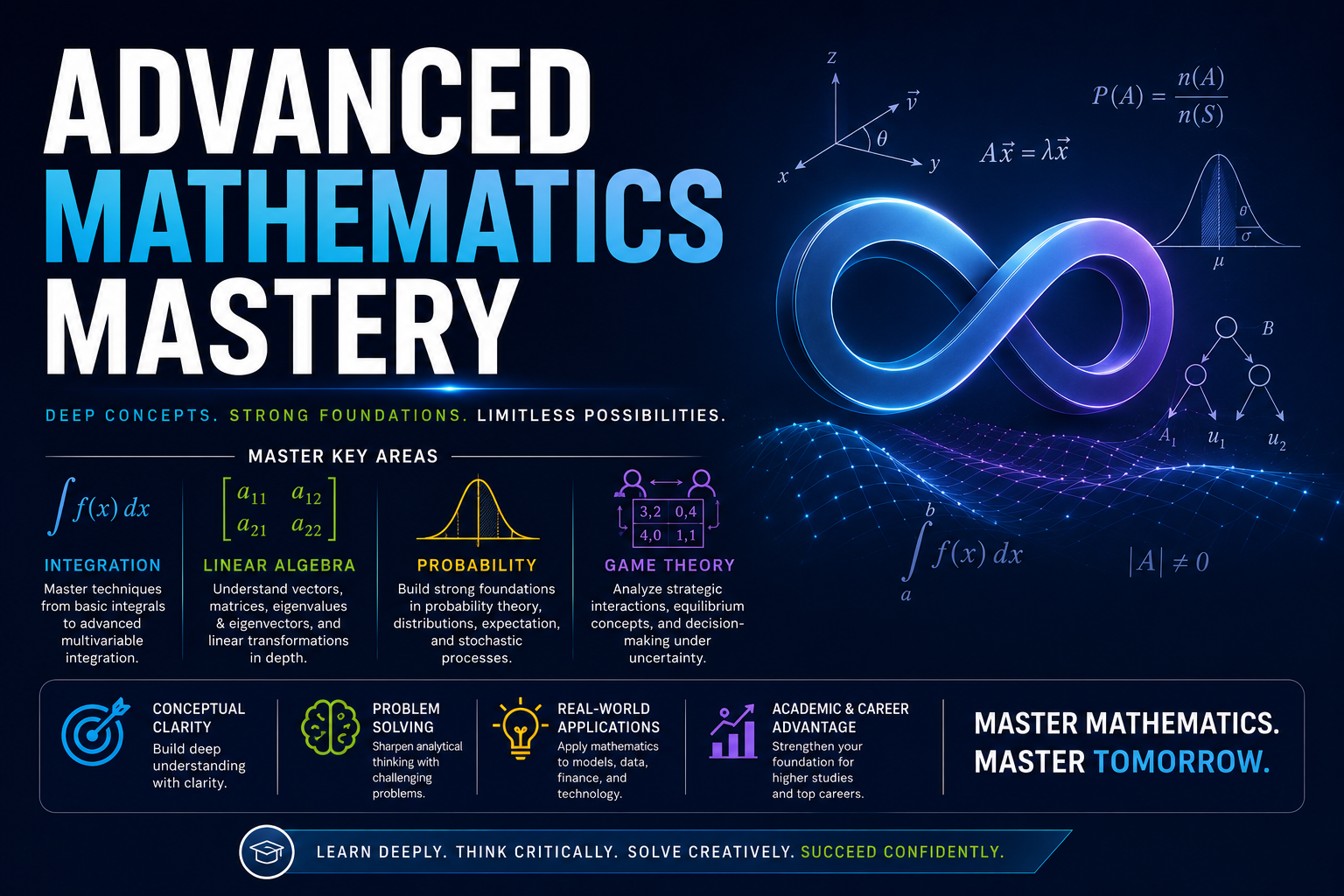
The Grand Prix is built on four tracks: Integration and Analysis; Linear Algebra and Optimization; Probability and Statistics; Game Theory. Each participant chooses three, and Round 1 is written offline with 5 multiple-choice and 5 numerical problems per track in two hours.
Ten problems per track in two hours is twelve minutes each, which is generous by competition standards and unforgiving in a different way: these are not problems that yield to pattern recognition. A student either has the technique or spends twelve minutes discovering they do not.
Choosing your three
This is the first real decision and students usually make it badly, picking the tracks that sound most impressive.
Game Theory is the most self-contained of the four. It needs probability for mixed strategies and little else, which makes it a sensible third track for many students — and our game theory course covers that track directly.
Integration and Analysis is the deepest and rewards a student who already has solid calculus. It is the track where unprepared students lose most.
Linear Algebra and Optimization and Probability and Statistics overlap considerably — eigenvalues and positive semidefiniteness run through convex optimisation, covariance and PCA run through both — so taking the pair shares a good deal of preparation.
What each track contains
Track 1 runs from integration technique — substitution, the Weierstrass substitution, parts, partial fractions — through sequences and series with the full convergence-test set, limits and continuity to epsilon-delta rigour, the mean value theorems, Riemann sums and the Riemann-Lebesgue lemma, linear recurrences, the inequality toolkit, ODEs and Laplace transforms, and finally Fourier methods and differentiation under the integral sign.
Track 2 runs from matrices and determinants through Gaussian elimination, diagonal dominance and the Gershgorin circle theorem, vector spaces and Gram-Schmidt, lattices, then eigen theory, the spectral theorem and the matrix decompositions, and into convex optimisation: convex sets and functions, Lagrangian duality, KKT conditions and linear programming.
Track 3 covers probability spaces, the standard distributions, the limit theorems, statistical inference and hypothesis testing, Markov chains with absorbing states, Bayesian updating with conjugate priors, and basic queuing.
Track 4 covers strategic and extensive form, Nash equilibria pure and mixed, iterated dominance, zero-sum and non-zero-sum games, impartial games with the Sprague-Grundy theorem, and backward and forward induction.
Why the extension blocks are not optional for everyone
The three extension blocks are described as taken by interest, which is true for a competition entrant and misleading for anyone heading into research.
A student who stops at the four tracks can sit the Grand Prix competently. A student who intends to read machine learning papers needs the measure theory, the concentration inequalities and at minimum an introduction to the modern methods, because those papers assume all of it without comment.
The honest framing is that the four tracks are a complete competition syllabus and roughly half of what research actually requires. Knowing which of those two things you are after should decide how far you go.
Order is not a presentational choice
The single most common way students waste a year on material like this is by starting with whatever sounds most interesting.
The dependencies are real. Measure theory needs Lebesgue integration from analysis. Gaussian processes need kernel methods from linear algebra and multivariate Gaussians from probability. Optimal transport needs measure theory and convex optimisation together. Attention and the neural tangent kernel need matrix algebra and gradient calculus.
A student who skips ahead cannot follow the arguments, concludes the material is beyond them, and is simply wrong — they arrived without the prerequisites. Any serious course in advanced maths for research states which unit unlocks which, and follows that order.
Beyond the competition
The four tracks are the competition syllabus. For students continuing further, three extension blocks matter.
Multivariable and optimisation theory: gradients, Jacobians and Hessians, multiple integrals, vector calculus, constrained optimisation, gradient descent with momentum and adaptive methods, automatic differentiation and backpropagation.
Measure, information and learning theory: sigma-algebras, the Lebesgue integral, dominated convergence, entropy and KL divergence, concentration inequalities, PAC learning and VC dimension.
Modern methods: spectral graph theory, kernels and RKHS, optimal transport, attention as matrix operations, the neural tangent kernel, variational inference, MCMC, Gaussian processes, SDEs, score matching and diffusion models.
This is the mathematics modern machine learning research is written in. A student who has done the four tracks properly can read it.
What two hours per track actually feels like
Round 1 gives two hours for ten problems in each chosen track, and students consistently misjudge what that allows.
Twelve minutes per problem is generous enough that triage is the wrong instinct — a problem abandoned at ninety seconds was almost certainly abandoned too early. But it is not generous enough to derive a technique you never learned, which is where unprepared students lose.
The practical implication is that preparation should aim at coverage rather than speed. A student who knows every technique in a track but works deliberately will finish; a fast student with gaps will meet a problem they cannot start and the time will not help them.
Who this is actually for
Who this is actually for
Three groups, and they overlap less than you might expect.
Integral Cup entrants, obviously. Students bridging into a quantitative undergraduate programme who want the first year to be revision rather than discovery. And students who intend to work in machine learning research and have realised that the mathematics is the hard part rather than the code.
Entry assumes single-variable calculus and confident school algebra. Our algebra course covers the linear algebra prerequisite, and our probability course the probability one.
Competition dates, fees, eligibility and registration are set by the organisers and change between seasons. Check theintegralcup.in for the current cycle.
Questions people ask
What is the Integral Cup Grand Prix?
A mathematics competition with four tracks: Integration and Analysis; Linear Algebra and Optimization; Probability and Statistics; Game Theory. Each participant chooses three of the four. Round 1 is held offline with 5 multiple-choice and 5 numerical problems per track in two hours.
Which three tracks should a student choose?
Choose on strength, not on what sounds impressive. Game Theory is the most self-contained and reachable without heavy prerequisites, which makes it a sensible third track for many students. Integration and Analysis is the deepest and rewards a student who already has solid calculus. Linear Algebra and Probability overlap considerably, so taking both shares preparation.
Is this only for competition entrants?
No. The syllabus is the standard first-year university mathematics of a quantitative degree: real analysis, linear algebra, convex optimization, probability and game theory. Students use it to prepare for the competition, to bridge into an undergraduate programme, or to build the foundations machine learning research assumes.
Why does the order of study matter so much?
Because the dependencies are real. Measure theory needs Lebesgue integration from analysis. Gaussian processes need kernel methods from linear algebra and multivariate Gaussians from probability. Optimal transport needs measure theory and convex optimisation together. A student who jumps ahead cannot follow the arguments and wrongly concludes the material is beyond them.
What preparation does a student need before starting?
Single-variable calculus and confident school algebra. Each track states its own entry point and the early units rebuild the core deliberately, because students arrive from very different school systems.
Get a study plan for this
Tell us the class and what they are working towards, and we will send a plan built around it, plus the next free trial class. No cost, and we will not pass your details on.