AP CS A 2027: Exam Date and Free Response Guide
One paper on 12 May decides the whole score. Why writing Java by hand is a separate skill, and where the four free-response questions take their marks.
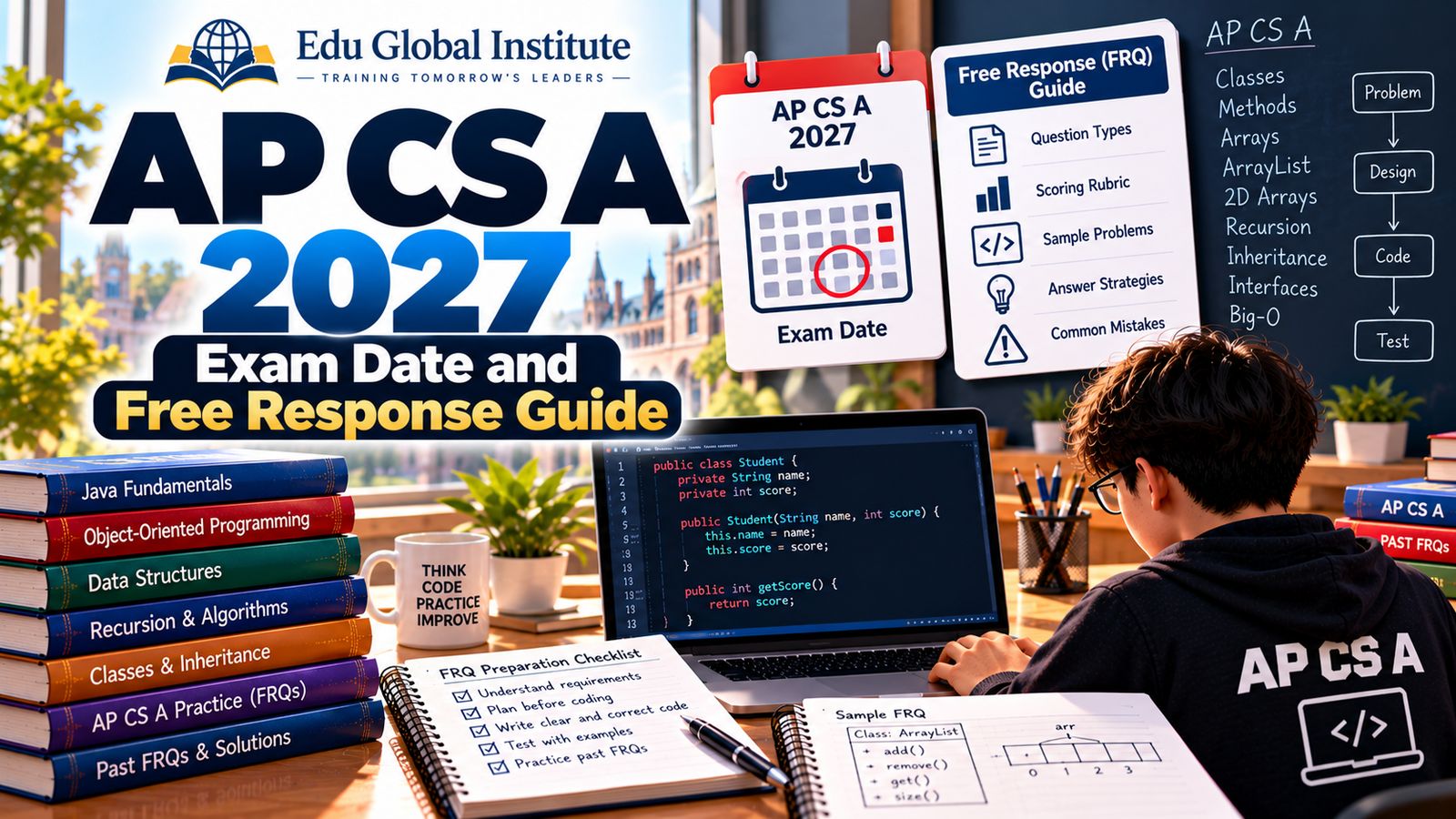
The AP CS A 2027 examination is on Wednesday 12 May 2027 in the afternoon session. Unlike its sibling course, Computer Science Principles, there is no portfolio and no April deadline: the entire score comes from one paper. That makes this the simpler of the two computer science APs to plan for and the harder one to pass without sustained practice, because nothing you did during the year can compensate for a weak three hours in May.
AP CS A 2027: the date and what it covers
| Exam | Date | Session |
|---|---|---|
| AP Computer Science A | Wednesday 12 May 2027 | Session 2 (afternoon) |
| AP Computer Science Principles | Friday 14 May 2027 | Session 1 (morning) |
The course is Java, and it is a genuine programming course rather than a survey of computing concepts. The paper has two sections: multiple-choice questions testing your ability to read and reason about code, and free-response questions requiring you to write working Java by hand on paper. That second part is what catches students who have only ever written code with an editor correcting their syntax.
Content spans primitive types and objects, boolean expressions and control flow, iteration, writing classes, arrays and ArrayLists, two-dimensional arrays, inheritance, and recursion. Recursion and 2D arrays are consistently where marks are lost, and inheritance is where conceptual misunderstandings surface most visibly in the free-response answers.
Writing Java by hand is a separate skill
The single most useful thing a candidate can do between now and May is practise writing complete methods on paper, without an IDE, and then type them up to see what failed to compile. Students who skip this step routinely lose marks for missing semicolons, mismatched braces, wrong return types and forgetting that an array has length while a String has length as a method and an ArrayList has size.
Examiners award points for correct logic even when minor syntax is imperfect, but the threshold is not generous: code that could not plausibly compile loses marks that the same algorithm would have earned if written cleanly. Thirty minutes of handwritten practice a week for twenty weeks is worth more than any amount of additional reading.
The free-response section in detail
There are four free-response questions and they follow a stable pattern across years. One typically asks you to write a method working with an array or ArrayList. One involves writing or completing a class, often implementing an interface or extending a given class. One asks for a method operating on a two-dimensional array. One tests whether you can read and extend an unfamiliar class given its documentation.
That last type is worth specific preparation because it mirrors real engineering: you are given a specification and some existing code and asked to work within it. Students who practise only on problems they fully understand from the start are unprepared for the question that deliberately withholds context.
Work past free-response questions with the official scoring guidelines open beside you and mark your own answers. The rubrics are published and they are specific, awarding points for individual behaviours such as correctly traversing a structure or correctly handling the boundary case. Seeing where the points actually sit changes how you write.
How AP CS A 2027 differs from CS Principles
These two courses are frequently confused and they are not interchangeable. Computer Science A is Java programming assessed by a single examination. Computer Science Principles is a broader survey of computing, including data, the internet and the social impact of technology, assessed partly through a Create performance task submitted by 30 April and partly by a written paper on 14 May.
For a student intending to study computer science at university, CS A is the stronger signal because it demonstrates programming ability directly. CS Principles suits a student wanting computing literacy alongside other subjects, or one who prefers assessed coursework to a single high-stakes paper. Taking both is reasonable and common, and our comparison of AP Computer Science A and Principles sets out which fits which student.
The multiple-choice section rewards reading, not writing
Roughly half the paper asks you to trace code you did not write and predict its output, or to identify which of several implementations is correct. This is a different activity from programming and it benefits from a specific technique: maintain an explicit table of variable values as you step through a loop, on paper, rather than attempting to hold the state in your head.
Students who skip the table are reliably wrong on questions involving nested loops or recursive calls, not because they misunderstand the concept but because working memory fails somewhere around the third iteration. Two minutes of writing beats thirty seconds of confident guessing, and the time budget on the multiple-choice section is generous enough to allow it.
A plan from October to May
From mid-October there are roughly twenty-nine weeks. Spend October to December on the core language: types, control flow, writing your own classes, and arrays, writing every exercise by hand at least once. January and February belong to the harder topics, meaning 2D arrays, inheritance and polymorphism, and recursion, which needs more time than students expect because it resists being learned by pattern-matching.
March and April are past papers. Sit complete multiple-choice sections under timing, and write full free-response answers by hand against the clock. Mark everything yourself against the official guidelines. Keep an error log classifying each loss as a language mistake, a logic mistake or a misread specification, because the remedies are entirely different.
Our AP Computer Science A tutoring teaches the Java and the handwritten examination technique together. Students who want to go further into algorithms afterwards will find our Java course with object-oriented programming and data structures a natural continuation, and those considering competitive programming should look at the USACO 2027 pathway.
What to do this week
Confirm your exam date and session with your AP coordinator, since CS A and CS Principles are on different days and the afternoon session matters for planning. Download one complete released paper and sit the multiple-choice section under timing to find your baseline. Then write one free-response answer by hand, type it up, and count the compilation errors. That number is the most honest assessment of where your preparation needs to start.
Sources
- College Board - 2027 AP Exam Dates, https://apstudents.collegeboard.org/exam-dates
- AP Central - AP Computer Science A course and exam description, https://apcentral.collegeboard.org/courses/ap-computer-science-a
Questions people ask
When is the AP CS A 2027 exam?
Wednesday 12 May 2027, in Session 2, which is the afternoon. AP Computer Science Principles is a separate exam on Friday 14 May in the morning session. Confirm exact start times with your AP coordinator.
Is there a portfolio or performance task for AP Computer Science A?
No. Unlike AP Computer Science Principles, which requires a Create performance task submitted by 30 April, CS A is assessed entirely by the examination in May. Nothing you do during the year contributes directly to the score.
What do the AP CS A free-response questions ask?
There are four, following a stable pattern: a method working with an array or ArrayList, writing or completing a class, a method operating on a two-dimensional array, and reading and extending an unfamiliar class from its documentation.
Do I lose marks for small Java syntax errors?
Examiners award points for correct logic even with minor syntax imperfections, but code that could not plausibly compile loses marks. Practising by writing methods on paper and then typing them up to count compilation errors is the most effective remedy.
Should I take AP CS A or AP CS Principles?
CS A is Java programming assessed by one paper and is the stronger signal for computer science applications. CS Principles is a broader computing survey with a performance task and suits students wanting computing literacy alongside other subjects. Taking both is common.
What is the hardest topic in AP CS A?
Recursion and two-dimensional arrays account for most lost marks, with inheritance close behind. Recursion in particular resists pattern-matching, so it needs more dedicated time than students usually allocate.
Get a study plan for this
Tell us the class and what they are working towards, and we will send a plan built around it, plus the next free trial class. No cost, and we will not pass your details on.