The Complete Art of Combinatorics Book: Counting to Olympiad
From First Principles to Olympiad Mastery - AMC, AIME, ISI/CMI, JEE
About this book
Counting, from the rule of sum to generating functions
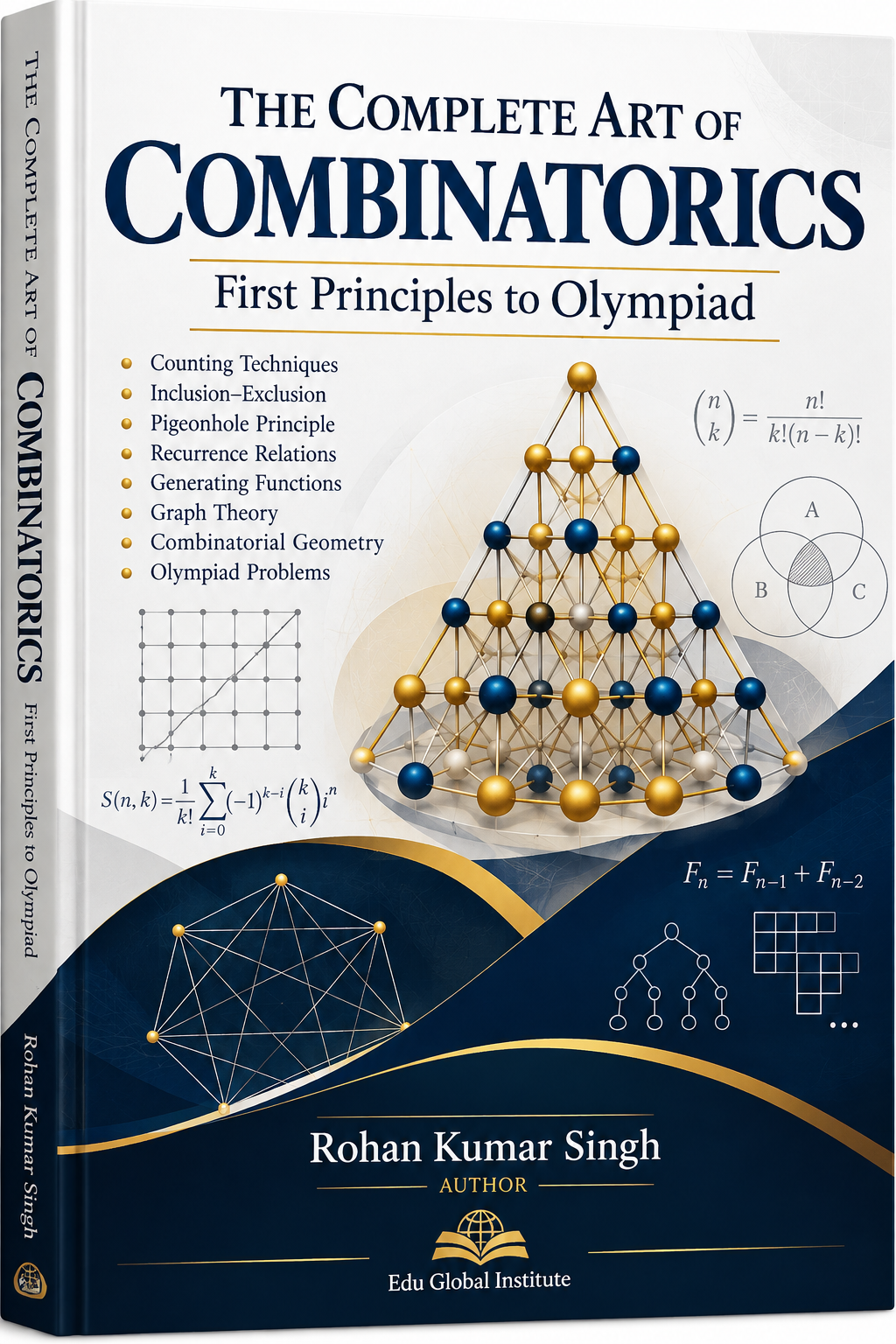
The Complete Art of Combinatorics is a 124-page course in counting, written by Rohan Kumar Singh and published by Edu Global Institute. It runs from the rule of sum and the rule of product through to Catalan numbers, generating functions and advanced structural combinatorics, in one continuous progression.
It is built for AMC 8, AMC 10 and AMC 12, AIME, ISI and CMI entrance, and JEE Main and Advanced. Those syllabuses overlap almost completely in combinatorics, which is why a single book can serve all of them properly rather than superficially.
Start at the right chapter
The book opens with a diagnostic pre-test. That is deliberate: most students who struggle with counting are not missing the advanced material, they are shaky on complementary counting or on when a selection is ordered. The pre-test tells you where your actual gap is, so you start at the chapter that will help rather than at page one out of duty.
What is inside
Chapters 1 to 4 build the foundation: the sum, product and complementary counting principles, set-theoretic groundwork, factorials with Legendre's formula and trailing zeros, then permutations in full — linear, with repetition, conditional and circular, including the string, gap and fixed-position methods — followed by combinations and the multinomial theorem.
Chapters 5 to 7 cover the harder standard material: distribution of objects through the Twelvefold Way, the principle of inclusion-exclusion with derangements, and geometric and grid combinatorics.
Chapter 8 is the one that distinguishes this book. It is given entirely to the techniques that decide olympiad and ISI/CMI problems: the bijection principle, double counting, the pigeonhole principle, parity, invariants and monovariants, and colouring arguments. Most books stop before this, which is exactly where competition problems begin.
Chapters 9 and 10 go further again — Catalan numbers, recurrence relations in counting, generating functions, and advanced structural combinatorics. Chapter 11 is a cumulative mock test of 60 mixed problems.
Over 400 problems, with the working shown
Every chapter carries a practice set with a complete answer key, and selected problems are given full worked solutions rather than a final figure. In combinatorics that distinction matters more than in most subjects: an answer tells you nothing about whether your reasoning was sound or you double-counted and got lucky.
Each chapter also ends with Common Pitfalls and Exam Tips and a summary. The pitfalls sections are worth reading even if you skip the chapter, because the characteristic error in counting is not ignorance of a formula — it is counting the same arrangement twice without noticing.
Who should buy it
Students from Class 9 upward preparing for any of the named examinations, and students who find counting consistently harder than algebra or geometry and want to fix that properly rather than memorising more cases. Teachers will find the problem sets and the pitfalls sections directly usable.
The file is a LaTeX-typeset PDF, so it reads well on screen and prints cleanly. Your download link is emailed on payment and shown on screen immediately, and it stays valid for 72 hours.
What is inside
- Preface, How to Use This Book, and a Diagnostic Pre-Test
- 1. Fundamental Principles of Counting - sum, product and complementary counting, set-theoretic foundations, factorials, Legendre's formula
- 2. Permutations: Arrangement of Distinct Objects - linear, repeated, conditional and circular, with the string, gap and fixed-position methods
- 3. Combinations: Selection of Distinct Objects - basic and conditional selection, properties of binomial coefficients
- 4. The Multinomial Theorem and Number of Terms - multinomial expansion and coefficient hunting
- 5. Distribution of Objects: The Twelvefold Way and Beyond
- 6. Principle of Inclusion-Exclusion and Derangements
- 7. Geometric and Grid Combinatorics
- 8. Core Olympiad and ISI/CMI Counting Principles - bijections, double counting, pigeonhole, parity, invariants, monovariants and colouring arguments
- 9. Advanced Sequences and Generating Functions - Catalan numbers and recurrence relations
- 10. Advanced Structural Combinatorics
- 11. Cumulative Mock Test: 60 mixed problems